
Loading...
Astrit Schmidt-Burkhardt (selfportrait).
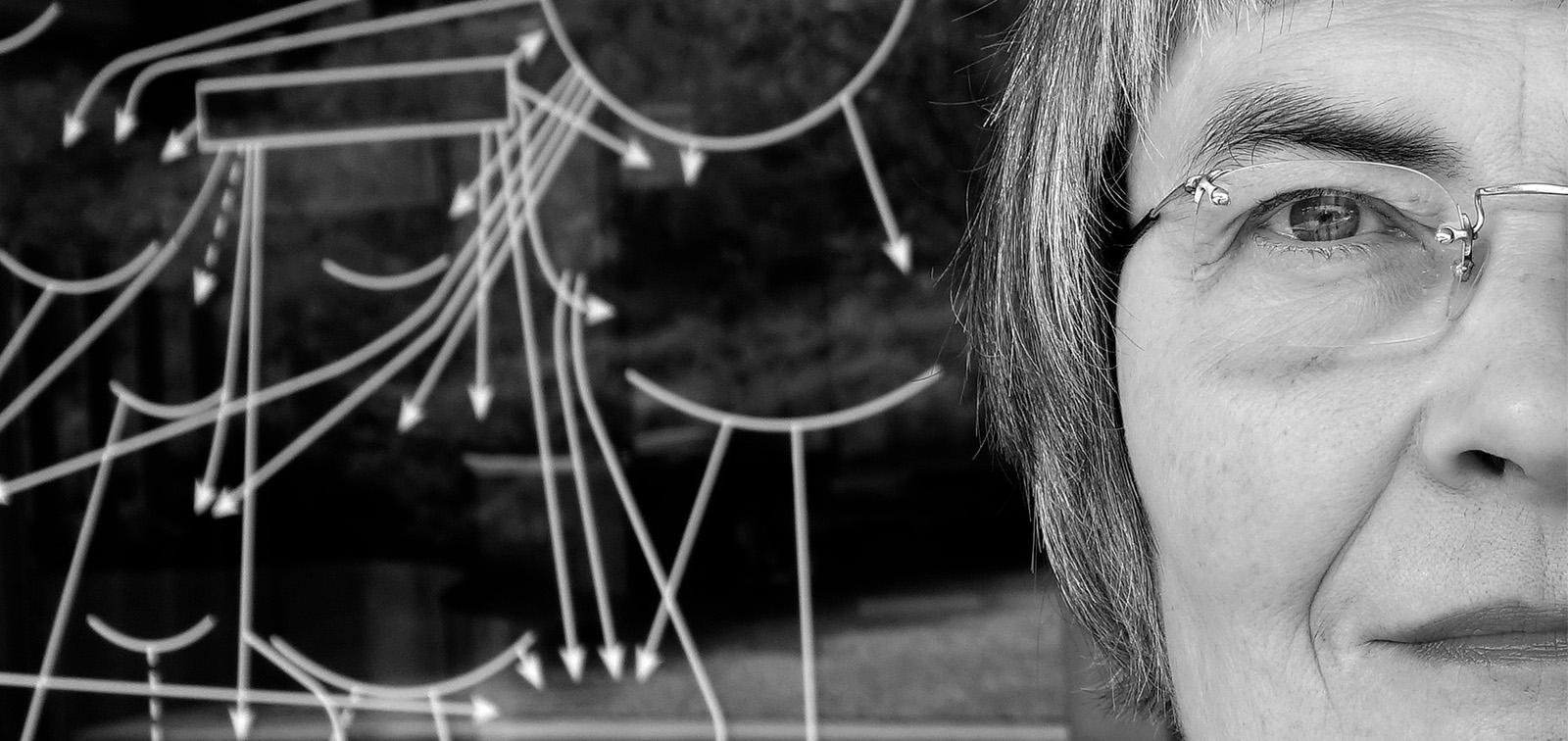
Lectures of the Cátedra del Prado.
Time – The Invisible Force Visual
Concepts Through History
2025
Academic Chair
Lectures of the Cátedra del Prado.
Lectures of the Cátedra del Prado.
Time – The Invisible Force Visual
Concepts Through History
2025
Astrit Schmidt-Burkhardt
Time is invisible. Yet it is always present. “Before” and “after,” and even space itself, would not exist without it, as then, everything would happen all at once. Only time gives us humans and our cultures a historical perspective. History arises out of life, art history out of creative image-making.
Time itself consistently eludes our senses, though its effects are everywhere visible. Art can help us towards a better understanding of this abstract numinosum; because it, too, is at once agent and fact in the sea of time. But how does time manifest itself in works of art—beyond their iconological representation of it as symbol, metaphor, or allegory? What influence does time, as a formative, impulsive force, have on the works themselves? How have lapses, lacunae, and speed inscribed themselves into them? How have these aspects been appreciated and understood at various times in history?
Conceived as an invitation to time-travel along a trajectory of selected exhibits, this year’s Catédra Lectures will offer answers to the questions raised here.
RDF
- Sponsored by:
-

- Sign up
- The registration period for the lecture programme of XIII Cátedra (13th Chair of the Prado Museum) is from October 1st to 26th 2025. Registration must be made through the online form available on the MNP website during the indicated period. Applications will be dealt with on a first-come, first-served basis. A certificate of attendance will be awarded at the end of the course (after confirming attendance at the four lectures)
- Schedule
- The times shown in the programme correspond to Spanish mainland time
- Recipients
- University students, researchers, professionals and the general public
- Direction
- Astrit Schmidt-Burkhardt
- Organization
- Museo Nacional del Prado
- Language
- The lectures will be given in Spanish
- Contact
- centro.estudios@museodelprado.es
Program
2025
- Nov
- 6
18.30 hBeing and Time: Form
Time has neither colour nor form, though we credit it with scale and direction. This allows it to be visualized, for example as a circle or line. Both are ancient metaphors in historical-political thought. The ideologically founded, conceptual poles, between which our secular notions of time are situated, are the eternal return immanent in the cycle and the irreversible sequence of events rendered as a unidirectional line of travel. Despite their crude simplification of complex historical phenomena, these elementary models of circle and line capture and confirm the experiences underlying them: the cyclical recurrence of day and night as well as the inherently directional nature of life. This lecture will examine these contrary concepts of time, this polarity between regularity and the unrecoverable singularity of the moment, as they are reflected in art.
- Nov
- 13
18.30 hTime and Work: Pace
The history of artistic pace has yet to be written. Meanwhile, time has always served as a gauge by which to measure the quality of art: specifically the hours invested in it as the measurable timespan within which a given work was produced. Slow painters and fast painters may constitute the extremes, but both types of artist are undoubtedly as old as art itself. The diverse, even contradictory, criteria for judging the speed at which an artist works have always been dictated by variables such as the prevailing taste, the latest theories, technical inventions, and economics. Artistic pace itself remains an immaterial factor, even when it can be timed by a clock or quantified by a calendar. This wide-ranging history of creative time will take in some fine examples of overpainted masterpieces, paintings that began ageing even as they were being painted, and photographs whose subjects had to hold still for what seemed like an eternity.
- Nov
- 20
18.30 hWork and Transience: The Material
All art materials are perishable to a greater or lesser degree, and hence in thrall to time. To put it another way, they represent materialized time. Whether they are tough or pliable, whether rare or available in abundance, whether natural or a product of technical expertise, they objectify time long before artists begin working with them. Here, our probing of temporality will focus on three materials: marble, paper, and snow. The notions of temporality associated with this revealing trio of substances could scarcely be more different. While the one promises monument-like durability and the other extreme ephemerality, paper can offer both. It can withstand wear and tear for a remarkably long time, yet is also quick to disintegrate.
- Nov
- 27
18.30 hTransience and History: The Event
For Spain, the year 1808 began with turmoil, it having been invaded by French troops under the command of General Murat in late 1807. In 1814, by which time the war was over, Goya visualized what had happened in two monumental history paintings. Taking El 2 de Mayo and El 3 de Mayo as examples, I shall conclude this lecture series by tracing an arc to historiographical concepts. The discussion here will turn on the following questions: How long does the present last? How does art translate abstract time into visible history? How can the creator of a work structure time, even stretch it or compress it, and to what end might an artist do this? Surprisingly, it is portraiture that provides some of the most illuminating answers to these questions.
Activity
Holder of the Prado Museum Chair 2025
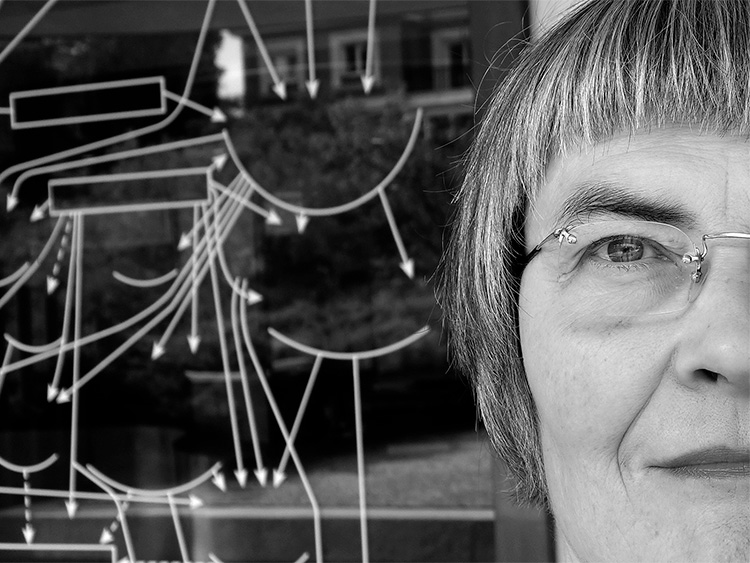
Astrit Schmidt-Burkhardt (selfportrait).
Image historian Astrit Schmidt-Burkhardt teaches post-Enlightenment History of Art and Visual Studies at the Freie Universität Berlin. She also works as an international appraiser, translator, and exhibition curator. From 1998 until 2013 she collaborated with both The Gilbert and Lila Silverman Fluxus Collection, Detroit, now at the Museum of Modern Art, New York, and the Jonas Mekas Visual Arts Center in Vilnius. She was arts editor of the journal Janus Head from 2005 to 2012 and a member of the editorial team of the Zeitschrift für Ideengeschichte from 2015 to 2023. She is among the co-founders of the Gesellschaft für interdisziplinäre Bildwissenschaft. She has published extensively on her research fields of interest, specifically the avant-garde and diagrammatics, the eye and pseudonyms.
Her publications ‒ some in translation, some in several editions, some award-winning – include Stammbäume der Kunst: Zur Genealogie der Avantgarde (2005); Die Kunst der Diagrammatik: Perspektiven eines neuen bildwissenschaftlichen Paradigmas (2017); Die Chronologiemaschine: Barbeu-Dubourgs Aufbruch in die historiografische Moderne (2022) and Die Augen der Avantgarden: Von der Macht der Blicke in der Moderne (2024).