Isaac and Jacob
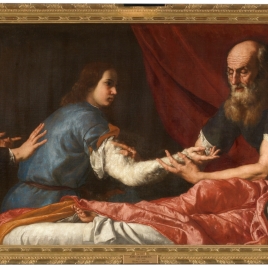
1637. Oil on canvas.Room 009
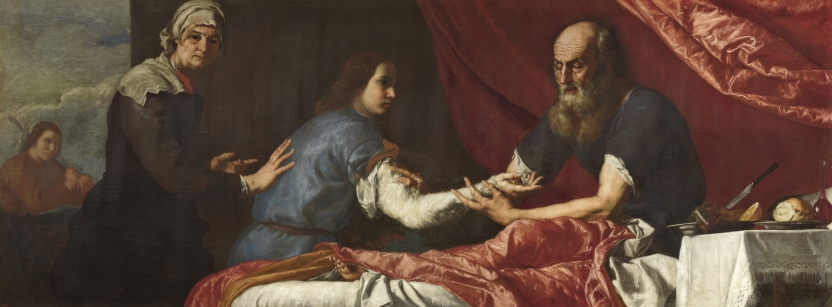
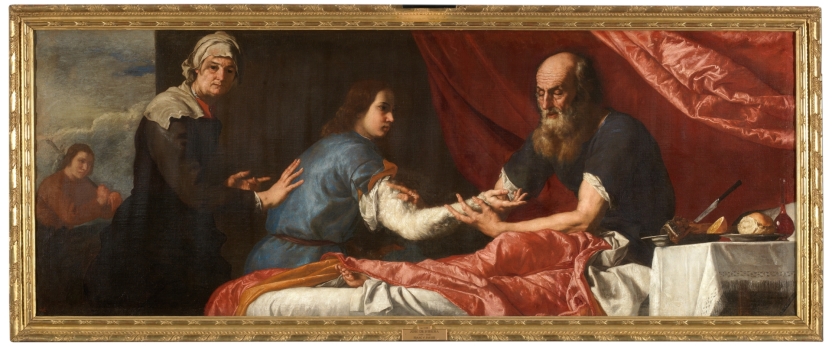
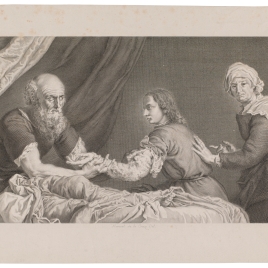
This painting narrates an event from chapter 27 of Genesis, in which Jacob tricks his father, Isaac, in order to obtain the blessing that should rightfully go to his older brother, Esau. Jacob’s mother, Rebecca, helps him dress in Esau’s clothes and cover his arm with a sheepskin that resembles his brother’s abundant body hair. He then takes food to his elderly, blind father, Isaac, thus inducing him to confuse him with Esau. This was a very common subject among 17th-century Italian painters, but was rarely depicted in Spain.
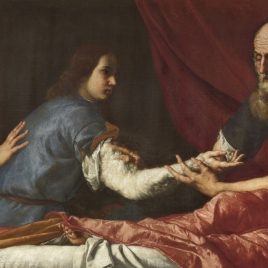
This painting is an excellent example of the artist’s gifts as a narrative painter and his capacity to transmit a broad range of complex human emotions. The spatial compression subliminally increases the story’s dramatic tension, as the viewer is aware of all the rage and disappointment that will explode when Isaac and Esau discover how they have been tricked. Esau, who appears in the distance through an opening on the left side of the composition, is returning tranquilly from the hunt with no idea that he is being tricked. With her right hand, Rebecca pushes Jacob toward his father, encouraging him to make the most of the situation. By looking directly out at the viewers, she makes us silent accomplices to her elaborate strategy. Jacob extends his hand with some hesitancy, uncomfortable with the hand fate has dealt him, while Isaac runs his hand along the full length of the young man’s arm without knowing whether his senses of touch and smell are mistaken: The voice is Jacob’s, but the hands are those of Esau (Verse 22).
Ribera approaches the subject almost like an allegory of the five senses, where the essence of the episode is that the sense of touch has to compensate for the absent sense of sight (Isaac’s blindness). According to the Bible, despite the fact that Jacob’s voice confused him, Isaac was certain that it was Esau alongside him because of the smell of his clothing. The reference to the sense of touch appears in the still life on the table to the right, which is the platter of game that Isaac had requested of his eldest son. In the series of The Senses Ribera painted in the mid 1610s, he had already explored some of these ideas. And here, as in another earlier work, The Sense of Touch (Norton Simon Museum, Pasadena), he uses the motive of blindness to draw our attention to the artist’s own extraordinarily precise vision.
This work dates from 1637, a fundamental year in Ribera’s career. That year, he began working for the Duke of Medina de las Torres -viceroy of Naples between 1637 and 1641- who commissioned him to paint various works for both his own collection and for the king. And that same year, he began working for the Carthusian monks of San Martino, with whom he maintained a fruitful, if problematic relation through the end of his life. Moreover, some of his finest works date from 1637, including the Pietà at San Martino, Apollo Flaying Marsyas, in Naples, and the Venus and Adonis at the Palazzo Corsini in Rome.
El Prado en el Hermitage, Museo Estatal del Hermitage: Museo del Prado, 2011, p.128-129