The Rest on the Flight into Egypt
1510 - 1515. Oil on panel.Room 056B
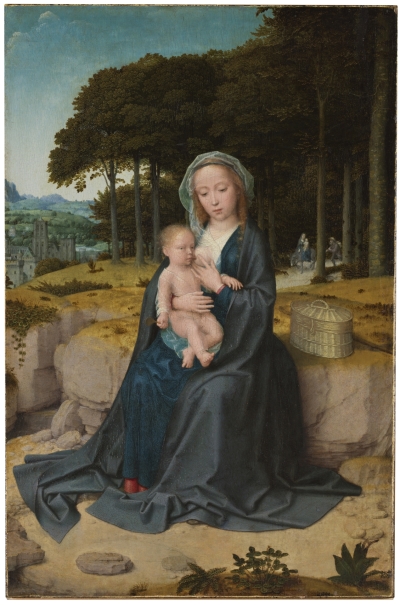
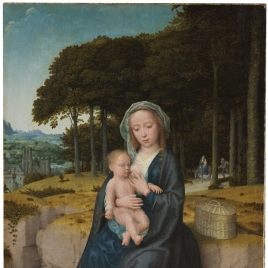
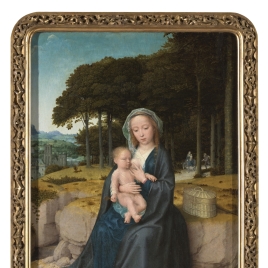
Mary, seated on a rocky ledge beside a watercourse just outside a forest, is nursing the Child. She wears a blue tunic over a red undergarment, a blue cloak, a white chemise and a veil on her head. The Child, barely covered by the transparent fabric of his garment, holds a spoon in his right hand. Beside them are a wicker basket constructed from very subtle touches of light on the plaited twigs and Saint Joseph’s staff. Behind them, on a path emerging from the forest, the previous stage of the story is depicted: Mary and the Child on the donkey and Saint Joseph carrying the staff and the basket that presumably contains the family’s sole belongings. In the background on the left a walled enclosure can be made out – possibly a monastery, whose church is noticeable – and behind it a lake and a copse above which a circular building rises.
The work was attributed to Gerard David from the time of its first known mention by Paul Lafond, who saw it in Bosch’s collection in 1903 and stressed the painter’s intention to emulate Hans Memling and Jan van Eyck, praising the fine, detailed design of the painting, its powerful human portrayal, its rich, luminous and transparent colour, and the firm and delicate draughtsmanship. This Rest on the Flight into Egypt is based on similar versions produced by David around 1510, such as that in Washington (National Gallery, Andrew W. Mellon Collection, inv. 1937.1.43). Aside from the question of attributions, it is evident from all the versions that models were repeatedly used. All this points to the use of models or cartoons made by David’s workshop that were employed in the studio itself and possibly later; unfortunately, no such templates or drawings have survived but they must have existed.
The clumsy execution of the Prado work is striking in places, for example, in the blades of grass on the ledge on which Mary sits. There is an absence of the sfumato and the Italianate hiaroscuro effects of the Virgin and Child in the Traumanncollection, now in New York’s Metropolitan Museum. As for the apparent inferiority of the execution of the Prado picture, it should be pointed out that the group with the Holy Family in the forest is handled with greater finesse in the Madrid work than in the New York version. The differences in some of these final details suggest that we are dealing with two different artists working with the same models found in the master’s workshop, though the one who produced the Madrid painting was less faithful to David’s compositions.
The possible dates of execution of the known versions also appear to indicate that this picture should be attributed to David’s workshop. The idea would have come from David’s first version of the theme, now in Washington and probably dated to around 1510, from which the Madrid work borrows some iconographical motifs. This, coupled with the presence of details included in the Rouen Virgin among Virgins, a work documented in 1509, justifies a slightly later date for the Prado panel, somewhere between 1510 and 1515.
Pérez Preciado, José Juan, Fifteenth-century netherlandish painting at the Museo Nacional del Prado. Catalogue raisonné, Madrid, Museo Nacional del Prado, 2024, p.110-117 nº.11