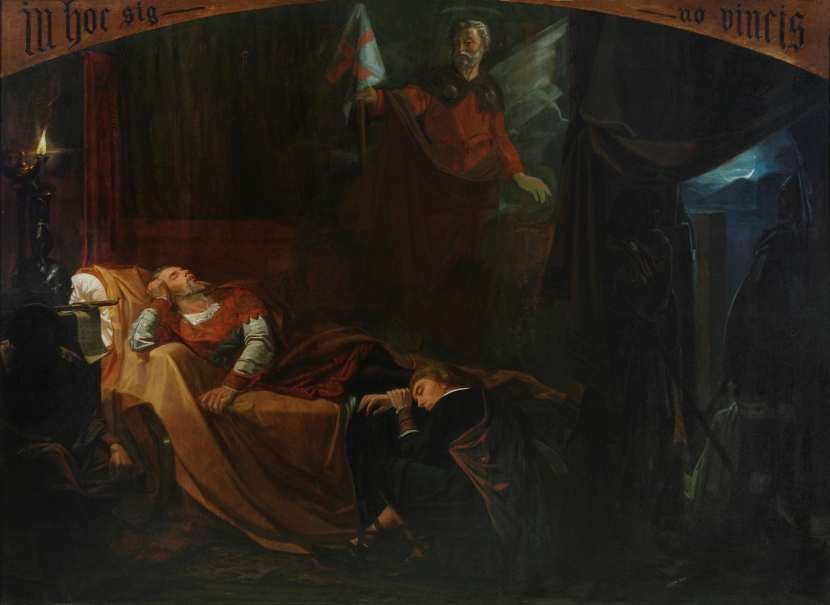
The dream of King Ramiro I
Ca. 1866. Oil on canvas.On display elsewhere
In this history painting, the artist depicts one of the moments preceding the legendary battle of the Reconquista in Campo de la Matanza, in the vicinity of Clavijo (La Rioja) on 23 May 844. On the eve of the battle, Ramiro I (791?–850), King of Asturias (842–850), has a dream suggesting to him that a miraculous intervention by Saint James the Apostle riding a white steed would lead to Christian victory in the battle.
This is The dream of King Ramiro I by Lorenzo Rocha, a painter born in Manila (The Philippines) in 1837. He received training in the School of Manila where he would become a pensioner by the Government and later honorary Court painter. He became Director of the School of Drawing, Painting, Sculpture and Engraving of Manila, where he gave lessons on different subjects in 1898, the year of his death, according to the Annual Directory of Commerce, Industry, Judicature and Administration.
With this work, he participated in the 1866 National Exhibition of Fine Arts – which really took place in 1867 – under No. 362. The description of the painting was included in the exhibition catalogue as follows: ‘Those were the times of the Spanish Monarchy. Hubristic Abdurrahman demands from noble Ramiro an abominable levy. Ramiro raises his realm in arms; and despite his host’s being callow and sparse, he besieges the Moors in their own fields, Alvelda. The night covers in a black mantle a calamitous and blood-stained scene. Ramiro reassembles his shattered army opposite Clavijo. His daring spirit is unabated: he ponders his vengeance. The colour and weariness deliver an unsettling, turbulent and convulsive dream to his eyelids. A thousand thoughts cross his mind. He focuses on a mystical apparition, perhaps fantastical, on the symbolic, living and corporeal figure of Saint James the Apostle, who swiftly tears the ether, radiant and glorious. As an image of the war genie, he enters the royal tent, inspiring and persuading with the faith labarum in his right, whilst pointing to the field of triumph with his left. Ramiro smiles in his dream after hearing the words in hoc signo vincis. Ramiro is armed and ready for the new combat. Ramiro is victorious. Ramiro fulfils his dream. Ramiro is glorified by posterity; Christendom reveres him, almost erecting altars in his name.’
This work was awarded a second-class honourable mention and was acquired by the State for the Overseas Ministry. Since it bore no visible signature at the time, the Ministry sent it to the 1887 General Exhibition in the Philippines, where it was identified by the motto in the spandrels. Afterwards, the work entered the Museo de Arte Moderno in 1908 upon the dissolution of the Museo de Ultramar. In the catalogue of paintings belonging to the Museo Biblioteca de Ultramar that were delivered to the Museo de Arte Moderno by Royal Decree [4 May 1908] for the same reason, this work is not listed. However, there is a note that reads as follows: ‘Apparition of Saint James the Apostle to King Ramiro I before the battle of Clavijo.’ This is the origin of the attribution of this work in the 19th-century Paintings Catalogue in the Museo del Prado.
It was deposited by the Royal Decree of 31 October 1908 in the Ramiro de Maeztu Institute in Vitoria (now Basque Parliament), from which it was transferred to the Museo Provincial de Álava in 1944 (now Museo de Bellas Artes de Álava). It was published as anonymous in the 1982 Museum guide. In the revision of works in storage in 1989, it was logged as untraceable in the Ramiro de Maeztu Institute, but it was actually in the Museo de Bellas Artes de Álava. It was restored there in 2008–2009 under the supervision of the Prado Workshop. During this process, no signature appeared on the canvas at all, and in 2013 a study attributing the painting to Félix Resurrección Hidalgo was published. This attribution was uncontested until C. Díaz Pascual published new data in 2018, correctly identifying the artist who made the work as Lorenzo Rocha.