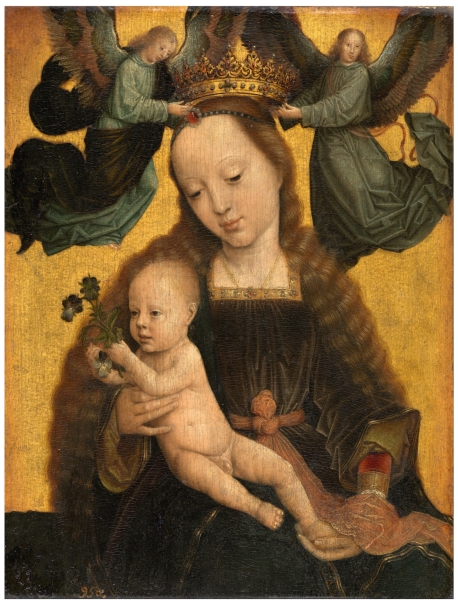
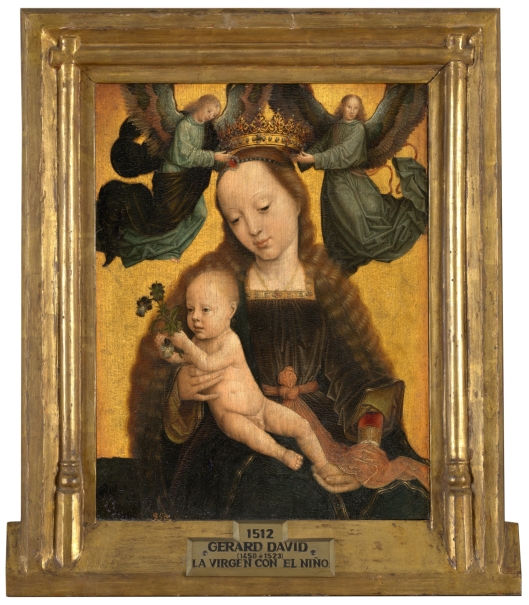
The Virgin, crowned by two Angels, and Child
Ca. 1520. Oil on baltic oak planks.Room 058A
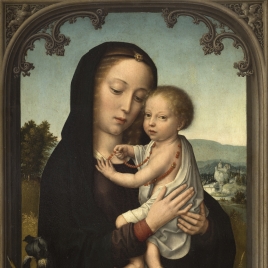
The painting represents the virgin, with the child, being crowned, an iconography alluding to her status as Regina Coeli, queen of Heaven. She wears a purple tunic with an elegant gold border adorned with pearls and jewels at the neckline over a very fine, almost transparent chemise whose V-neckline is barely hinted at; on her lap is a green mantle with gold trimming. A hairband of pearls with a rubi in the centre holds in place her hair, whose long curly locks tumble over her shoulders. The pinkish-red sash knotted around her very slender waist hangs down elegantly in the same diagonal line as the body of the Christ Child, whom Mary holds on her lap, cradling his left foot in her left hand. Jesus, who is fully naked, plays with a bunch of violet, white and yellow wild pansies (Viola tricolor). The winged angels crowning Mary wear identical blue tunics and over them the one on the left sports a brown cape that may originally have been green or purple, and the one on the right a pinkish stole-like garment. The colours and arrangement of their wing feathers are also different. It is striking how the artist depicts certain apparently superfluous details, such as their toes peeping out from beneath their tunics.
The composition combines several sources. The most evident is Dürer’s engraving known as the Virgin and Child with a Monkey of about 1498. However, apart from the final iconography, there are evident substantial differences between the source and the painting. For example, the position of the Virgin’s left hand departs from the print, and the modelling of her face and head is different too. Mary’s face appears to have more in common with the female model in the Coronation of the Virgin by Gerard David in Pasadena (Norton Simon Museum, inv. F.1965.1.017.P). In any case, it is evident that representations of this kind were very popular in Bruges at the start of the sixteenth century. All these paintings were executed in Bruges in the early decades of the sixteenth century, coinciding with the possible date of the Prado work. In fact, having proven that the Prado work is based on an existing model that enjoyed certain success in those workshops, there is good reason to rule out the Museum’s official attribution to David. It seems more plausible to think that it was produced by any of the abovementioned artists’ workshops, though it is not possible to establish a certain or firm link with any one in particular. We know that both Isenbrant and Benson often worked for the Spanish market or at least that a great many of the paintings ascribed to them ended up in Spain. At first sight the panel might seem to bear more formal similarities to Isenbrant given the type of shading, the small mouth and other details with which the Works given to him are commonly described, but such an attribution seems flimsy given the insubstantiality of his corpus, as there are no securely documented Works.
In this connection it is relevant to draw attention to certain formal characteristics of the Prado panel that are also found in Cornelis’s work, such as the line of light marking the profile of the nose both in the main figures and in the faces of the angels, whose features, particularly the small eyes, also closely resemble his figures in the large Bruges work. This, coupled with the necessary collaboration of the Bruges workshops to keep pace with the high demand for devotional paintings in their own market and that of Spain, the uncertainties posed by the many versions of the composition, and the fact that the same models were repeated by different workshops are arguments which, until the corpuses of Isenbrant and Cornelis are more clearly defined, for the time being do not allow us to attribute the Prado work with greater certainty.
Pérez Preciado, José Juan, Fifteenth-century netherlandish painting at the Museo Nacional del Prado. Catalogue raisonné, Madrid, Museo Nacional del Prado, 2024, p.128-134 nº.14