
Loading...
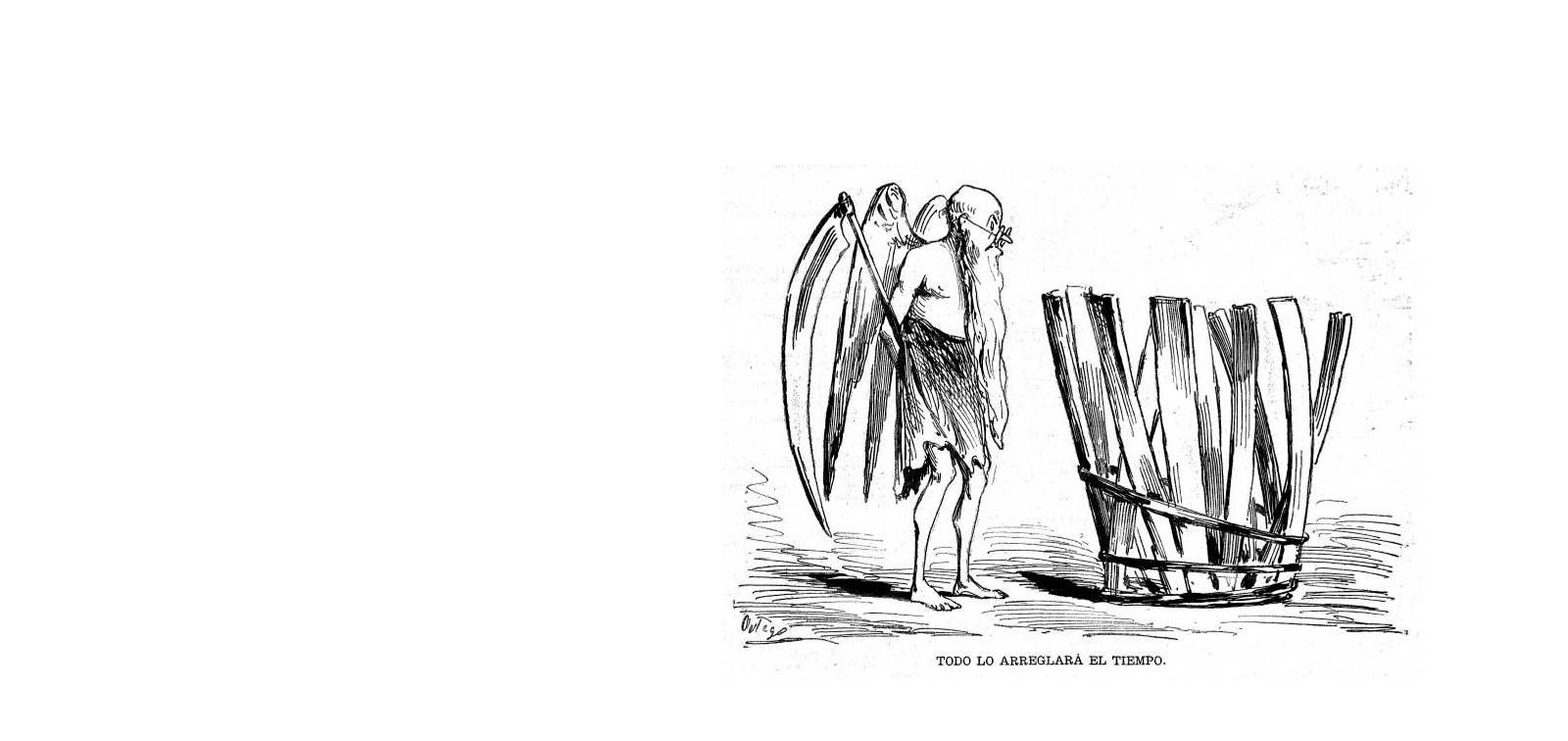
Ortego, "Todo lo arreglará el tiempo" (Time heals all wounds), Gil Blas, 384, July 9, 1871, p. 3.
Seminar of the Prado Museum Chair
Forms of time
November 7, 14, 21 and 28, 2025
Academic Chair
Seminar of the Prado Museum Chair
Seminar of the Prado Museum Chair
Forms of time
November 7, 14, 21 and 28, 2025
The XIV Cátedra del Prado course is comprised of four lectures, a colloquium and a seminar, to be held in four sessions, on Friday mornings, in November. The participants will undertake practical historiographic analysis on the theme that gives the Chair its title, Time, the Invisible Force: Imaginal Concepts in the Course of History. The seminar, a valuable academic endeavor, will be intensive and necessarily in-person. This special learning opportunity is addressed to final-year students and young researchers in the field of art history.
“Time” is an abstract, universal concept. Unlike three-dimensional space, it is difficult to apprehend. It cannot be seen, heard, touched, smelled, nor tasted. It has no high or low points. In short, it has no beginning and no end. Because time is always everywhere. But what does this imply for art and its works? What is this “time” we are talking about? Is it days and dates? Is it periods of creation? Or the duration of materials? In what way does temporality take place in the work of art itself? And how has the view of the various ways in which time occurs and appears in art and theory changed over the last centuries? These and other questions tackling the meaning of “Chronos” in an allegorical and metaphorical sense will be the subject of the exhaustive seminar that reinforces the four Cátedra del Prado Conferences, whose program can be consulted here. The seminar invites participants to formulate answers in common, working together and jointly analyzing visual and written documentation, key texts of art history and works of the Museo del Prado. The working languages will be English and Spanish.
RDF
- Sponsored by:
-

- Schedule
- Seminars: Fridays 7, 14, 21 and 28 November 2025, from 9.30 a.m. to 2 p.m. (Spanish peninsular time)
- Recipients
- Postgraduate, predoctoral students and postdoctoral students who have obtained their doctoral degree within the last three years (not before 2023).
- Location
- Classroom 1 of the Casón del Buen Retiro (Alfonso XII, 28) and permanent exhibition halls of the Museo Nacional del Prado.
- Direction
- Astrit Schmidt-Burkhardt
- Organization
- Museo Nacional del Prado
- Contact
- Attendance application
- Attendance at the seminar is subject to pre-registration. The Museo del Prado and the Fundación Notariado offer a maximum of 25 places, all of which are free of charge. Applicants should be either postgraduate, predoctoral and postdoctoral students or researchers. In the case of postdoctoral students, the doctoral degree must have been obtained within the last three years (not before 2023). Participants will be selected on the basis of their academic record, educational profile and interest in the course, proof of which will be provided by means of a text (500 words maximum), by way of a letter of motivation and a summary of their academic record, which should not exceed one page. Applications are to be submitted between September 11 and October 26, 2025, inclusive. After the deadline, applicants will be notified of the decision. Successful applicants must attend all the lectures as well as participate in the seminars. The application must be made online using the form available on this page during the period indicated above.
Program
2025
- Nov
- 7
09.30 hImage of Time I: Form
Despite lacking any visible appearance, time responds to patterns of steadfastness, measurability and direction, projecting them on its visual representation. These factors of experience, governing history, have inspired various modes of physical figuration and schematization.
- Nov
- 14
09.30 hImage of Time II: Velocity
Time is also a circumstance in the execution of artistic works, in technical construction and in the imagination. Speed and slowness are presented as patterns that are essential to the changing assessment of artistic creations.
- Nov
- 21
09.30 hImage of Time III: Matter
The hallmark of time on the substance of which artistic creations are made necessarily speaks to different measures and degrees of importance. Works made of clay, of snow, of porphyry, or marble or bronze, compete against each other to differently indicate their temporal dimension.
- Nov
- 28
09.30 hImage of Time IV: Intensity
Using two notable historical paintings by Goya as an example – El 2 de mayo and El 3 de mayo –, we will deal with a particular circumstance of the time factor in the understanding of art: the event proper and its experience. In this final session we will address these issues, among others: how long does the present last? How does abstract time become concrete history in art?
Activity
Chair 2025
The Chair of the Prado 2025 proposes for the seminar a participatory learning dynamic based on the attention to written and visual documents to be analysed in common, useful for the approach to the object of study: the time factor in the historical-artistic understanding. The seminar will use a digital platform to facilitate access to much of the documentation and literature proposed for the study.
Development
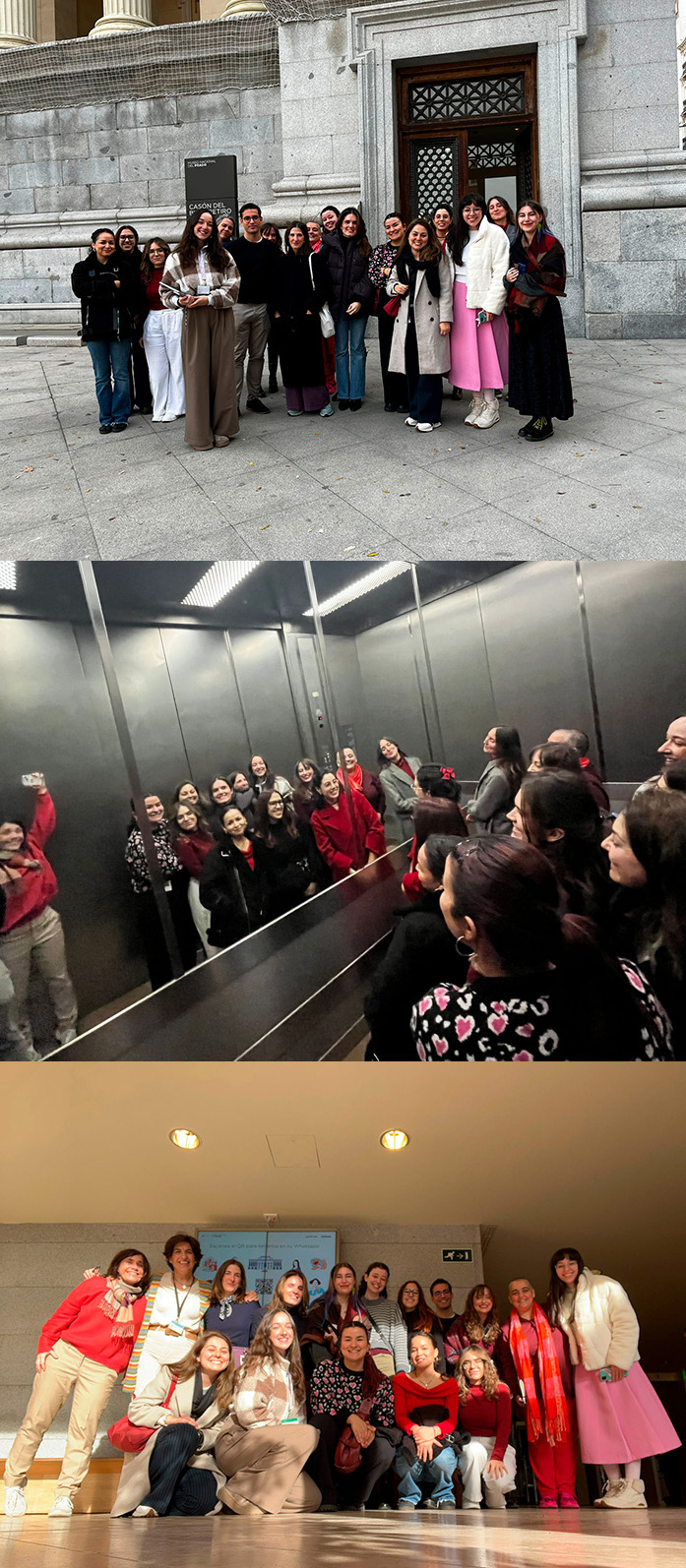
Images of the Prado Chair Seminars held in 2019 and 2023.
Since its first editions, the Prado Chair has included in its programme a seminar, always distributed in four sessions, aimed at a small group of students. The objective is to study in depth the issues raised in the Chair's lectures and to experience intensive learning, always in accordance with the work dynamics proposed by the Chair holder. The seminar usually takes place in a classroom in the Museum's Study Centre, but it also occasionally takes place in the exhibition rooms or in other areas of the Museum. The results of this teaching experience have been highly valued by those who have participated in successive editions of the Chair.
Work dynamics
The Chair of the Prado 2025 proposes for the seminar a participatory learning dynamic based on the attention to written and visual documents to be analysed in common, useful for the approach to the object of study: the time factor in the historical-artistic understanding. The seminar will use a digital platform to facilitate access to much of the documentation and literature proposed for the study.
Recipients
- Postgraduate students, predoctoral students and young doctors in Art History.
- Applications from students and young doctors in the following specialities will also be considered: Art Restoration, Fine Arts and Architecture.
- Occasionally, well-reasoned applications from students in other humanities disciplines may be considered on a case-by-case basis if the application is sufficiently justified.
Requirements
- In case of having completed a PhD, applicants must have obtained their doctoral degree within the last three years (no earlier than 2022).
- Good knowledge of English and Spanish.
Deadline and application
- Pre-registration period: 11 September - 26 October 2025, inclusive.
- Pre-registration must be done through the on-line form that will be available on this website during the pre-registration period.
- At the time of pre-registration, candidates will be required to produce:
- Identity document or passport.
- Brief description of your academic career (maximum one page).
- Academic record or any other document that allows the recognition of the studies carried out and the results obtained.
- A letter of motivation of no more than 500 words, stating your interest in attending the Prado Chair seminar.
Selection criteria
-
The selection of students from among the applications that meet the requirements for participation will be carried out by the academic management of the Chair in coordination with the management of the Study Centre. Consideration will be given to the suitability of the applicants' educational profile, academic record, specific interest in the subjects and research methods proposed, as well as the arguments set out in the letter of motivation. The academic management reserves the right to conduct personal interviews with candidates.
-
Selection as a student for the Chair's Seminar requires attendance at the four Lectures and the four Seminar sessions scheduled, as well as the preparation of the readings and/or exercises proposed by the academic management.
- The Museo Nacional del Prado will issue the corresponding certificates to the students of the Seminar.
Holder of the Prado Chair 2024
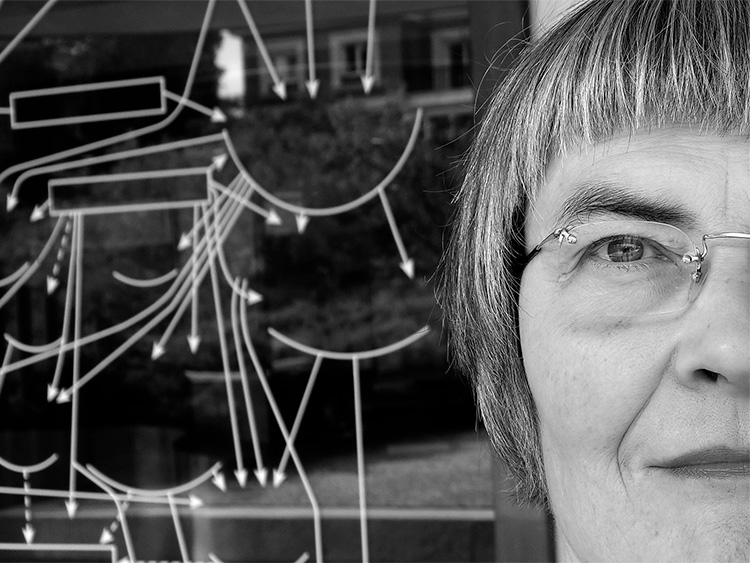
Astrit Schmidt-Burkhardt (selfportrait).
Image historian Astrit Schmidt-Burkhardt teaches post-Enlightenment History of Art and Visual Studies at the Freie Universität Berlin. She also works as an international appraiser, translator, and exhibition curator. From 1998 until 2013 she collaborated with both The Gilbert and Lila Silverman Fluxus Collection, Detroit, now at the Museum of Modern Art, New York, and the Jonas Mekas Visual Arts Center in Vilnius. She was arts editor of the journal Janus Head from 2005 to 2012 and a member of the editorial team of the Zeitschrift für Ideengeschichte from 2015 to 2023. She is among the co-founders of the Gesellschaft für interdisziplinäre Bildwissenschaft. She has published extensively on her research fields of interest, specifically the avant-garde and diagrammatics, the eye and pseudonyms.
Her publications ‒ some in translation, some in several editions, some award-winning – include Stammbäume der Kunst: Zur Genealogie der Avantgarde (2005); Die Kunst der Diagrammatik: Perspektiven eines neuen bildwissenschaftlichen Paradigmas (2017); Die Chronologiemaschine: Barbeu-Dubourgs Aufbruch in die historiografische Moderne (2022) and Die Augen der Avantgarden: Von der Macht der Blicke in der Moderne (2024).