The Museo del Prado and Fundación BBVA are marking the 5th centenary of the death of Jheronimus Bosch with the first monographic exhibition to be devoted to the artist in Spain, the most complete and the one of the highest quality organised to dateFriday, May 27, 2016
The Museo del Prado and Fundación BBVA are marking the 5th centenary of the death of Jheronimus Bosch with the first monographic exhibition to be devoted to the artist in Spain, the most complete and the one of the highest quality organised to date. In addition to the Prado’s own holdings of the artist’s work, which are the largest and best in the world, including works such as the triptychs of The Garden of Earthly Delights, The Haywain and The Adoration of the Magi, the exhibition will feature loans such as The Saint Anthony Triptych from the Museo Nacional de Arte Antigua in Lisbon, Christ carrying the Cross from Patrimonio Nacional, The Crowning with Thorns from the National Gallery in London, and the drawing of the Man-Tree from the Albertina in Vienna, which is one of the artist’s great masterpieces.
With an installation as striking and exceptional as the exhibition itself, Bosch. The 5th Centenary Exhibition brings together more than 50 works, including 21 original paintings and 8 original drawings by Bosch, constituting more than 75% of his surviving output. It also includes prints, reliefs, miniatures and paintings by other artists, which explain the context in which Bosch created his oeuvre.
The Museo del Prado has organised an extensive and varied programme of activities in order to complement, explain and disseminate this unique exhibition. They include a documentary directed by José Luis López-Linares and the publication of a comic by the cartoonist Max. To complete the programme, the 5th Prado Fellowship, held this year by Reindert Falkenburg, will be devoted to Bosch and his renowned follower, Pieter Bruegel the Elder.
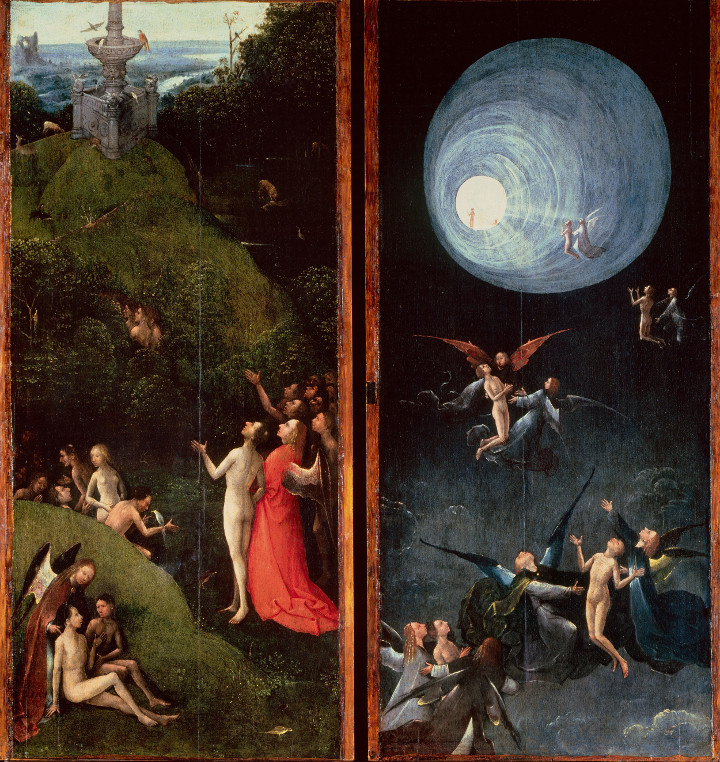
Visions of the Hereafter, Jheronimus Bosch (c. 1450–1516), The Ascent of the Blessed,88.8 x 39.9 cm, 1505–15, Venice, Galleriedell’Accademia
With the sole sponsorship of Fundación BBVA, the Museo del Prado is presenting the exhibition that marks the 5th centenary of the death of Jheronimus Bosch (on display until 11 September 2016), representing an unrepeatable opportunity to see a remarkable group of works comprising the eight original paintings by the artist to be found in Spain together with others loaned from collections and museums around the world. This represents the greatest number of Bosch’s works ever to be assembled, created by one of the most enigmatic and influential artists of the Renaissance. As such, the exhibition will encourage visitors to look deeper into his personal vision of the world through the spectacular installation in which Bosch’s most important triptychs are shown free-standing in order for both the fronts and backs to be visible.
Bosch. The 5th Centenary Exhibition focuses on the artist’s original works and is divided into seven sections. The first, “Bosch and ’s-Hertogenbosch”, locates visitors in the city where the artist lived throughout his life. Given the monographic character of this exhibition and due to the difficulty of establishing a chronology for Bosch’s works, his output has been divided into six thematic sections: The Childhood and Ministry of Christ; The Saints; From Paradise to Hell; The Garden of Earthly Delights; The World and Men: Mortal Sins and non-religious works; and The Passion of Christ.
The exhibition also includes works produced in Bosch’s studio or by followers from now lost originals. Another group, which includes paintings, miniatures, engravings by Alart du Hameel, reliefs by Adrien van Wesel and the manuscript of the Comentario de la pintura by Felipe de Guevara, allows for a better understanding of the context in which Bosch produced his works, the personality of some of his patrons, such as Engelbert II of Nassau, and the status of painting in the 16th century.
Thanks to Philip II’s interest in Bosch, Spain has the finest group of original paintings by the artist, all of which are included in the exhibition. The Prado, which together with Patrimonio Nacional inherited the Spanish royal collection, now houses six of his works, including the triptychs of The Garden of Earthly Delights, The Adoration of the Magi and The Haywain. These are now joined by Christ carrying the Cross from El Escorial, which has been generously sent by Patrimonio Nacional from the exhibition Jheronimus Bosch and El Escorial in order to be present in this one; and Saint John the Baptist from the Fundación Lázaro Galdiano, one of the best acquisitions made by the collector José Lázaro. These works can be seen alongside loans from Lisbon, London, Berlin, Vienna, Venice, Rotterdam, Paris, New York, Philadelphia and Washington, among other cities, making this exhibition a unique opportunity to enter the imagination of one of the most fascinating painters of world art.
The exhibition’s importance lies in the benefits that both the general public and experts alike will derive from its contemplation. In this sense, it is not only important but also necessary. The fact that for the first time it brings together most of the artist’s masterpieces will decisively contribute to resolving some of the questions that relate to his work, both with regard to establishing his corpus and reconsidering issues of dating.
Only the Museo del Prado is able to accept a challenge of this nature and the exhibition has been in preparation for many years. Firstly, through the systematic restoration of the paintings, thanks to the support of Fundación Iberdrola as a Benefactor Member of the Museum and the Sponsor of its Restoration Programme. In the months leading up to the exhibition this campaign has culminated with the restoration of The Adoration of the Magi Triptych, one of the artist’s masterpieces and a work whose beauty and quality are now even more evident, in addition to the restoration of The Temptation of Saint Anthony, which has regained its original arched top, an element that allows for both a better appreciation of the composition and an assessment of this unique version of a subject so often depicted by the artist.
In addition, the Museo del Prado, which is a pioneer in the technical study of Bosch’s painting, has re-analysed his works using the most advanced scientific methods. Visitors to the exhibition can see the results of these studies in the infra-red reflectograph and the X-radiograph of The Garden of Earthly Delights, which reveal the creative process behind the work and show the surprising changes that Bosch made between the start of the under-drawing and the completion of the pictorial surface. The results of this research into Bosch’s work at the Prado, led by Pilar Silva, have been included in the accompanying catalogue, which also has contributions by leading experts on the artist such as Eric de Bruyn, Paul Vandenbroeck, Larry Silver, Reindert Falkenburg and Fernando Checa.
Finally, as part of the complete and extensive programme of activities organised in conjunction with the exhibition (see list at the end of this Press Release and www.museodelprado.es), from 4 July, Room C of the Museum will have an audio-visual space entitled Infinite Garden, specially created by the artist Álvaro Perdices and the filmmaker Andrés Sanz.
In the light of the anticipated interest in this event, the Prado will be remaining open later for the exhibition (two hours more a day from Fridays to Sundays) and advance purchase of tickets is recommended. Tickets can be purchased in advance from the Museum’s website (www.museodelprado.es) or by phone on tel: 902 10 70 77 with a specific date and entry time in both cases.
The exhibition
Jheronimus van Aken (ca.1450-1516) was born and lived in ’s-Hertogenbosch (Bois-le-Duc), a city in the north of the duchy of Brabant in modern-day Holland, to which the artist linked his own fame by signing his works “Jheronimus Bosch”.
Bosch’s immense powers of invention are evident in the innovations he introduced into the technique of painting, notably his distinctive treatment of the pictorial surface, in addition to the content of his works, which is difficult or even impossible to decipher, given that the many of the keys to interpreting it are now lost.
Sections of the exhibition
1. Bosch and ’s-Hertogenbosch
This section, which locates the artist and his work in the city with which he so closely identified, centres on the Ecce Homo Triptych from Boston, painted in the artist’s studio for Peter van Os.
Also on display are works by other artists who either worked for ’s-Hertogenbosch during Bosch’s lifetime, such as the two reliefs by the Utrecht sculptor Adriaen van Wesel for the altarpiece of the Brotherhood of Our Lady’s chapel in the church of Saint John (1475-1477), or who were active there at this time, for example the three prints by the architect and engraver Alart du Hameel.
This section also includes an engraved portrait of Bosch by Cornelis Cort; an anonymous painting of the cloth market in the main square in ’s-Hertogenbosch, which shows the house where the artist lived; and the manuscript of the Comentarios de la pintura by Felipe de Guevara from the Museo del Prado’s library.
In Bosch’s day, ’s-Hertogenbosch was a prosperous city. The market square, where the artist lived between 1462 and 1516, was a meeting point for all social classes and the setting for a range of everyday, festive, religious and secular events. These were fundamental to the artist’s visual universe and he witnessed them from the privileged vantage-point of his own house.
Bosch’s rising social status is evident in the fact that from 1487 to 1488 he was a sworn member of the Brotherhood of Our Lady, bringing him into contact with the city’s social elites. Bosch received commissions from individuals such as Peter van Os, another sworn member of this brotherhood, and from the numerous ecclesiastical institutions existing at that date.
The absence of a local tradition and of a guild of painters encouraged Bosch to create an original style. While his starting point was the work of earlier painters such as Jan van Eyck, he broke away from them in terms of both technique and iconography.
2. The Childhood and Ministry of Christ
Displayed to flank the Prado’s Adoration of the Magi Triptych are the versions of The Adoration of the Magi from New York and Philadelphia, a drawing by a follower of Bosch of The Marriage at Cana from the Louvre, and an engraving by Alart du Hameel.
The figure of Christ is the principal focus in these works, reflecting the spiritual trend known as the devotio moderna, which aimed to transmit to the faithful the practice of the imitation of Christ.
The subject most represented by Bosch is that of the Adoration of the Magi, through which he expressed the universality of the Redemption. The pagans – the Magi – undertake a long journey to adore the Messiah, whom the Jews rejected.
While the artist remained relatively close to tradition in these works, he nonetheless reformulated them in his own style, incorporating symbolic elements in the backgrounds and buildings, and in the figure of the Antichrist in the central panel of the Prado Adoration triptych.
3. The Saints
This section, which is larger, focuses around the Saint Anthony Triptych from Lisbon, displayed together with the Prado’s two versions of TheTemptation of Saint Anthony, one original and the other a workshop product, and the fragment of the Temptation from Kansas City, in addition to the drawing from the Louvre of sketches for a composition on this subject.
Completing this section are the Saint Wilgefortis Triptych from Venice, the Job Triptych from the Museum in Bruges (the latter by a follower), and the panels of Saint John the Baptist from the Museo Lázaro Galdiano in Madrid, Saint John the Evangelist from Berlin, Saint Jerome from Ghent, Saint Christopher from Rotterdam and the drawing from the Albertina of Beggars and Cripples by a follower.
The cult of saints flourished during Bosch’s lifetime, as evident in their widespread presence in his works and in those of his studio, either as protectors or as separate figures. These depictions include Job and some of the Apostles, who were honoured as saints at this period. Other images depict female protector saints such as Agnes, Catherine and Mary Magdalene, or titular saints such as Wilgefortis, the bearded virgin venerated in the Low Countries.
Among male saints (the most frequently depicted) some enjoyed particularly widespread devotion, including Saint Christopher, protector against sudden death. Notably important in Bosch’s work are hermit saints, who lived on the margins of society in the desert, which at this period symbolised solitude rather than absence of life.
Saint Jerome and above all Saint Anthony Abbot, the patron saint of Bosch and his father, were examples for the faithful. The artist presents them as models of self-restraint (particularly over the passions of the flesh), patience and constancy in the face of the Devil’s temptations.
In the Saint Anthony Triptych in Lisbon, the backgrounds are not directly related to the saint’s life. Rather, they are inventions of the artist who was guided by his imagination, as evident in his depiction of the demons.
4. From Paradise to Hell
Displayed in close proximity to The Haywain are various other triptychs by Bosch in which Paradise and Hell are depicted on the lateral panels, albeit represented in different ways. Traditionally, the central panel of such triptychs included the Last Judgment, as in the example in Bruges.
For the first time in art and in a totally original manner, in the centre of The Haywain Triptych and flanked by the panels of The Garden of Eden and Hell, Bosch located a haywain. Using this motif, he showed how, in their desire to give themselves over to the pleasures of the senses and to acquire material goods, men and women of all social classes are deceived by demons who lead them to hell. The haywain thus functions as a mirror, in which whoever looks into it can see his own image, offering the lesson that in order to avoid eternal punishment, it is less a matter of doing good than of avoiding evil throughout life. As a result, the work illustrates exempla contraria or examples to be avoided.
Also in this section are two drawings from Berlin, the first of a walking grotesque head and a small toad-monster, and the second, a studio product, of a scene of Hell, which thus connects with another studio drawing on display, The Ship of Fools in Flames, loaned from Vienna.
5. The Garden of Earthly Delights
Displayed alongside the artist’s most celebrated and iconic work are the infra-red reflectograph and X-radiograph of it, reproduced on a smaller scale. These technical images enable visitors to appreciate the changes Bosch made between the start of the under-drawing and the completion of the pictorial surface. Also displayed here is the remarkable Tree-Man drawing from the Albertina.
This section is completed with a portrait of the work’s patron, Engelbert II of Nassau, from the Rijksmuseum in Amsterdam, painted by the Master of the Portraits of Princes; The Book of Hours of Engelbert of Nassau by the Vienna Master of Mary of Burgundy, loaned from the Bodleian Library in Oxford; and the manuscript of the Vision of Tundale by Simon Marmian from the Getty Museum in Los Angeles.
The X-radiograph
The X-radiograph shows details of the support and the paint layers that are not visible to the naked eye. Given that this image passes through all the paint layers, the scenes on the front and back of the lateral panels appear as superimposed.
Bosch made changes and small corrections during the painting phase. In the central scene of The Garden of Earthly Delights he eliminated some elements such as the piece of fruit (possibly a pomegranate) at the lower left edge and also modified some aspects of the landscape, such as the diagonal plane that emerged from the right.
Particularly striking is the precision of the outlines and the way the artist focused on some figures, including the woman with two cherries on her head, whose face he insistently reworked. In the scene of Hell Bosch eliminated various large objects and fantastical beasts such as the amphibian with a large sphere emerging from its body with a man inside it.
The infra-red reflectograph
The under-drawing was executed free-hand in brush over the white ground. It reveals Bosch’s characteristic strokes, to be seen in the faces in which just three lines define the eyes and nose.
The under-drawing of the earthly Paradise underwent significant changes: Adam, Eve and God the Father were first located in the middle of the scene but were then moved further down. Initially drawn as bearded and as addressing Adam, God the Father was subsequently given the appearance of Christ and is shown looking out at the viewer. Even more significant are the changes in the scene of The Garden of Earthly Delights: the couple in the cave in the lower right corner and the group of men and women next to them; the rider breaking the circle around the pool and above all, the false fountain of the Four Rivers in the centre of the background.
6. The World and Men: Mortal Sins and non-religious works
This section centres on the Table of the Seven Deadly Sins in the Prado and the incomplete Triptych of The Path of Life, comprising The Pedlar from Rotterdam, Death and the Miser from Washington, The Ship of Fools from the Louvre and Allegory of Intemperance from New Haven.
Also on display are the drawing entitled Grotesque with a Man in a Basket from the Albertina in Vienna, The Conjurer from the museum in Saint-Germain-en-Laye, Concert in an Egg from Lille, and The Battle between Carnival and Lent from the Noordsbrabant Museum in ’s-Hertogenbosch, the latter three by followers of Bosch.
7. The Passion of Christ
The exhibition is completed with works relating to Christ’s Passion: Ecce Homo from Frankfurt, The Crowning with Thorns from the National Gallery in London, two versions of Christ carrying the Cross from El Escorial and Vienna, The Passion Triptych from Valencia, by a follower, and three drawings: The Entombment of Christ from the British Museum, Two Orientalsin a Landscape from Berlin, and Two Men from a private collection in New York.
In addition to the depiction of episodes from the Passion in grisaille on the reverse of The Adoration of the Magi, Saint John the Evangelist on Patmos and The Temptation of Saint Anthony, Bosch also depicted these scenes as separate works. In the latter type he reduced the number of figures, while Christ looks out at the viewer, appealing to us and arousing sentiments of anguish and compassion, suggesting the influence on the artist of the spiritual trend that promoted an ascetic life and prayer.