The Prado is exhibiting for the first time The Wine of Saint Martin's Day by Pieter Bruegel the ElderTuesday, December 13, 2011
The Museo del Prado is presenting to the public for the first time The Wine of Saint Martin's Day by Pieter Bruegel the Elder, the leading figure within 16th-century Flemish painting. Following the recent acquisition and subsequent restoration of the painting, it will be displayed in Room D in the Jerónimos Building until 25 March. In addition to highlighting the exceptional nature of a new discovery and acquisition of a work by Pieter Bruegel the Elder (of whom only 41 paintings are known), the presentation of the painting alongside an x-ray of it and an explanatory video detailing its restoration will allow the visiting public to appreciate the key phases within its complex restoration and to assess the final results of that process.
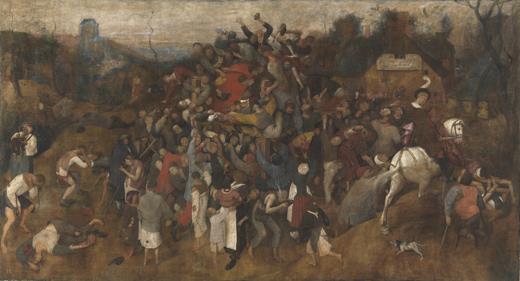
The Wine of Saint Martin’s Day after restoration
The definitive attribution to Pieter Bruegel the Elder of The Wine of Saint Martin's Day represents one of the most important discoveries in many years with regard to the oeuvre of this artist, a figure of even greater importance than Quintin Massys and Joachim Patinir, the two other leading Flemish painters of the 16th century. This new addition to the Prado's collection of one of the most dazzling and complex compositions by the artist means that the Museum now possesses two works by his hand, the other being The Triumph of Death (previously the only other known painting by Bruegel in Spain), a masterpiece by the painter that was formerly in the Spanish royal collection (cat. 1393, Museo Nacional del Prado. Oil on panel, 117 x 162cm, ca.1562).
The Painting
The Wine of Saint Martin's Day by Pieter Bruegel the Elder. 1566-1567. Glue-size tempera on linen. 148 x 270.5cm
The painting is of a type known as a tüchlein, painted in glue-size tempera on a piece of unprimed linen. This was a common technique in Flanders in the 15th and 16th centuries but relatively few examples have survived. The painting is executed on a piece of very fine, regularly woven linen with a taffeta weave of a type widely used at this period to which no more than a preliminary coat of animal size was applied, in line with the normal practice for works of this kind, which were generally hung on the wall unframed. The working method is notably simple, comprising no more than one or two layers of paint as glue-size was not suitable for the application of impasto or glazes. In addition, there is very little under-drawing as such works were painted directly, alla prima.
Bruegel depicts the wine festival associated with Saint Martin's Day on 11 November when a goose was eaten and when the winter pig-killing took place. The new wine of the year, known as Saint Martin's wine, was sampled the night before the festival. The fact that the saint's day coincides with the end of the wine harvest in late autumn meant that the two events became associated, with the distribution of the free wine taking place outside city gates. As a result, and despite the presence of Saint Martin, Bruegel's painting is not a religious scene or a devotional work, nor, however, is it a genre composition. The focus of the painting is rather the celebration of the saint’s day as it took place in Flanders and the Germanic world at this period, where it acquired almost the nature of a bacchanal and was a prelude to the winter carnival. As such, it reveals an ironic tension between the charity of Saint Martin – dressed as a 15th-century patrician – and the excesses of the festival that bears his name.
The scene takes place in late autumn with many of the trees bare. Bruegel locates the events taking place outside the city gates, which recall the Porte de Hal in Brussels, and near some rural houses. The centre of the composition is occupied by a huge barrel of wine painted in a shade of red and standing on a wooden platform. Around the barrel the artist has arranged a varied crowd of figures: old and young men, women, some with children, peasants, beggars and thieves, all trying to obtain the largest possible quantity of wine. Those who have been successful and have filled their containers with wine are back on the ground while others are still clinging onto the wooden supports, lying on the barrel or leaning over perilously to catch the wine as it spurts from the barrel in whatever recipients they have to hand, including their hats and shoes. Revealing his remarkable abilities to compose and arrange all these figures (numbering around 100), Bruegel creates the effect of a human mountain urged on by greed: a veritable Tower of Babel made up of drinkers. The artist presents a deliberate contrast between the circle of figures around the barrel and the much more stable, pyramidal form of the group representing the charity of Saint Martin on the right. The composition is completed on the left-hand side by figures that reveal the effects of having drunk the wine: unlike the saint they have not been guided by virtue but have been led astray by the sin of Greed, including the figure about to vomit, the one lying unconscious in his own vomit on the ground, the two men fighting and the woman giving wine to her baby to drink.
Identification and Acquisition
In November 2009 the tüchlein of The Wine of Saint Martin's Day came to the Prado via Sotheby's from an old Spanish collection in which it had traditionally been attributed to Pieter Bruegel the Elder. It entered the Museum for study and with a possible view to acquisition. The technical analyses undertaken clearly revealed the artist's unique pictorial handwriting, which had been concealed beneath a thick layer of polyester varnish. The removal of this layer allowed Bruegel's technique and style to become fully evident on the surface. Furthermore, the attribution was confirmed with the reappearance of the signature in September 2010, facilitating the acquisition of the painting for the Museum's collection at the end of that year.
Restoration
Following the initial phases of restoration that led to the rediscovery of the artist’s signature, which was worn and incomplete, as well as the remains of the date in Roman letters, “MDL […]”, Elisa Mora, the restorer undertaking the project, proceeded to recover the original texture of the support and to remove the folds and bulges that were the result of earlier, inappropriate restorations. She removed additional strips that had been added around the edges of the linen support and removed old gesso infilling, areas of repainting and inserts that had been used to fill in splits and holes. She then removed the relining and the thick glue with which it was attached to the original linen support using a controlled humidification system. While this slow and delicate procedure was taking place the old inserts were replaced with small pieces of cloth of a type very similar to the original and all the weak zones on the back were reinforced. To complete the treatment of the support strips were added all round the edge and the painting was placed in a metal frame to correct distortions. A 'floating re-lining' was mounted on the stretcher before the painting was attached to it in order to act as a supporting and protecting structure without actually attaching the original linen support to it. The first step in the restoration of the paint layer consisted in covering over the largest areas of paint loss in order to recover the composition visually, progressively adjusting their tonality using pigments with a resin binding. These pigments were applied with a texture similar to the original one in order to recover the painting’s distinctive tone and luminosity.
As the process of cleaning advanced the composition gradually became clearer to the naked eye, despite its complexity. New details came to light and both the overall composition and the groups of figures became much easier to read, while the landscape gained in depth and its quality of execution was once again evident. It became increasingly possible to appreciate Bruegel's method of painting black outlines, as well as his characteristic brushstrokes. In addition, it was now possible to discern pictorial devices such as the manner of creating shadows through hatched, parallel brushstrokes that in turn create a sense of volume, as in the group of the mother and child on the far left. The colour also returned to life, particularly the red tones that are of such compositional significance in this work, together with the yellows and blues that are always important in Bruegel's paintings.
Although Bruegel might have made a preparatory drawing before executing this work alla prima in order to proceed to its execution with greater security, he nonetheless introduced a few changes that became visible once the dirt and layers of varnish had been removed from the surface. The most important pentimento is undoubtedly the one relating to the figure drinking on the upper part of the barrel. When Bruegel decided to make the barrel recede further into the pictorial space he covered over the original white of the figure's shirt with the red colour of the barrel. The white, however, now shows through from underneath. Other less significant pentimenti include the change in the position of the horse's muzzle and its left hoof, which Bruegel moved slightly further back into the pictorial space.
The outcome of this complex and extremely difficult process of restoration has exceeded all prior expectations given that the work's original texture and colours are once again evident. The result is the recuperation of a masterpiece in which Pieter Bruegel the Elder reveals his artistic genius in the conception and realisation of the composition.