26.11.2024 - 16.03.2025

26.11.2024 - 16.03.2025
Texts: Gloria Moure
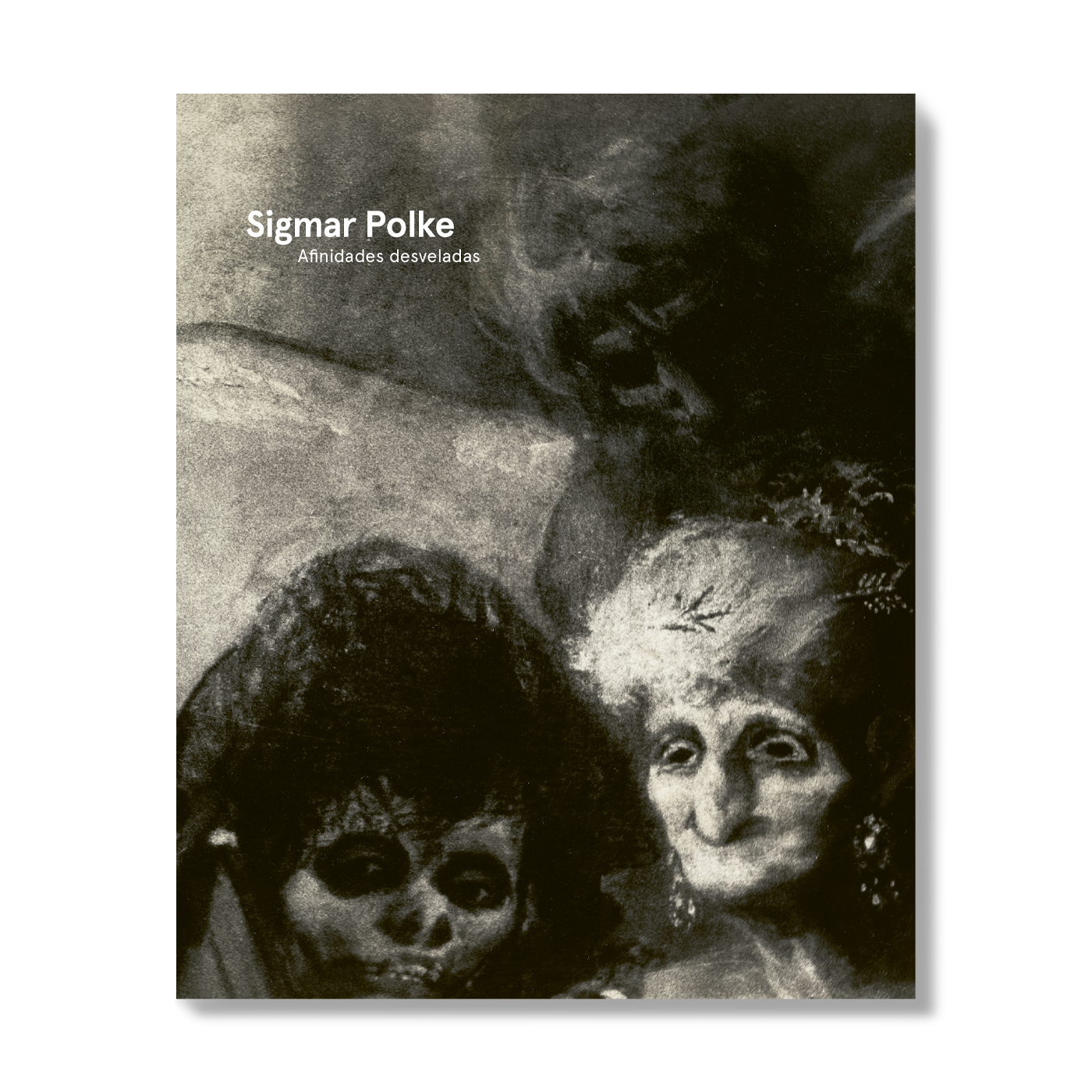
The relationship between Sigmar Polke (Oels, Silesia, 1941– Cologne, 2010) and Francisco de Goya – the man and his work – provides the backdrop to this exhibition, which highlights a heterogeneous set of parallels that together reveal, in a timeless manner, a connection in terms of both subject matter and execution. The configurative consequences of Polke’s 1982 encounter with Francisco de Goya’s Old Women / Time (1810–12) were soon apparent; thenceforth, indeed, echoes could be found throughout the whole corpus of Polke’s work, influencing motifs, techniques and compositional criteria.
In the X-radiographical examination of The Old Women, Polke discovered much more than what his intuition had led him to seek. This revealing of what lay hidden reinforced his view of painting as the layered sediment of time and memory.
Goya’s influence on Polke, and Polke’s empathy with Goya, fall under three headings: first, the man himself, and his artistic, political and social circumstances; second, the objectual and anthropomorphic iconography found both in The Old Women and in the X-radiographs of it; and finally, the specific facture of the picture in question.
The exhibition is not arranged chronologically, but rather through concepts which criss-cross linear time, intersecting with the use of different techniques and thus showcasing the creative complexity of one of the leading figures in contemporary art.
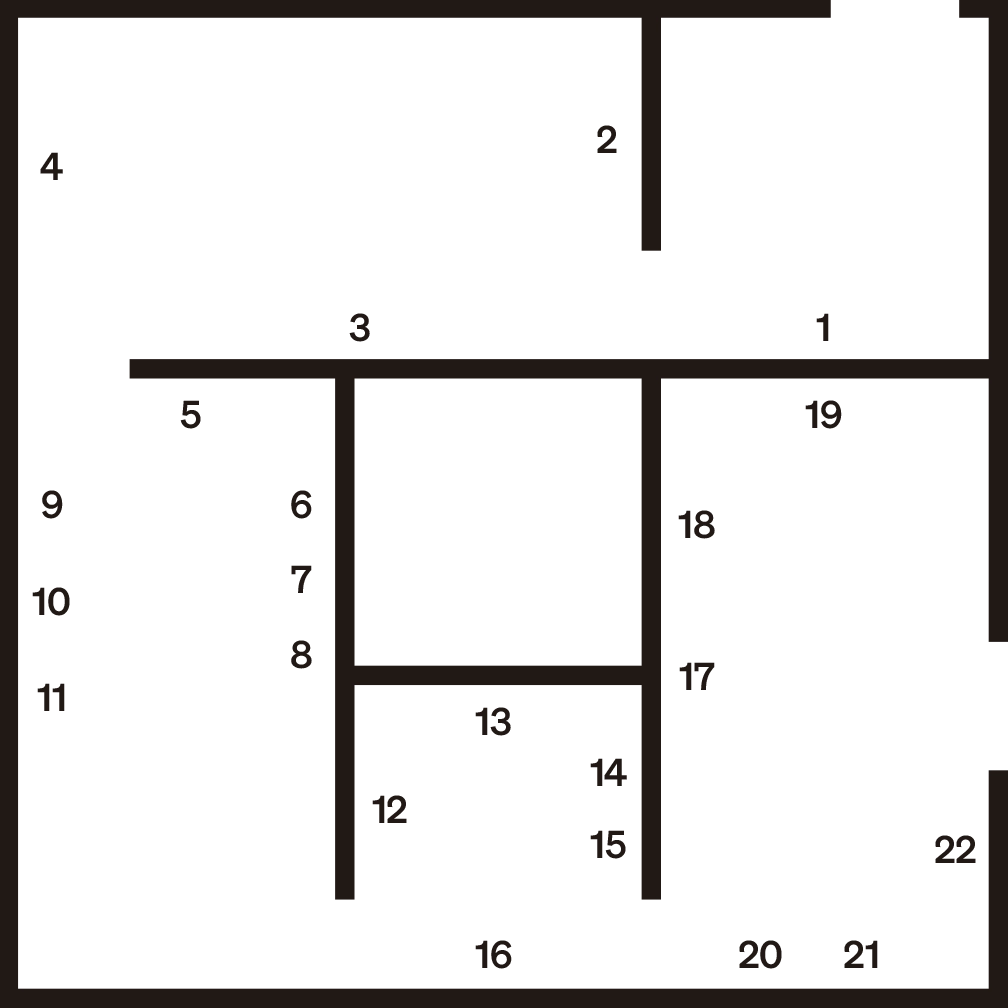
1. Ashes to Ashes (Asche zu Asche)
After scattering white pigment over three parallel horizontal strips of printed fabric and velour (perhaps a disguised flag), Polke overprinted a number of half-buried skulls resembling ectoplasmic materializations. The title, Ashes to Ashes, serves as a metaphorical catalyst, embodying a wealth of allusions. Goya’s influence was probably crucial to this renewed interest in themes addressed earlier; his Disasters of War may have provided the underpinning for this particular work. Here, Polke takes the duality of death and resurrection conveyed in Goya’s Old Women, and extends it to embrace issues transcending German borders, among them modernity; yet rather than focussing on the epistemological manifestations of modernity over the 19th and 20th centuries, he traces it back to its origins in the French Revolution.
Chicago, Collection Museum of Contemporary Art Chicago, Gerald S. Elliott Collection, 1995.78
2. White Obelisk (Weißer Obelisk)
A conventional monument, bearing no inscription, floats over a black background featuring a regular pattern of skulls, bones and eyes with piercing stares. The image seems to showcase the grisly evidence of the Holocaust and the hardships of a rebirth understood as punishment, but also as hope for those so cruelly swallowed up by the chaos of history. In a much later work, Ashes to Ashes, produced in 1992 and displayed in the previous room, Polke seems to have revisited this theme.
Siegen, The Lambrecht-Schadeberg Collection, Museum für Gegenwartskunst Siegen
3. Untitled (Triptych) (Ohne Titel [Triptychon])
In this disturbing triptych, ghostly faces peep out between layers of artificial resin that imbue the pictures with a wispy, insubstantial air. The composition is deliberately ambiguous, in that the sense of depth conveyed by the grouping of images around apparent rectangular openings – as though they were observing the viewer from above – is belied both by the light background tones and by the clearly superimposed layers of colour and motifs, as though we were seeing several canvases at once, one behind another. At the same time, there are echoes not only of the wraithlike images surrounding the figure discernible in one corner of the X-radiograph of The Old Women, but also of Goya’s frescoes in San Antonio de la Florida, in which – as in Polke’s triptych – the rectangle comes to resemble an inner courtyard or a skylight. Alternatively, the arrangement of the sparse iconography could suggest visions of the other side of a mirror, a reading consistent with Polke’s fondness for mirror images, and also with the key iconographical significance of the mirror in The Old Women.
Potomac, Maryland, Glenstone Museum
4. Paganini
Polke spent three years working on this piece, inspired by a legend according to which the virtuoso violinist Niccolò Paganini made a Faustlike bargain with the devil. In this work, whose huge format reflects both the complexity and the ambiguity of the subject matter, a printed fabric is overlaid with an engraving by Louis-Léopold Boilly illustrating the dream of Giuseppe Tartini, another seasoned violinist with satanic connections, in which Mephistopheles plays the symphony that later inspired Tartini’s Devil’s Trill. The painting hints at another alleged Faustian pact, one which involved and eventually destroyed German culture; this might account for the apotheosis of swastikas invading the canvas, springing out of the support itself – like the notes played by the diabolical violinist – or swirling around the haggard harlequin. He also focuses on the perhaps-unavoidable link between shadowy gloom as a generic construct and the specifically German “disasters of war”, whose outcome would inevitably have ranged from physical destruction to cultural conditioning. As for the motif, the spiralling whirlwind of skulls bears some resemblance to the spectral mandorla of clouds in the underlying Resurrection scene detected during X-radiography of Goya’s Old Women; the skulls themselves with their wry, possibly ironic smiles, certainly recall two photographic approaches to that painting – one positive and the other negative – in which Polke highlights the emaciated face of the dark-clad lady-in-waiting, beside the coquettish woman rummaging through the ruins of her lost beauty. But the Mephistophelean violinist on the right of Paganini also provides a major point of reference, in terms of iconography as well as scale: he can be linked to the idea of the ghost but also to that of the colossus, and thence to the figure of Saturn, ready to sweep away the two old women in Goya’s painting.
Private collection
5. Nightcap I (Nachtkappe I)
In Nightcap I, a painting produced using indigo and alcohol varnish on canvas – its very title indicative of his burgeoning interest in headdresses, hats and wigs following his encounter with Goya’s Old Women –, Polke blends an almost classical landscape feature with the chaotic formal genesis inherent in the flow of substances and the ecstatic ambiguity of inner experience, while at the same time seamlessly fusing content and form. The varnishes seem to have been poured vertically onto the surface and then encouraged to drip in opposite directions; but there are also more diluted areas of colour in which the dispersion of the brushstrokes can be inferred. In any case, the contrast between the drawing and the colours is sufficiently sharp to prevent any sense of being submerged in a mesh of superimposed layers, so that the gradations of blue above what appears to be a mountain range, with the dark patch at the centre, dominate the semantic fabric of the composition and psychologically establish a huge scale, leading inevitably to a comparison with Romantic landscapes in the style of Caspar David Friedrich, although the independence of the colour layers in the lower part of the picture transforms it into a virtual, imaginary panorama.
Paris, Fondation Louis Vuitton
6. This is how you sit correctly (after Goya and Max Ernst) (So sitzen Sie richtig [nach Goya und Max Ernst])
Polke’s interest in the headdresses worn by Goya’s Old Women, and in the chair in which one of them is seated, ties in with this picture produced in dispersion paint on printed fabric. Although there are several motifs, the central figures are the two young women with chairs on their heads, a partial replica of Goya’s Capricho no. 26, illustrated by a caption similar to Polke’s title: They already have a seat (Ya tienen asiento). Unlike others, this Capricho is somewhat ambiguous. The two girls are balancing upside-down chairs on their heads, while their petticoats have been pulled up to cover the upper half of their bodies, like hooded capes. The game depicted is a practical example of the “topsy-turvy world” whose iconography was – and still is – associated with Carnival (an event which fascinated both Goya and Polke). Yet the real ambiguity of the work lies in its title: the Spanish word “asiento” means “a thing to sit on” or “a place in which to sit”; more interestingly, given the scene depicted, the phrase “sentar la cabeza” (lit. “to seat one’s head”), means to “settle down”, in the sense of attaining prudence, common sense and balanced behaviour. The colours and tones of the printed pattern on the right are repeated on the left, although here the decorative pattern changes and is painted rather than printed; at the same time, the colours blend seamlessly with the soft grey and lilac of the engravings transferred to the support, so that the partly transparent overlaying of images, graphic patterns and colours form a visually consistent and structurally balanced pastel composition, remarkable both for its centrality and for its diagonal thrust. The figures mingling with those of Capricho no. 26 are drawn from an engraving by Max Ernst to illustrate his novel Une semaine de bonté, itself based on an 1886 print to which Ernst made some additions (including the snake and the warrior seated in the armchair). The semantic fit of the two engravings (one of which is in itself challenging because of its surrealist nature) is perhaps less important here than the iconological density of the guest artists and the shaping presence of Polke himself. In this sense, Goya may be hailed as a pioneer in the more subversive facets of modernity; Max Ernst as one of its prime movers and Polke as a respectfully disobedient continuator intent on questioning every aspect of modernity and turning it all “upside down”, albeit in a highly poetic manner.
Private collection
7. Interior (Interieur)
In Goya’s Old Women, the lady in white is seated on a chair, an object which Polke was later to subject to close scrutiny. But he had already explored the theme some years earlier, in his rather disturbing Interior, which shows an elegant sitting room – chair, table and armchair, carpet and curtains – lit from outside through wide-open doors. Wholly defined by a grid of positive and negative dots, the room has an atmospheric quality that stresses the absence of its usual occupants, just as passport photographs, especially in black and white, are readily associated with death. The subject matter of Interior is an academic cliché and a commonplace of historical painting, whose main theme is therefore painterly perception itself; here, however, the treatment is ironical, since in visual terms the content of the room is born out of the negative outlines. Yet at the same time, the way the image is generated highlights Polke’s detachment from any subjective gesture, showcasing the central role of the industrial dot-screen process as applied to works which are unfailingly unique. These twin features demonstrate Polke’s ability to turn manuality into corporality, thus becoming an inducer of images in an objective landscape that encompasses nature, artifice and the culture that interprets them.
Baden-Baden, Museum Frieder Burda
8. Oil Slick (Ölfleck)
Close scrutiny of Goya’s painting in the Palais des Beaux-Arts in Lille reveals that, apart from the background architecture, the brightest area of the painting is the empire-style dress worn by the dejected lady; shimmering embroidered particles discernible in its fine texture of soft tulle hint at a redundant préciosité which Polke surely took a delight in sublimating, although – as is often the case when he highlights something in a composition – he then goes to sarcastically subvert it. In this more symbolic vein, Polke used pieces of gold leaf for his 1983 painting Oil Slick, in which a thick patch of petroleum, dotted with golden fragments, covers most of a support which is vertically divided into two pieces of printed fabric: the cloth on the left is typical of a Western suit; the fabric on the right is filled with palm trees, figures in Arab dress and barrels of oil scattered around. The allusion in this case is ironically obvious: after two oil crises, the oil-producing Arab countries managed to achieve what the alchemists never succeeded in doing.
Germany, Würth Collection
9. Woman in the Mirror (Frau im Spiegel)
The inquisitive mirror that asks the lady how she is feeling (“¿Qué tal?”) in Goya’s Old Women, coupled with the withered old woman gazing into her looking glass in his Capricho no. 55 – entitled Until Death – lead us to focus now on the shaping effect these mirrors had on Polke’s work. As early as 1966, Polke produced the superb Woman in the Mirror, in acrylic on printed fabric. The first thing we see is that the rectangle of the stretcher contrasts with the irregular pentagonal form of the supposed mirror. Next, we notice that the woman’s features are drawn rather than taken from a photograph, and are reflected as if the invisible room were almost in darkness, although they are quite deliberately extended until they permeate the support. Yet this is not a real mirror, pasted onto the printed fabric, but rather a simulated mirror made of glass attached to the opaque support, whose marks are visible. Taken as a whole, the work can be seen as an icon of consumerist idealisation; the woman is reminiscent of a pin-up in an advertisement for cosmetics.
London, private collection
10. Seeing Things as They Are (Die Dinge sehen wie sie sind)
This 1992 work includes, among other things, a mirror effect which is almost painful, but whose purpose leaves no room for doubt, since technique and meaning coincide point for point, without leaving the slightest margin of uncertainty regarding its interpretation. Made of synthetic resin and lacquer on polyester, the painting is vertically and symmetrically divided by two supports, one translucent and soaked in resins and the other opaque, in such a way that the transparent part reveals the geometric structure of the stretcher. These two clearly differentiated sections contain two shared motifs that unite them in a somewhat equivocal manner. In fact, centred in the upper part are a number of parallelepipeds, carelessly drawn in perspective with two distinct vanishing points. At the same time, dividing the composition into two horizontal halves, the title of the piece is written like a reflection in an impossible mirror and hence with the text inverted. Moreover, the right-hand side of the sentence is painted faintly, as though mysteriously emerging through the opacity of the print. It is difficult to avoid seeing here an allusion (in the negative) to Magritte. This work can be read as a powerful protest, not against painting – on the grounds that it largely eschews truth by virtue of its poetic nature – but against the tricks of supposedly realistic representation and its characteristic perceptual redundancy, which is wholly unnecessary.
Karlsruhe, Städtische Galerie, Garnatz Collection
11. Pikes
A number of works produced by Polke in 1988 focus on the French Revolution; all of them highlight – albeit elliptically – the contrast between its cruelty and the revolutionary virtues it proclaimed, in what amounts to a pointed attack on positivist rationalism and a call for the urgent refounding of modern humanism. The most interesting of these, for our present purposes, is entitled Pikes. On a background fabric in Prince of Wales check, haphazardly stained with the colours of the French flag, Polke has painted three guillotined heads skewered on long pikes; he has also added patches of white, again resembling ectoplasmic materializations, from which incipient faces appear to be emerging, shaped by light or dark grid dots, bearing an obvious resemblance to the ring of nebulous faces in the drawing underlying Goya’s Old Women. Germany did not undergo a social revolution comparable to that taking place in France, and the fall of the Ancien Régime was by no means such a cataclysmic event there. An almost medieval status quo was maintained practically until the unification of Germany in the latter third of the 19th century. Even so, German intellectuals – in the service of their noble masters – undoubtedly grasped the message conveyed by the spirit of the times; indeed, they explored the message in such depth that the evolution of modern continental Europe, be it towards the Left or the Right, became much more of a German concern than a genuinely French issue. Polke’s sarcastic stance in Pikes is underpinned by the moral courage and authority of a culture which appropriated the philosophical precepts espoused by its European neighbours, with all their consequences. At the same time, the genesis of this specific series of works may owe a great deal to the fact that Goya – a champion of the Enlightenment as well as a Francophile – was horrified by the excesses witnessed during the Peninsular War, and fearful of the atrocities that might be committed by a deified Reason.
Madrid, private collection
12. Untitled (Ohne Titel)
Another fruitful result of Sigmar Polke’s meeting with Max Ernst is this composition, taken from an illustration for Ernst’s novel La Femme 100 têtes. To create it, Ernst used two earlier prints from 1833 and 1891, shown here. The older of the two shows the catacombs of Palermo, their occupants in full view; the other shows a flock of butterflies fluttering in the light of a street gaslamp, as well as unexpected insects crawling on its glass. Ernst merged the two images, and Polke simply enlarged the fused version, adding greens, blues and pinks. The absence of a title does not prevent us from inferring meanings in the work. We see, for example, that life and death coexist within it, although the vitality around the streetlamp precedes the catacombs – nicely tinged in a rather strong pink –, which would underline (in a positive manner) the fleeting nature of life, as long as in life one has access (direct or vicarious) to beauty, of which butterflies are an archetype. In any case, and though the lively colours used preclude any melancholy slant, this work is close to the central theme of The Old Women and also reinforces our appreciation of superimposed layers as essential to the concept of painting.
Kunstmuseum Bonn
13. Lines of the Left Hand (Handlinien links) and Lines of the Right Hand (Handlinien rechts)
Polke’s encounter with Goya’s Old Women served to reinforce lines of creativity that were either still latent or had already been explored, such as the artist’s presence and his interaction with his surroundings. In 1968, for example, Polke had produced two large-format works using synthetic fabrics printed in soft colours which nonetheless reflected different tones depending on the viewer’s position; over this support he superimposed an enlarged image of the lines on the palms of his hands. Various readings are possible: Polke may be highlighting the union of his destiny with that of art, or perhaps laying bare his future destiny, by way of a double self-portrait which would be phenomenological rather than ontological, and oriented towards what is yet to come.
Kunstmuseum Bonn
14. Profile (Profil)
The redundancy inherent in any formalisation is satirically highlighted in Profile, which can be read as a veritable antipattern gibe, since Polke traces the outlines of a face in a remarkably rudimentary manner, by joining the small geometrical shapes decorating a light printed fabric, the shapes thus substituting stars, places and, in a broader sense, configuring points.
Stuttgart, Froehlich Collection
15. Expanding the Planetary System with a 10th Planet (Erweiterung des Planetensystems um einen 10. Planeten)
A certain poetic humour underlies Polke’s allegorical use of science in a number of works. In this drawing in ballpoint pen, ink and watercolour, he mimics the solar system, adding a tenth planet – out beyond Pluto – which he names “Polke”; the new planet is linked by filaments to the others.
Berlin, London and New York, Galerie Michael Werner
16. Velocitas-Firmitudo
One of the photocopies of the Conjectural Drawings that Polke made for his Old Women project shows Goya’s original signature, complete with its hallmark curlicues. It would seem reasonable to link this photocopy, in formal terms, to another series of works – including Velocitas- Firmitudo – which, with their shared allusions to Dürer, highlight the presence of the artist as part of a symbiosis fusing virtues, calligraphy and Nature to form what can only be regarded, aesthetically, as a spectacularly solid whole. The works in question were presented at the 1986 Venice Biennale, and the various graphic motifs are taken from The Great Triumphal Carriage of Maximilian, a woodcut made by Dürer in 1522 to mark the triumphal apotheosis of Emperor Maximilian I, who had died three years earlier. The scene as imagined by Dürer comprises a spectacular carriage drawn by an imposing team of horses. Each of the elements in the iconographic ensemble has a particular laudable quality assigned to it in the form of a caption; Polke was especially interested in the virtues extolled in the captions above the horses. While these are known to have been suggested by his political masters, Dürer found a way of imposing his own stamp on them, adding whimsical calligraphic scrolls that offer a highly personal allegory of each of the emperor’s attributes. By highlighting Dürer’s signature, Polke effects a corporeal as well as mental intervention in the work; turning it into an interaction rather than a gestural act, thus emphasising his individuality as a creator. In that sense, parallels can be drawn with Lines of the Hand and even with Profile, both dating from 1968.
Private collection
17. Large Man (Großer Mann)
A male figure resembling a classical statue – albeit not dressed as a warrior – vertically occupies this picture. While the sheer size of the image might easily remind us, yet again, of Saturn in The Old Women, the most important features here are the dialogue between the dot grid and the pattern of the background fabric, the anatomy of the figure itself and the random flow of the acrylic paint. The human figure breaks up as it recedes into the background, and the irregular mass of colour, instead of unifying the various prints with the figure, now seems to destroy the ordered grouping of dots, in a sense attracting and engulfing them within its chaotic development. Thus, the dot grid acts here as an illusory grille or filter that challenges and sharpens our perception. The visual primacy attained by the most disordered and unexpected part of the composition also ensures its thematic predominance over the fading human figure. Whilst this, too, might suggest a parallel with auras and apparitions, the picture could also be read as a demonstration of error as a positive value, viewed as an accident rather than a mistake.
Baden-Baden, Museum Frieder Burda
18. Black Man (Schwarzer Mann)
In 1982, Polke produced at least two works on the colossus theme, which share a similar compositional distribution (in diagonal, and from left to right): Black Man, shown here, and another directly entitled Colossus (Kolob). In Black Man, a broad lattice of clearly hand-made dots appears sometimes in front of the colour patches, and sometimes behind them, effectively nuancing – as in many other works by Polke – the purpose of the dot grid, which can be used both to generate or dismantle images and to promote visual ambiguity; that is the case here, since the painting operates as a perceptual agent of pictorial superimposition, serving as a palimpsest rather than as a means of generating depth. In that sense, as a technique it would function in much the same way as the total or partial use of printed fabrics, but with an additional element of transparency. On the subject of transparency, it might be noted that the meticulous analysis of the images superimposed by Polke on Goya’s Old Women would, in itself, be sufficient justification for his abundant use of this resource from 1982 onwards. In any case, transparencies aside, the imposing black man is the dominant element, not only because of his scale in relation to the painting, but also because in the equivocal overlapping of planes he is shown almost in his entirety, and is prominent on account of his colour.
Riehen/Basel, Fondation Beyeler, Gift of Collection Renard
19. Fear (Black Man) (Furcht [Schwarzer Mann])
Behind the image of Saturn armed with a broom in Goya’s Old Women, Polke certainly discovered much more than he expected. However, for an artist “thinking with his eyes”, disquisitions on the original cause of these emerging images are of no interest whatsoever; rather, he is arrested by more generic visual states, for example, by the fact of discovering or intuiting what is concealed, as well as by the anamorphosis on which everything illusory depends. His creativity operates in the realm of transformative ambiguity, leaping from image to image, and appropriating – rather than rejecting – the semantic multiplier inherent in every image. Fear (Black Man), in all its brazen expressionism, revisits the theme of the colossus via the title used for a number of pieces dating back to 1982. It belongs to a series of gigantic figures in terrifying settings, created in 1997 by deforming existing images on the photocopier and enlarging them on a massive scale.
London, private collection
20. We’ve never done it like this before (Das haben wir noch nie so gemacht)
The mixture of pigment and resin here allowed Polke to create superimposed, translucent layers. In the lower part of the picture, a roughly traced horizon belies what is happening above; in three of the rectangle’s corners there is a face drawn in typical comic-strip style, with blurred features. In the lower right corner, sketchy but unstructured features can be discerned in a light magma of violet pigment that spreads over the entire support, partially erasing the faces and forming something resembling a cloud that revitalises the horizon. Here, yet again, the violet is reminiscent of Goya, and its apparently gradual spread brings to mind the large photograph of the two old women threatened by the traces of photochemical substances. At the same time, the placing of the three heads in the three corners of the picture brings to mind Polke’s 1982 piece Untitled (Triptych), which – as we noted earlier – echoes Goya’s frescoes for the dome of San Antonio de la Florida, where the rectangle also serves as an opening into an inner courtyard, or as a skylight. More than an iconographic mixture linking two creative periods, this picture blends two approaches to generating images, and two ways of weaving them into the composition as a whole, which effectively correspond to two successive stages in the creative process.
Rotterdam, Collection Museum Boijmans Van Beuningen
21. Opium Smoker (Opiumraucher)
Polke’s Opium Smoker was prompted not only by his discovery of pigments and colour materials that were either unknown or had fallen into total disuse, but also – of course – by his contact with users of opium and hallucinogenic mushrooms, as well as his abiding interest in alchemical processes. Underlying this work is a Chinese drawing of a man smoking opium on a terrace overlooking the sea, faced by a sea monster. Superimposed over this motif, a rubbery film of small lacquer-like red beads disintegrates into a pure dot grid, with no clumping, so that what at first seems like a veil of privacy fades away to become both an invitation and a perceptual disorientation.
Düsseldorf, Droege Art Collection
22. Untitled (Fly Agaric) (Ohne Titel [Fliegenpilz])
The magical aspects of perception and creation have always been inherent in art. While Polke did not, as a rule, make use of hallucinogenic mediation, he certainly experimented with it and explored it; he also made clear references to it, believing – as Goya did – in the visionary quality of art. A good example of that belief is Untitled (Fly Agaric), a series of eight photographs in which a hallucinogenic mushroom occupies the centre of each composition, superimposed on the figures of several Native Americans who, to judge by their dress and attitude, are probably shamans in a trance.
Otterlo, Kröller-Müller Museum, formerly in the Visser collection, acquired with support from the Mondriaan Foundation
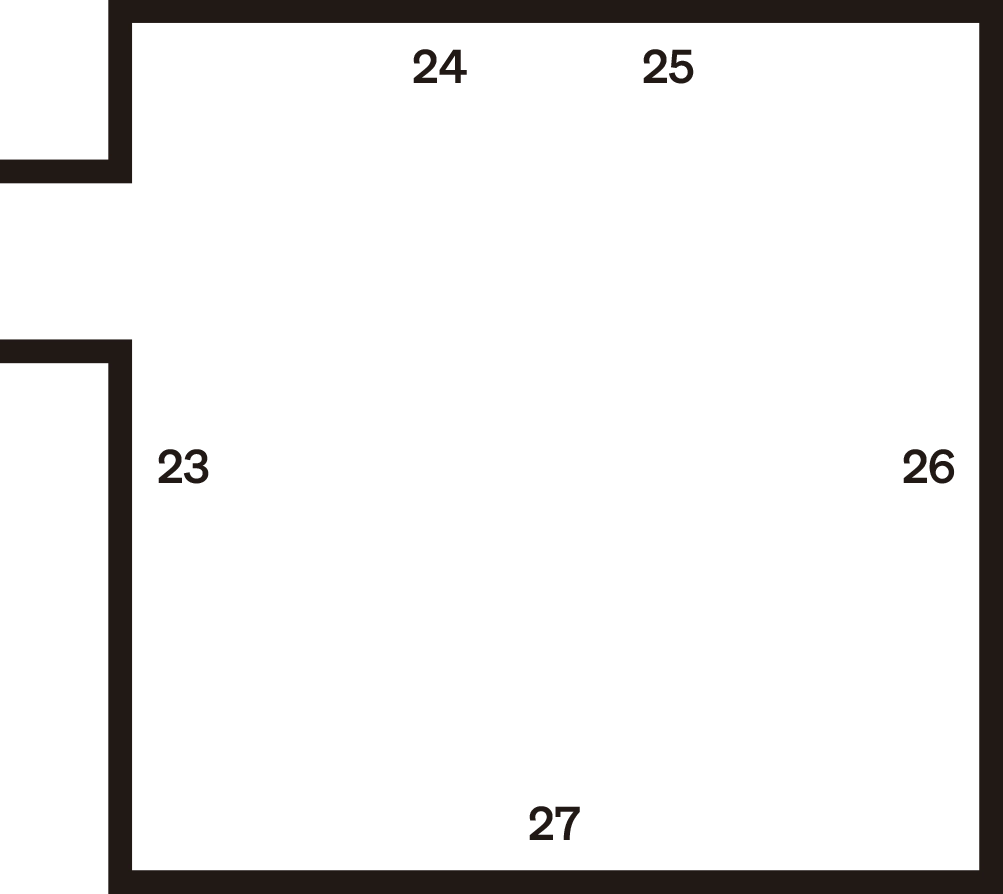
23. China Sea (Chinesisches Meer)
In this work produced using violet pigment and synthetic resin on canvas, the subject matter – rather than being superimposed – is split both iconographically and technically, though the separate areas converge in transparency. Moreover, the violets (which the viewer always finds beguiling) tend to obscure possible meanings in the lower part of the picture, where the colour mass prevails; by contrast, they become transparent in the upper part, blending into the resin. The illustration transferred to canvas shows several swimmers (survivors of a shipwreck?) flailing around in towering though evenly spaced waves, while rain from a series of calligraphic clouds falls relentlessly on the choppy sea. The survivor closest to the viewer has clearly human features, but the others resemble sea creatures, closer in form to monsters or sea gods than to castaways about to sink beneath the waves. Yet a different, equally clear reading can also be glimpsed: the dark violet area at the base of the painting (i.e. the shore in the other reading) could itself be seen as a stormy sea with an ochre coastline reflecting a violet sky, in which – as in a Turner skyscape – we can just make out a patch of sunshine amidst the rain and the clouds that are disintegrating as they shed their rain. But this deliberate thematic redundancy is undermined, though not invalidated, when what appears to be a typhoon funnel, outlined in lacquer, rises out of the sea only to turn into some kind of winged creature, a cross between a gigantic insect and a huge prehistoric bird. In fact, however, the creature appears to be trapped between the narrative illustration and the “seascape” of violets, interposing the inevitable mystery of its form and position between two other attractions or hypnoses: that provoked by the calligraphic detail of the unsettling scene depicted in the illustration and that caused by the violets of varying density, with all their nuances and apparent formal concealments. This work defies the viewer with its superimposed opaque or translucent layers, introduces unusual materials, issues semantic challenges and demonstrates a materialism which, while critical of the landscape genre, never disparages the image; indeed, quite the reverse.
Private collection
24. 25. Catastrophe Theory II (Katastrophentheorie II) Catastrophe Theory IV (Katastrophentheorie IV)
The ontological victory of time over mechanicism and determinism may be regarded as decisive. Polke was perfectly aware of this, and thus his engagement with thermodynamics and catastrophe theory is entirely deliberate, and should not be dismissed as a side issue. The presence of the violet tones, as a visual chaos accompanying the catastrophic impact of the celestial body, provides us with a chromatic nexus, linking Goya’s Black Paintings – an unquestionable paradigm of the Spanish “catastrophe” (which prompted the tragic loss of much that was gained during the enlightened 19th century in the Western world) marked by a parallel predominance of formal blurring – with the five works on chaos theory that Polke completed in 1983 using synthetic and natural resins on canvas (Catastrophe Theory I-V). Polke’s decision to explore a subject as specific as catastrophe theory can be attributed not just to Goya’s influence, or to his own awareness of a definitive shift towards indeterminacy in the formalisation of reality, but also to the fact that this theory stems much more from the modulation of forms than from equations, and that by way of this formal path all disciplines enter into reciprocal contact and, in turn, are integrated into both nature and life. This ties in perfectly with the idea of an interactive and unpredictable landscape to which Polke unreservedly adheres.
Vienna, Schauer Collection
26. Rainy Weather (Rainbow) (Regenwetter [Regenbogen])
In this picture, meanings, colours and forms are woven together in a perfect symbiosis that owes much to its large format. Here, we can detect neither a horizon nor any geometric or tonal depth; instead, we discern a pictorial depth, or perhaps an epidermal depth, since the superimposing of layers appears endless, and the viewer has the sensation of being inside the meteor, bereft of any spatial reference or indicator of scale. The droplets of colour have a certain diagonal directionality that lends verisimilitude to the title, while the diffraction of light is splintered into several iridescent areas. The picture has Romantic echoes, due to its fragmentary framing, its cataclysmic appearance and the enlargement of detail, which equates the macrocosm and the microcosm (a well-known precept in alchemy). In addition, it is a tenebrist composition with no focal highlighting, bringing to mind the unsettling darkness of some of Goya’s Black Paintings. The meeting of material and image, in all its immediacy, apparent in Rainy Weather (Rainbow) foreshadows the acceleration or radicalisation of Polke’s creative approach in the course of the 1980s towards the use of unorthodox, uncommon or long-neglected materials.
Kunstmuseen Krefeld
27. Meteorite Fragments (Meteorenspäne)
By being grouped under the title Meteorite Fragments, the set of twenty-four photographs subjected to Polke’s manual intervention in 1989 take on a poetically enhanced meaning; indeed, they even transform meaning, through metaphor rather than ambiguity. The drawn forms – based on the whorled ridges of the fingertips – range from masks to supposed insects or symmetrical organisms, as well as spirals and other ancestral signs; in some cases, however, the manual intervention disintegrates into vague dispersions and accumulations of meteorite dust, creating a kind of relief that is inferred rather than delineated. With this kind of high relief, Polke is “touching the sky”, but also, by a happy poetic coincidence – and as with the dot grid – it is the contours of the dark grain that shape the signs and images impressed with his fingers, though illuminated by the light of the photograph. The near golden colour achieved in developing the photographs is vaguely reminiscent of the reflection of the ubiquitous interstellar dust and, in passing, serves to sacralise these instances of interactive formalisation, as well as probably alluding to the solar gold of the alchemists.
Karlsruhe, Städtische Galerie Karlsruhe, Garnatz Collection
Spanish
32€
Compra ahora
20 and 27 November and 4 December 2024
Mostrador de Educación
10 €
More info
Sala de Conferencias
Actividad gratuita para los visitantes con entrada al Museo
More info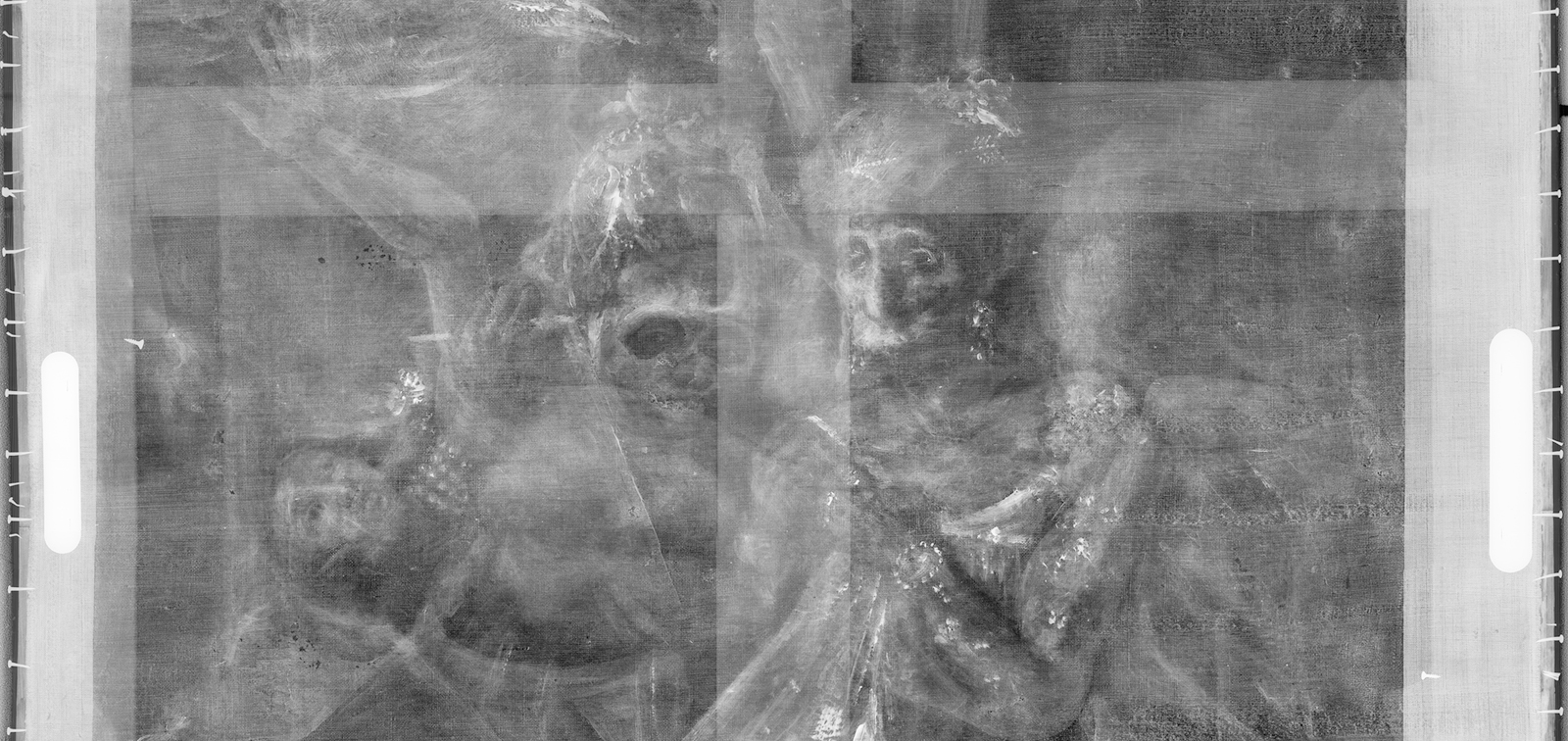
Directed by Javier Arnaldo
More info
12 €
More infoMonday to Saturday: 10.00 am - 8.00 pm
Sundays and holidays: 10.00 am - 7.00 pm
6 January and 24, 31 December: 10.00 am - 2.00 pm
Last admission 30 min before closing time.
Visitors must leave the galleries 10 min before they close.
1 de enero, 1 de mayo y 25 de diciembre
Open until 30 min before closing time
www.museodelprado.es and ticket office
cav@museodelprado.es / 91 068 30 01
Standard ticket: 15 €
Reduced price ticket: 7,50 € (with proof of status)
Spanish and English
Includes the Collection, current temporary exhibitions and the route
On sale at the ticket office and online
Sponsored by:

With the collaboration of:
