A metal plate with several lemons, a basket full of citrons that still have their leaves and orange blossoms, and another metal plate on which a cup and a rose rest, are arranged on a table and against a dark background. Dated in 1633, this is the only still life signed by Zurbarán and it stands as one of the masterpieces in the history of this genre in Europe. Some of its elements, such as the cup and the rose, appear in other works of the painter, who lavished his religious compositions with still life details throughout his career. Nevertheless, he painted very few independent still lifes.
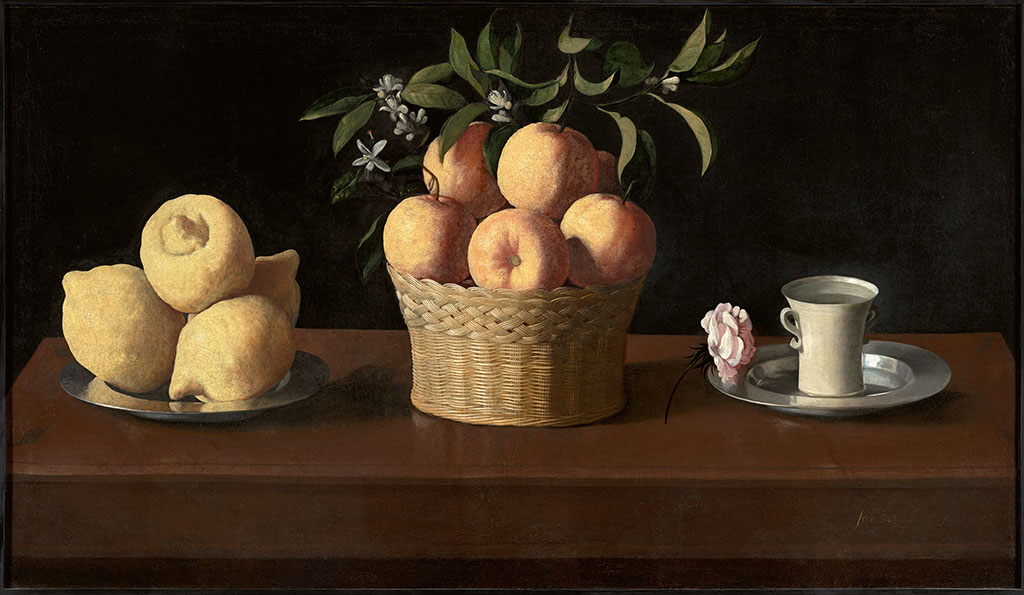
Francisco de Zurbarán (1598-1664). Still Life with citrons, Oranges and a Rose. Oil on canvas, 62.2 × 109.5 cm. Signed and dated 1633. Pasadena, Ca., The Norton Simon Foundation, F.1972.06.P
The extraordinary fame acquired by this work since its revelation in the 1920s is due to Zurbarán’s masterful use of scale, his incredible descriptive accuracy, and his compositional values. The objects occupy a considerable portion of the painting’s surface and they are arranged in three slightly differentiated planes, where a very selective side light pulls shadows from them and helps to clearly define their volumes and transmit their textures. The strict order that prevails, the highly individualized presence of all the objects, the targeted use of lighting and the darkness of the background give rise to a work that is simultaneously silent, delicate and solemn. This explains why for many decades there were very few authors who had not suggested the possibility of it containing sacred content.
Zurbarán was 35 years old when he created this painting and found himself at a unique moment in his career. Since 1626, he had taken on important commissions from religious institutions in Seville, such as the Dominican Convent of Saint Paul, the Franciscan School of Saint Bonaventure, the Convent of Mercy or the School of Saint Thomas, which generally requested series of paintings from him. All of this made him the city’s most prolific and important painter. At the same time, however, in the early 1630s he began to diversify his work by offering independent small or medium paintings, which allowed him to explore new themes and expand his client base. During this time, he created memorable works, such as those that revolve around topics like the Veil of Veronica or Agnus Dei. In this context, it is important to include this still life, since it is the earliest signed still life of Sevillian painting known to date.
For its exhibition at the Prado, the painting from Pasadena has been displayed in the room dedicated to Zurbarán and appears next to Agnus Dei and the Still Life with Vessels. Another work accompanying it in this space is Saint Francis of Paula, which was acquired by the museum just over a year ago and, after undergoing restoration, is shown to the public for the first time.