
Loading...
Jaume Serra, Virgin of Tobed [detail], Ca. 1368 – 1371, Museo del Prado
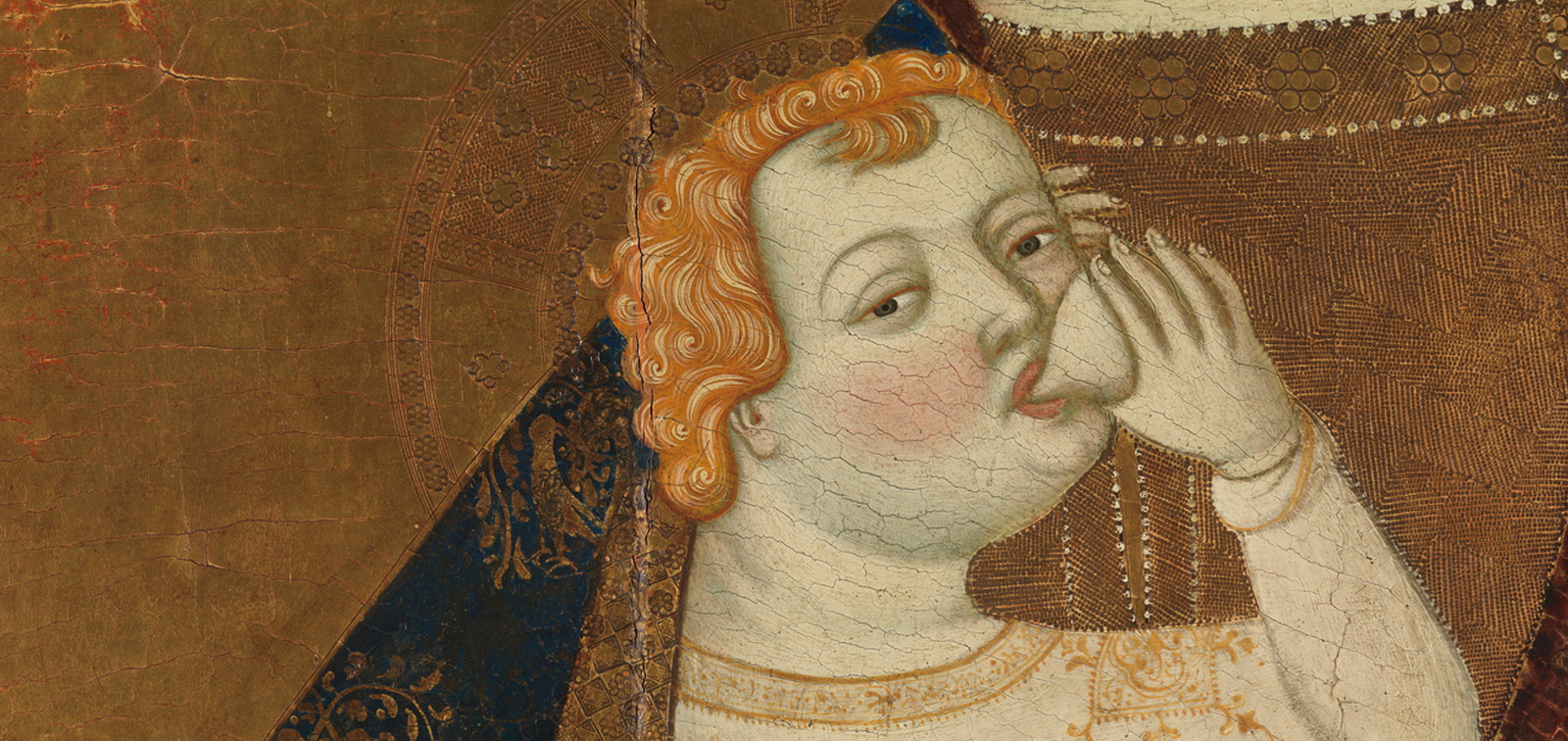
International Conference: The Gothic Period in the Mediterranean: Networks, Artists, and Forms between Italy and the Iberian Peninsula (1320–1420)
September 9, 10 and 11, 2026
Call for Papers
International Conference: The Gothic Period in the Mediterranean: Networks, Artists, and Forms between Italy and the Iberian Peninsula (1320–1420)
September 9, 10 and 11, 2026
The circulation of art in the western Mediterranean and the role played by Italian Trecento models in shaping Spanish art of the Middle Ages have been the subject of growing academic interest in recent decades. Different findings have contributed to expanding our knowledge of the transnational exchanges of images, techniques, and artists in the late Gothic period, helping to reformulate the concepts of boundaries, originality, and influence. This is the context for the research carried out by the Department of European Painting up to 1500 at the Museo Nacional del Prado, to be concluded with the exhibition In the Italian Manner. Spain and the Mediterranean (1320–1420).
This international conference is a natural extension of the exhibition project and aims to further explore the lines of research the exhibition deals with. By means of this initiative, the Museo del Prado invites the academic community to explore, from a comparative, critical, and material perspective, the various ways in which Italian art was appropriated, reinterpreted, and adapted in and by Spanish territories. Originally conceived as a platform for reflection, discussion, and exchange, this scientific meeting seeks to be a space both for the analysis of specific works and artists as well as for the study of broader historical and theoretical issues. Among these matters are the circulation of forms, techniques, and artists; the networks of diplomats, merchants, and men of the cloth that furthered these exchanges; the aesthetic and semantic values of artistic techniques; and the limits of the concepts of center and periphery in the study of medieval art.
The Museo Nacional del Prado is the venue for the exhibition that will give rise to this reflection, and, as such, it supports this proposal with the aim of promoting a cross-cultural dialogue that will further the interpretation of late Gothic art from a genuinely Mediterranean perspective.
- Organized by:
-

- Coordination
- Prado Museum Study Center
- Direction
- Joan Molina Figueras
Mariaceleste Di Meo - Venue and dates
- Auditorium of the Museo Nacional del Prado
September 9, 10 and 11, 2026 - Call for papers
- Participants are invited to send an abstract (maximum 2,000 characters, including spaces) accompanied by a brief CV (maximum 1,500 characters, including spaces) and a minimum of three keywords to: congreso.maneradeitalia@museodelprado.es
All applications will be evaluated by the scientific committee. - Accepted languages
- Spanish, Italian, French, and English
- Deadline for the submission of proposals:
- January 15, 2026
- Notification of acceptance
- March 1, 2026
Activity
Description
This international conference is organized within the framework of the exhibition In the Italian Manner. Spain and the Mediterranean (1320–1420), which will be held at the Museo Nacional del Prado from May 26 to September 20, 2026. The exhibition considers the assimilation of Italian artistic models in late medieval Spain by allowing for the study of a collection of paintings, sculptures, the works of gold- and silversmiths, embroideries, illuminated manuscripts, and luxury items.
The main objective is to assemble specialists, researchers, and young academics who will together explore the multiple processes of reception, assimilation, and reworking of Italian artistic models in the Iberian Peninsula during the 14th and 15th centuries.
The conference will be held on September 9, 10, and 11, 2026, at the Museo Nacional del Prado. Participation will be on-site at the Museum.
All conference presentations will be 20 minutes long and will be followed by a discussion. Proposals from young researchers will be given preference.
The possibility of publishing the papers in a subsequent collective volume will be considered.
Thematic Areas
Proposals for papers must fall within one of the following areas:
- Artistic and cultural transfers between Italy and the Iberian Peninsula (1320–1420)
An invitation to explore the processes of assimilation, reinterpretation, or transformation of Italian artistic models in the context of the peninsula: from the arrival of imported objects to the endeavors of local artists influenced by visual languages from beyond the Alps. This thematic area will include case studies focusing on specific objects (paintings, sculptures, manuscripts, textiles and cloths, among others), ateliers, or works promoted by courtly, ecclesiastic or mercantile circles, which show connections with Italian models, whether direct or indirect.
- Exchange networks: Mediterranean routes, diplomacy, and trade
This area focuses on the agents of cultural exchange between Italy and the Iberian Peninsula. Importance will be attached to studies on merchants, diplomats, members of the clergy, traveling artists, or other individuals who mediated in the circulation of objects, people, and ideas. The aim is to highlight the role of the Mediterranean as a dynamic space where connection and artistic transfer were furthered, superseding political borders: maritime routes, dynastic alliances, diplomatic missions, and ecclesiastical channels are the paths to be analyzed.
- Artists astride two worlds
Submissions focusing on Italian artists active in the kingdoms that made up what is now Spain, or artists from the peninsula who trained or worked in Italy are encouraged. Their careers provide us with the opportunity to study the singularity of stylistic adaptation, of conflicts or resistance to foreign models, or of aesthetic crosspollination that resulted in hybrid languages. The analysis of these figures sanctions our rethinking of the dynamics of prestige associated with specific schools or artistic centers.
- Technique and luxury: materials, objects, and shared knowledge
This area focuses on the circulation of techniques, craftsmanship, and precious materials between Italy and the peninsula. We encourage the submission of studies on the production and reception of luxury items, including the works of goldsmiths, embroiderers, enamellers, textile weavers, ivory sculptors, painters on wooden panels, and fresco painters. This study will help to unveil a transnational technical language. Special attention will be given to material, technological, and sensory aspects, as well as to the transfer of technical knowledge through workshops.
- Iconographies in transit
This theme invites analysis of how certain iconographic themes of Italian origin were adopted, adapted, or reinterpreted in the context of the peninsula. The aim is to follow the traces of models such as the Madonna of Humility, certain Franciscan themes, passages from the Passion of Christ or scenes of courtly exaltation, which found new functions and interpretations when inserted into the specific Spanish cultural contexts. The analysis may cover the images as well as their social and liturgical uses.
- Spaces of reception and reinterpretation
This section explores the material and symbolic reception of Italian works in specific architectural contexts in Spain – Mudejar, Gothic, Romanesque, and others. What meanings did these works acquire when they were installed in places that were culturally different from the venues that originally housed them? How were they modified or given new meanings? The study of the processes of integration, transformation, or functional reinterpretation of these works in their new environments is encouraged, as well the study of the tensions between the imported works and the native ones.
Registration conditions
Participation in the conference does not entail the payment of registration fees.
Scientific committee
Joan Molina Figueras
Mariaceleste di Meo
Manuel Arias
Vincent Debiais
Joan Molina Figueras

Joan Molina Figueras
Joan Molina Figueras is Head of the Department of Spanish Gothic Painting at the Museo Nacional del Prado since 2020, where he also heads the European Painting Collection up to 1500. As such, he is responsible for the Department’s conservation, research, and acquisitions activities, as well as for curating exhibitions of late medieval and early Renaissance European painting and art. His recent exhibition El espejo perdido. Judíos y cristianos en la España Medieval (The Lost Mirror: Jews and Christians in Medieval Spain, 2023-2024) addressed the role played by images of Jews and converts in the process of defining Christian identity between 1282 and 1492. The images on display in that exhibition reminded us that, while differences did exist, otherness is nevertheless constructed. Other exhibitions at the Prado have included Bartolomé Bermejo (2018), a monographic project on one of the most outstanding painters of the Crown of Aragon, and El marqués de Santillana. Imágenes y letras (2021), dedicated to the artistic promotion and love of books of a distinguished Castilian aristocrat.
Professor Molina Figueras also teaches History of Art at the University of Gerona. He has been a visiting professor at the École des Hautes Études en Sciences Sociales in Paris, at the Kunsthistorisches Institut in Florence, at the Bibliotheca Hertziana in Rome, and at the universities of Rome, Naples, and Tuscia. He has published over sixty studies, including books and articles, on various topics, mainly on the nature and reception of images in Spain and Naples during the 14th and 15th centuries.
Mariaceleste Di Meo

Mariaceleste Di Meo
Mariaceleste Di Meo holds a degree in History of Art from the Università degli Studi di Massina and a master's degree in History of Medieval Art from the Università degli Studi di Firenze; she has focused on the cultural relations between painting in southern Italy and Catalonia in the 14th and 15th centuries. She received her PhD cum laude from the Università degli Studi di Udine in 2022, and her thesis, centering on the fate of medieval and Renaissance art in Tuscany in Filippo Baldinucci's Notizie de' professori del disegno da Cimabue in qua (1681-1728), was published in 2024 by S.P.E.S.-Memofonte. In 2017-2018, she was a fellow at the Roberto Longhi Foundation; in 2022-2023 the Memofonte Foundation, in collaboration with the Accademia della Crusca in Florence, awarded her a grant for a project to digitize Baldinucci's work in the online section entitled Archivi del Lessico dell'Arte. She has collaborated on several national projects, such as the Edizione Nazionale delle Opere di Federico Zuccari and the cataloguing project of 15th-century paintings in the museums of Palazzo Venezia and Palazzo Barberini in Rome. Her publications are notable both for the quality of the research involved, focusing on medieval and early Renaissance painting in southern and central Italy, and for the attention she pays to the fate of the subject in the broader panorama of historical and artistic sources of the early modern period.
Since October 2023, thanks to a grant from the Banco de España-Museo Nacional del Prado, she is a fellow at the Museo Nacional del Prado’s Department of European Painting up to 1500. Furthermore, she was recently awarded the Gondra Barandiarán Foundation’s postdoctoral fellowship, also at the Museo Nacional del Prado.