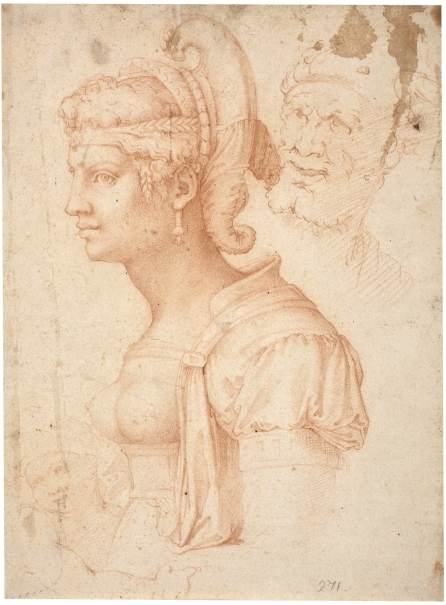
Idealized head of a woman, called Zenobia
XVI century. Red chalk on paper.Not on display
This is a copy of the famous drawing by Michelangelo –the so-called Zenobia- formerly in de Granducal collection and now in the Uffizi, Florence (inv. no. 598 E). Vasari records the Uffizi drawing among those made by Michelangelo for the young nobleman Giovanni Perini in c. 1525. The curious subject matter has prompted a number of interpretations: among them Venus, Mars and Cupid; Venus, Vulcan and Cupid; and Zenobia and her child turning from her royal husband. The Prado drawing repeats faithfully and attractively the modeling of Michelangelo´s original, dwelling especially on the rendition of the halftones of the head and shoulders of the woman, with her splendid coiffure and headdress.
Whereas Michelangelo´s original is in black chalk, the Prado copy is in red, as are two other copies of the Uffizi drawing, one in the Nationalmuseum Stockolm (inv. no. 158/1863); and the other in the Musées des Beaux-Arts, Rennes (inv. no. 794.1.2927). The style of the Prado copy seems to indicate the draftsman was Florentine: the handling is too tentative for Francesco Salviati (1510-1563), who made several replicas of drawings by Michelangelo, and as Paul Joannides has suggested, a more likely alternative seems to be Francesco Ubertini, called Bacchiacca, who is now believed by some to have drawn the Rennes copy. Bacchiacca was a repetitive artist, and it would have been quite characteristic of him to have made a series of copies of the same original.
Turner, Nicholas, From Michelangelo to Annibale Carracci. A century of Italian drawings from the Prado, Chicago, Art Services International, 2008, p.319