formularioRDF
The itinerary <em>TITULORECORRIDO</em> has been successfully created. Now you can add in works from the Collection browser
<em>TITULOOBRA</em> added to <em>TITULORECORRIDO</em> itinerary

Close Continuar a ficha de la obra Continuar a ficha de la obra
02-06-2026
Hyacinthe Rigaud

Perpignan (France), 1659 - Paris (France), 1743

See author's file

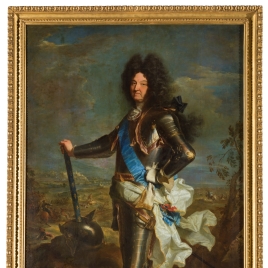
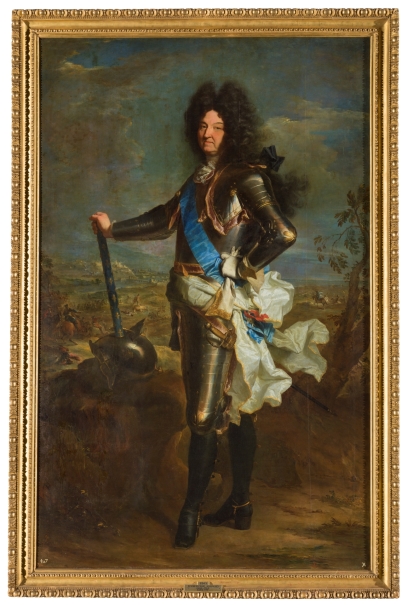
Louis XIV of France

1701. Oil on canvas.
Room 019

The absolute protagonist of this canvas is the Sun King, who governed France from 1643 to 1715. He was only five years old when he took the throne after the death of his father, Louis XIII, but the early years of his reign were under the regency of his mother, Queen Anne of Austria (1601-1666), who was the sister of Philip IV of Spain and of Cardinal Mazarino (1602-1661). The image is completely military and its intentionality is clearly political-dynastic. The monarch appears in a landscape with a battle in the background -the siege of Namur, painted by Joseph Parrocel (1646-1704)- that marks the last time the king led his armies. He wears French cavalry armor decorated with fleurs de lis of a type that was normal in the 17th century. His helmet rests on a stone on which he also rests one end of his command baton, which has the same decorations as his armor. He wears a general’s cummerbund and the sash of the Order of the Saint-Esprit across his chest, with the plaque hanging against his left side. This elaborately martial appearance does not stop him from wearing a high and dark wig of the sort then in vogue and his air of distinction combines a blasé self-confidence with an aura of majestic distance, all of which is reinforced by the authority conveyed by his gestures. He firmly grasps his command baton in his right hand while resting he left on his hip. This is one of a series of portraits of male members of the French royal family, including the Grand Dauphin, Louis; the Duke of Burgundy and the Duke of Berry, of which there are replicas in various collection. All of these figures appear armed and were painted by Rigaud, except for the last, which was by Nicolas de Largillièrre (1656-1746). They were probably conceived to emphasize the roles of the grandfather, father and brothers of the Duke of Anjou, the future Philip V, as defenders of his right to the Spanish throne in the internecine War of Succession (1701-1713). The origin of the present work’s commission is relatively complex. The French sovereign asked Rigaut to portray him in majesty, with all the symbols of his monarchical consecration, in a work to be sent to his grandson, Philip V. The latter was so pleased with its pompous composition that he requested a replica for himself, which he wanted to hang at Versailles. Over time, that likeness (now at the Musée du Louvre in Paris) has become the most popular image of Louis XIV. However, he may have reconsidered, reaching the conclusion that Philip V was as much a king as he, and that such a grandiloquent canvas steeped in royal spirit might not be appropriate for the court in Madrid. Therefore, because of their French arrogance, he did not send either canvas. Consequently, he ordered the present work, which is based on the earlier one, but clearly martial in its presentation. In fact, this painting was made by Rigaud with considerable participation by his workshop. The king’s face is attributed to him -this is immediately clear when studied under oblique light- while his assistants are thought to have painted the rest -armor, vegetation, landscape, clothing, etc.- notwithstanding a few final touches by the master to add special qualities to a few details. Certain researchers believe, with no documental basis, that this canvas was painted earlier, and that the signature may have been applied several years after its completion (Text drawn from Luna, J. J.: El arte del poder. La Real Armería y el retrato de corte, Museo Nacional del Prado, 2010, p. 252).

Technical data

Imagen del carrusel
Imagen del carrusel
Inventory number
P002343
Author
Hyacinthe Rigaud
Title
Louis XIV of France
Date
1701
Technique
Oil
Support
Canvas
Dimension
Width: 149 cm; Height: 238 cm
Provenance
Royal Collection (Collection of Felipe V, Royal Palace of La Granja de San Ildefonso, Segovia, 1727; La Granja Palace, 1746, n. 407; La Granja Palace, 1794, n. 407; La Granja Palace, 1814-1818, n. 407; La Granja, Pieza décima, 1827, nº 407)
Entry date
1827

Bibliography +

Inventario de Fernando VII, Real sitio de La Granja de San Ildefonso, Madrid, 1814, pp. 23.

Inventario de las Pinturas del Museo Hecho a la Muerte del Rey, Texto fotocopiado, Madrid, 1834, pp. 70.

Dussieux, Louis, Les artistes français a L'etranger, Lecogne Fils et Cie, París, 1876, pp. 382.

Mabilleau, Léopold, La peinture française au Musée de Madrid, Gazette des Beaux Arts, abril, 1895, pp. 305 y 415.

Lefort, P., Hymans, H., Lostalot, A., Mabilleau, L., Maindron, M., Les Musées de Madrid. Le Prado, San Fernando, L'Armeria, Gazette des Beaux Arts, Paris, 1896, pp. 183.

Sánchez Cantón, Francisco Javier, Salas de Pintura Francesa, Museo del Prado, Madrid, 1925, pp. 15.

Nicolle, Marcel, La peinture française au Musée du Prado, Perrin et Cie, París, 1925, pp. 40.

Réau, Louis, Histoire de l'expansion de l'art français: le monde latin: Italie, Espagne, Portugal, Roumanie, Amerique du sud, Bulletin Monumental, Henri Laurens, París, 1933, pp. 238.

Thieme, Ulrich; Becker, Felix, Allgemeines Lexikon der bildenden Kunstler von der Antike bis zur Gegenwart, W. Engelmann, Leipzig, 1934, pp. 350.

Bottineau, Yves, L'art de la cour dans l'Espagne de Philippe V: 1700-1746, Féret & fils, Burdeos, 1962, pp. 237.

Gaya Nuño, Juan Antonio, Historia y guía de los museos de España, Espasa Calpe, Madrid, 1968, pp. 412.

Lafuente Ferrari, Enrique, El Prado. Escuelas italiana y francesa, Aguilar, Madrid, 1970, pp. 318.

Sánchez Cantón, Francisco Javier, Museo del Prado. Catálogo de las pinturas, Museo del Prado, Madrid, 1972.

Benezit, E., Dictionnaire critique et documentaire des peintres, sculpteurs, dessinateurs et graveurs de tous les temps et de tous les pays, Librairie Gründ, París, 1976, pp. 762.

Luna, Juan J., Pintores y pinturas francesas de principio del XIX en España, II Congreso Español de Historia del Arte: Valladolid, 11-14 de octubre, Valladolid, 1978, pp. 186.

Museo Nacional del Prado, Catálogo de las pinturas, Museo del Prado, Madrid, 1985, pp. 560-561.

Fernández Miranda y Lozana, Fernando, Inventarios Reales. Carlos III. 1789-1790. Vol. I, Patrimonio Nacional, Madrid, 1988, pp. 32.

Museo Nacional del Prado, Museo del Prado. Inventario general de pinturas (I) La Colección Real, Museo del Prado, Espasa Calpe, Madrid, 1990.

Buendía, José Rogelio, El Prado. Colecciones de Pintura, Lunwerg Editores, Barcelona, 1994, pp. 510.

Bettagno, Alessandro, El Museo del Prado, Fonds Mercator Fundación Amigos del Museo del Prado, Madrid, 1996, pp. 549.

Posner, Donald, The genesis and political purposes of Rigaud's portraits of Louis XIV and Philip V, Gazette des Beaux Arts, 131/2, 1998, pp. 85/ lám.6.

El arte en la corte de Felipe V, Fundación Caja-Madrid, Patrimonio Nacional, Museo Nacional del Prado., Madrid, 2002, pp. 436.

Aterido Fernández, Ángel; Martínez Cuesta, Juan; Pérez Preciado, José Juan, Colecciones de pinturas de Felipe V e Isabel Farnesio. Inventarios Reales, II, Fundación de Apoyo de la Historia del Arte Hispánico, Madrid, 2004, pp. 455.

Louis XIV : l'homme et le roi, Skira Flammarion: Château de Versailles, 2009, pp. 204-395.

Luna, Juan José, Guerra y pintura en las colecciones del Museo del Prado. Siglo XVI a Goya, Arte en tiempos de guerra, Jornadas de Arte, Madrid, 2009.

El arte del poder. La Real Armería y el retrato de corte, Museo Nacional del Prado, Patrimonio Nacional, Madrid, 2010, pp. 252-253.

James-Sarazin, Ariane, Hyacinthe Rigaud, 1659-1743, vol I L'homme et son art, Éditions Faton,, Paris, 2016, pp. 128-135,146-163.

James-Sarazin, Ariane, Hyacinthe Rigaud, 1659-1743. Catalogue raisonné, II, Éditions Faton, Paris, 2016, pp. 262 P774.

Pérreau, S, 'Jean Ranc. Portrait de Louis XIV (Brunswick, Herzog Anton Ulrich Museum, Kunstmuseum des Lnades Niedersachsen)' En:, Jean Ranc: un montpelliérain à la cour des rois, Silvana Editoriale,, 2020, pp. [O.R] p.64-66 fig.2.

Other inventories +

Inv. Felipe V, La Granja, 1746. Núm. 407.
Un Retrato origl en Lienzo, de mano de Rigo, qe representa al sºr Rey Luis Decimo Quarto de Francia de Cuerpo entero, Armado, y con Bastòn en la mano, qe descansa sobre el Morrion tiene dos varas y tres quartas de alto; una, y tres de ancho. Marco dorado con Targetas à las Esquinas ... 1

Inv. Testamentaría Carlos III, La Granja, 1794. Núm. 407.
[2223] 407 / Otra [pintura] en lienzo de nuebe pies y medio de alto por seis de ancho marco dorado con talla en las esquinas: representa á Luis Decimo tercio Rey de Francia en seis mil reales. Rigó ... 6000

Inv. Fernando VII, La Granja, 1814-1818. Núm. 407.
{20188} 407 / Nueve pies y medio de alto seis de ancho, Luis XIII rey de Francia = Rigo

Inv. Real Museo, 1857. Núm. 986.
Rigaud (Jacinto) / 986. Retrato de Luis 14, en pie. / Esta el príncipe armado, con la cabeza descubierta, con banda azul y faja blanca. / Alto 8 pies, 6 pulg; ancho 5 pies, 4 pulg.

Catálogo Museo del Prado, 1873-1907. Núm. 2072.
2072.-(986-I.)-Retrato de Luis XIV, de pié en el campo, vestido con su arnés de guerra, la cabeza descubierta, y apoyando el baston de mando en el yelmo. Lleva faja blanca de pomposo lazo, y al pecho la banda de la órden del Sancti Spiritus.-Figura entera, de tamaño natural. Col. de Felipe V, Pal. de San Ildef., de donde vino para la formacion de este Museo en 1827.-F.L. / Alto 2,57; 1,49.-L.

Inscriptions +

Hyacinthus Rigaud pinxit 1701
Signed and dated. Front

407
Inscribed in white. Front, lower left corner

X
Cross of Burgundy or Cross of Saint Andrew, collection’s mark belonged to King Felipe V. Front, lower right corner

986
Inscribed in orange. Front, lower left corner

Exhibitions +

The Art of Power. The Royal Armoury and court portraiture
Madrid
09.03.2010 - 23.05.2010

Louis XIV. The Man and the King
Versailles
19.10.2009 - 07.02.2010

El arte en la corte de Felipe V
Madrid
30.10.2002 - 26.01.2003

Location +

Room 019 (On Display)

Expuesto

Displayed objects +

Armor: Luis XIV con armadura francesa de caballería, sembrada de flores de lis, siguiendo la tipología normal del siglo XVII, con el casco sobre una piedra, encima del cual también apoya el bastón de mando flordelisado (Luna, J. J. en: El arte del poder. La Real Armería y el retrato de corte, Museo Nacional del Prado, 2010, p. 252).
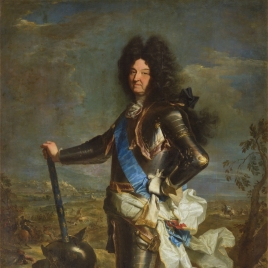
Insignia of the Order of the Holy Ghost: El blanco será el tradicional color de los Borbones que va a ir unido a la banda azul de la orden del Espíritu Santo que se ha convertido en la máxima distinción que puede otorgar la Corona francesa desde su creación por Enrique III el 31 de diciembre de 1578. En 1601 Enrique IV ordenó que el Delfín recibiría la cruz y el cordón de la Orden en el momento de su nacimiento, y en 1607 extendió este privilegio al resto de los Hijos de Francia, siendo recibidos formalmente en la Orden tras su primera comunión. Los Nietos de Francia eran hechos caballeros de la orden tras su primera comunión, y los Príncipes de la Sangre y los descendientes legitimados de la Casa de Borbón a los 15 años, mostrando así bien a las claras su carácter dinástico (Proyecto catalogación elementos heráldicos y falerísticos, Real Academia Matritense de Heráldica y Genealogía).

Baton, Command: Bastón de mando flordelisado.

Update date: 02-06-2026 | Registry created on 28-04-2015

Visor 360

Drag with the cursor to rotate the piece

Print on demand

Print artworks available in our catalogue in high quality and your preferred size and finish.

Image archive

Request artworks available in our catalogue in digital format.

Up