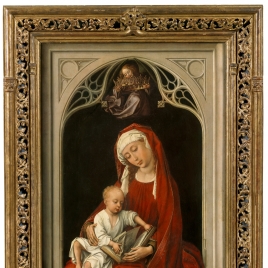
Bibliography +
Friedländer, Max J., Die altniederlandische malerei II: Rogier van der Weyden und the Meister of Flémalle, Paul Cassirer, Berlín, 1924, pp. 89 lám.137.
Sánchez de Rivera, Daniel, Las nuevas salas del legado Fernández Durán, Arte español, 10, 1930/31, pp. 180-181.
Hulin de Loo, Georges, Quelques oeuvres d'art inédites rencontrées en Espagne, Académie Royale de Belgique, Bulletins de la Classe des Beaux-Arts, 13, 1931, pp. 39-43 [42-43].
Schöne, Wolfgang, Über einige altniederländische Bilder, vor allem in Spanien, Jahrbuch der preussischen Kunstsammlungen, 58, 1937, pp. 153-181 [160-162].
Friedländer, Max J., Die altniederlandische malerei XIV: Pieter Bruegel und nachträge zu den früheren bänden, A.W.Sijthoff, Leiden, 1937, pp. 88-89 fg. XI.
Hulin de Loo, Georges, 'Weyden, Rogier de', Bibliographie Nationale de la Belgique, Bruselas, 1938, pp. 222-245 [241].
Noul, M., Sotomayor, F., Muguruza, P., Les chefs-d'oeuvre du Musée du Prado, Musée d'Art et d'Histoire, Ginebra, 1939, pp. 27.
Beenken, Hermann, Rogier van der Weyden und Jan Van Eyck, Pantheon, 25, 1940, pp. 129-137 [136].
Michel, Edouard, Roger van der Weyden, Plon, Paris, 1945, pp. 7.
Musper, Theodor, Untersuchngen zu Rogier van der Weyden und Jan van Eyck, Kohlhammer, Sttutgart, 1948, pp. 49.
Winkler, Friedrich, 'Rogier van der Weyden', 37, Wilhelm Engelmann, Leipzig, 1950, pp. 468-476 [472].
Beenken, Hermann, Rogier van der Weyden, Bruckmann, Munich, 1951, pp. 40.
Bruyn, J, Van Eyck Problemen, Haent Jens Dekker and Gumbert, Utrecht, 1957, pp. 5.
Birkmeyer, Karl M, The Arch Motif in Netherlandish painting of the Fifteenth Century: Part One, The Art bulletin, 43, 1961, pp. 1-20 [15 nº87].
Dohmann, Albrecht, Die Altniederlandische Malerei des Funfzehnten Jahrhunderts, E.A.Seemann BuchUnd Kunstverlag, Leipzig, 1964, pp. lám. 80.
Veronee-Verhaegen, Nicole, La Vierge et l'Enfant au coussin d'après Rogier van der Weyden, Bulletin des Musées Royaux des Beaux-Arts de Belgique = Bulletin van het Koninklijke Musea voor Schone Kunsten van België, 3, 1966, pp. 144-156 [154-155].
Huysmans, J.K., Trois primitifs: les Grünewald du Musée de Colmar Le Maître, Flammarion, Paris, 1967, pp. 162.
Friedländer, Max J., Early netherlandish painting II: Rogier Van der Weyden and the Master of Flémalle, Leyden, 1967, pp. 89 nº del suplemento 132, lám.137.
Koch, Robert, A., Copies of Roger van der Weyden's 'Madonna in Red', Record of the Art Museum Princeton University., XXVI, 1967, pp. 46-58 [47-49].
Coekelberghs, Denis, Grisailles et le trompel'oeil dans l' oeufvre de Van Eyck et Van der Weyden, Leuven University Press, Lovaina, 1970, pp. 29,30,32.
Vos, Dirk de, De Madonna-en-Kindtypologie bij Rogier van der Weyden en enkele minder geikende flemalleske voorlopers, Jahrbuch der Berliner Museen, 13, 1971, pp. 102,119-120.
Panofsky, Erwin, Early netherlandish painting: its origins and character T.I (Text) T.II (Plates), Icon Editions, Nueva York, 1971, pp. T.I: 259.
Sánchez Cantón, Francisco Javier, Museo del Prado. Catálogo de las pinturas, Museo del Prado, Madrid, 1972.
Davies, Martin, Rogier Van Der Weyden: an essay, with critical catalogue of painting assigned to him and to Robert Campin, Phaidon, Londres, 1972, pp. 226-227 L.2.
Kerber, Ottmar, Rogier van der Weyden: die frühen Werke, Giessener Beiträge zur Kunstgeschichte, 3, 1975, pp. 11-32 [23].
Blum, Shirley N., Symbolic Invention in the Art of Rogier van der Weyden, Konsthistorisck Tidskrift, 1977, pp. 103-122 [103].
Smolar-Meynart, A. Eeckhout,P. Deknop, A. et al., Rogier van der Weyden. Rogier de Le Pasture. Peintre officiel de la Ville de Bruxelles. Portraitiste de la Cour de Bourgogne / Officiële Schilder van de Stad Brussel.Portretschilder aan het Hof van Bourgondië, Crédit communale de Belgique, Bruselas, 1979, pp. 143-144 nº 7.
Campbell, Lorne, Van der Weyden, Harper & Row,, Nueva York, 1980, pp. 9, 42.
Bermejo, Elisa, La pintura de los primitivos flamencos en España I, C.S.I.C., Instituto Diego Velázquez, Madrid, 1980, pp. 112-114.
Courthion, Pierre, La Peinture Hollandaise et Flamande, Fernand Nathan, 1983, pp. 27.
Harbison, Craig, Realism and symbolism in early Flemish painting, The Art Bulletin, 66, 1984, pp. 595-596.
Silver, Larry, The Paintings of Quinten Massys: with catalogue raisonné, Phaidon, 1984, pp. 199.
Museo Nacional del Prado, Catálogo de las pinturas, Museo del Prado, Madrid, 1985, pp. 774.
Forsyth, W.H., A Fifteenth-Century Virgin and Child attributed to Claux de Werve, Metropolitan Museum journal, 21, 1986, pp. 41-63.
Delenda, Odile, Rogier van der Weyden - Roger de la Pasture, Éitions du cerf tricorne, Paris, 1987, pp. 45-46 lám.17.
Balis, A (dir.), La pintura flamenca en el Prado, Ibercaja Fonds Mercator, Amberes, 1989, pp. 34-35.
Klein, Dan, The History of Glass, Orbis, Zwolle, 1992, pp. 20-21,232-235.
Panofsky, Erwin, Les Primitifs Flamands, Hazan, Paris, 1992, pp. 457, 458 Lám. 326.
Asperen de Boer, J.R.J; Dijkstra,J.; Schoute, R.van, Underdrawing in Paintings of the Rogier van der Weyden and Master of Flémalle Groups, Waanders, Zwolle, 1992, pp. 20-21, 232-235.
Acres, Alfred J., Compositions of Time in the art of Rogier van der Weyden [tesis doctoral], Ann Arbor Pennsylvania University, 1992, pp. 213-231.
Campbell, Lorne, 'Rogier van der Weyden and his workshop', Lectures and memoirs 1993, Proceedings of he British Academy, 84, 1994, pp. 9 y 10.
Belting, Hans; Kruse, Christiane, Die Erfindung des Gemäldes: das erste Jahrhundert der niederländischen Malerei, Hirmer, Munich, 1994, pp. 84 nº87.
Les primitifs flamands et leur temps, La Renaissance du Livre, Belgique, 1994, pp. 130.
Museo Nacional del Prado, Museo del Prado. Inventario general de pinturas (III). Nuevas Adquisiciones. Museo Iconográfico. Tapices., Museo del Prado, Espasa Calpe, Madrid, 1996.
Martens, Didier, Le rayonnement européen de Rogier de la Pasture (vers 1400-1464) peintre de la Ville de Bruxelles, Annales de la Societé Royale d'Archéologie de Bruxelles, 61, 1996, pp. 9-78 [58-78 f.20].
Kemperdick, Stephan, Der Meister von Flémalle die Werkstatt Robert Campins und Rogier van der Weyden (Ars Nova, 2),, Brepols, Turnhout, 1997, pp. 47-48.
Panofsky, Erwin, Los primitivos flamencos, Ediciones Catedra, Madrid, 1998, pp. 256 Lám. 107.
Campbell, Lorne, The Fifteenth Century Netherlandish Schols. National Gallery catalogues, National Gallery Publications.Yale, Londres, 1998, pp. 392-406.
Martens, Didier, Metamorfosis hispánicas de una composición de Dieric Bouts, Goya, 262, 1998, pp. 4.
Châtelet, Albert, Rogier van der Weyden (Rogier de las Pasture), Gallimard; Electa, Paris; Milán, 1999, pp. 57.
Dhanes, Elisabeth Dijkstra, Jellie, Rogier de la Pasture Van der Weyden. Introduction a l' oeuvre. Relecture des sources, La Rennaissance du livre, Tournai, 1999, pp. 42 Lám. 29.
Châtelet, Albert, Rogier van der Weyden, problèmes de la vie et de l'oeuvre, Presses Universitaires, Estrasburgo, 1999, pp. 104-106.
Vos, Dirk de, Rogier Van Der Weyden: The complete works, Harry N. Abrams, New York, 1999, pp. 189-191 Lám. 116.
Silva Maroto, Pilar, Pintura flamenca de los siglos XV y XVI: guía, Museo del Prado, Aldeasa, Madrid, 2001, pp. 82-83.
Campbell, Lorne, Van der Weyden, Londres, 2004, pp. 50-51.
Benedicto García, Eugenio, El asesinato en 1465 de Jehuda Alitienz, de la judería de Huesca, Sefarad, 71, 2005, pp. 287--325.
Martens, Didier, Du Saint Luc peignant la Vierge à la copie des maîtres: la 'norme en acte' dans la peinture flamande des XV et XVI siècles, Revue belge d'archéologie et d'histoire de l'art, 74, 2005, pp. 3-49 [18-20].
Reynolds, Catherine, "Netherlandish Patterns in Fifteenth-Century Paris : Campin, van der Weyden and the Bedford Workshop". En: Von Kunst und Temperament : Festschrift für Eberhard König, Brepols, Turnhout, 2007, pp. 217-218.
Martens, Didier, Una huella de Rogier van der Weyden en la obra de Bernart de Aras, `pintor vecino de la ciudat de Huesca´, Archivo español de arte, LXXXI Enero-Marzo, 2008, pp. 1-16.
Caballero Escamilla, Sonia, Nouvelles recherches sur 'La Vierge à l' Enfant' de Petrus Christus conservé au Musée du Prado, Annales de la Societé Royale d'Archéologie de Bruxelles, 69, 2008, pp. 39-53 [42 f.2].
Martens, Didier, Un emprunt à Rogier de la Pasture dans l' oeuvre de Bernart de Aras' pintor vecino de la ciudat de Huesca', Annales de la Societé Royale d'Archéologie de Bruxelles, 69, 2008, pp. 16-37 [23-31 f.6].
Campbell, Lorne y Stock, Jan van der, Rogier van der Weyden 1400-1464 : master of passions, Waanders Uitgeverij: Davidsfonds, Zwolle, Lovaina, 2009, pp. 214-215,386-388.
Martens, Didier, La 'Lamentation aux figures aux paupières baissées' une oeuvre perdue de Rogier van der Weyden? En:, Rogier van der Weyden in context. Seventeenth Symposium for the study of underdrawing and technology in painting. Leuven 22-24 Oct. 2009, Paris-Leuven-Walpole,Ma, 2012, pp. 318-329.
Martens, Didier, Los primitivos flamencos y la recepción de sus propuestas en el Reino de Castilla, Boletín de la Institución Fernán González, 1, 2013, pp. 119-150 [123-142 f.1].
Zutter, E de, Perrin, M, Le triptique de la Vierge à l' enfant avec des anges musiciens, sainte Catherine et Sainte Barbe' a l' église de Jérusalem à Bruges, Institut royal du patrimoine artistique IRPA Koninklijk instituut voor het Kunstpatrimonium . Bruxelles, 34, 2013-2015, pp. 77-95 [81-82].
Alba, L. García-Máiquez, J. Gayo, M. D. Jover, M. Silva, P., Las prácticas artísticas de los pintores "hispanoflamencos" en la Corona de Castilla en el siglo XV, Boletín del Museo del Prado, XXXII, 2014, pp. 122-147 [124 f.1b].
Lacarra Ducay, Mª C., 'Las relaciones artísticas entre Aragón y Flandes durante la Baja Edad Media', Aragón y Flandes. Un encuentro artístico (siglos XV-XVII)., Universidad de Zaragoza, Zaragoza, 2015, pp. 40-65 [54].
Ruiz Quesada, F, 'Del Internacional al Ars Nova. Flandes y la pintura del arco mediterráneo de la Corona de Aragón en el siglo XV', Aragón y Flandes. Un encuentro artístico (siglos XV-XVII)., Universidad de Zaragoza, Zaragoza, 2015, pp. 78-99 [85].
Campbell, L. Pérez, J.J., 'Rogier van der Weyden. La Virgen con el Niño' En:, Rogier van der Weyden y los reinos de la Península Ibérica, Museo Nacional del Prado, Madrid, 2015, pp. 82-86 n.2.
Dimov, Alexandre, le modèle rogiérien de la Vierge a l'enfant dans une loggia et ses échos dans la peinture flammande de la fin du XV siècle, Annales d'histoire de l'art et d'archéologie, XL, 2018, pp. 69-102 [80].
Pérez Preciado, José Juan, 'Roger van der Weyden pictore nobilissimo', Editorial Planeta, 2022, pp. 159-180 [170].
Avril, François, 'Un tableau perdu de Fouquet et ses répliques enluminées', Art de l'enluminure, Décembre n.87, 2023, pp. 8-45 [36-38].
Pérez Preciado, José Juan, Fifteenth-century netherlandish painting at the Museo Nacional del Prado. Catalogue raisonné, Museo Nacional del Prado, Madrid, 2024, pp. 328-337 nº.42.
Pérez Preciado, José Juan, Pintura flamenca del siglo XV en el Museo Nacional del Prado. Catálogo razonado, Museo Nacional del Prado, Madrid, 2024, pp. 328-337 nº.42.