Pietro da (Pietro Berrettini) Cortona
Cortona, Tuscany (Italy), 1596 - Rome (Italy), 1669He was one of the decisive artists in the formulation of the Italian Baroque of the seventeenth century, both in architecture and painting, transcending to the European field in general. He was educated at a very early age in his native village, near Florence, with the painter Andrea Commodi, with whom he arrived in Rome in 1612. After also being a pupil of Baccio Ciarpi, he came into contact with the circles of antiquarians and dilettantes of the Eternal City, lovers of the ancient remains of the city. His studies focused on Raphael and Michelangelo, as well as the Carracci and the Venetian classics. It was in the aforementioned intellectual circles that he met the Sacchetti brothers, who from then on became his most important patrons and supporters, commissioning all kinds of works from him.
The fact that the enormously cultured and very rich brothers also came from Tuscany only brought them closer to the man who became their favorite painter. The election of another Tuscan as pope, Urban VIII Barberini, in 1623, would make Giulio Sacchetti a cardinal and his brother Marcello the papal treasurer. The latter would enjoy a privileged position as a taste definer of the pontifical court, so it didn't take long for Cortona to be promoted. His excellent genius would be exploited by the Pope's nephew and new Cardinal Francesco Barberini to decorate the ceiling of the great hall of the family's Roman palace, which would be the most significant and influential work of 17th century Roman painting. In the fresco of the "Triumph of Divine Providence", Cortona carried out a spectacular display of pictorial rhetoric in the service of the exaltation of the papal family. Thus the barriers between painting, sculpture and architecture were blurred, to the greater glory of Barberini hagiography. The composition, which displayed a complex iconographic program, became the key to later Baroque poetics, creating the most exalted path that would dialectically oppose the severe classicism of artists such as Andrea Sacchi or Nicolas Poussin.
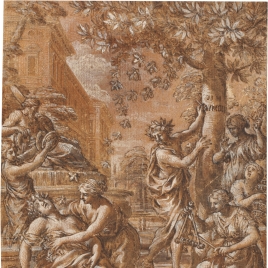
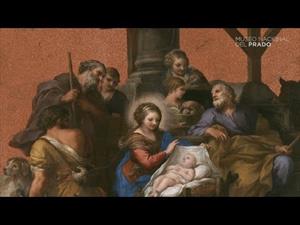
Cortona was requested by successive popes, as well as by the ducal court of Tuscany, where his decorations of the Pitti Palace enjoyed equally overwhelming success. It is also necessary to refer to his architectural work, since his labor in works such as the church of Santa Maria della Pace in Rome, served to initiate the motif of the curved facade that would later be used so fervently by Bernini and Borromini, creating an authentic theatrical scenario between square, church and façade. The Museo del Prado holds some interesting drawings by the Tuscan artist, most of them from the Fernández Durán bequest (1930). One of them is especially significant because it is an "Allegory of the Barberini House", in which you can distinguish his palace in the background, and which served as the basis for a series of engraved illustrations, published in 1633. The Prado collection also has a unique painting on venturine stone from Cortona's last period: a small and exquisite "Nativity" given by Cardinal Francesco Barberini to King Philip IV in 1659, luxuriously decorated for the occasion with a rich silver and lapis lazuli frame. It was a highly esteemed work at the Spanish court, being placed as a devotional painting in the oratory of the lower room of the Alcázar de Madrid (D. G. L. en Enciclopedia M.N.P., Madrid, 2006, Volume III, 855-857).