Matthias (also called Stomer) Stom
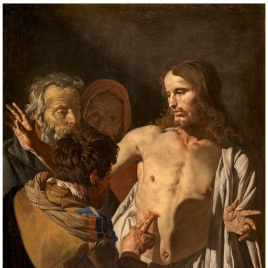
Amersfoort (Netherlands), h.1600 - Sicily (Italy), después.1650Little is known about this Dutch painter who settled in Italy. The earliest extant documentary reference to Stom is the parish family book from 1630 and 1631 in the Roman church of San Nicola in Arcione, where it is recorded that he was 30 years old and lived on the strada dell’Olmo. Therefore, his date of birth can be placed around 1600. Amersfoort has been his assumed place of birth, although documentation has yet to be found to confirm this information. His early works suggest that he received his training in Utrecht in the late-Mannerist tradition of Abraham Bloemaert (1564–1651) and Joachim Wtewael (around 1566–1638). More formative for him, however, was the influence of Gerard van Honthorst (1592–1656), who worked in the style of Caravaggio and returned to Utrecht in 1621 after spending more than ten years in Italy. It is precisely this influence that would characterise the style Stom worked in throughout his life. In Rome, he had the opportunity to study the great altar paintings of Van Honthorst as well as the major works of Caravaggio and his followers. In 1630 he moved to Messina, and around 1631 to Naples, where he remained until 1640 painting works for various churches.
He then moved to Sicily, probably prior to 1641, since Saint Isidore the Labourer, which he painted for the Caccamo Cathedral, is dated that year. His activity on the island is also documented by the paintings he made for the churches of Palermo, Messina and Monreale, as well as by three canvases acquired in 1648 by Rembrandt’s famous collector and patron, Antonio Ruffo, Duke of Messina. Payment receipts for the painting Assumption of the Virgin with three Saints for the church of Santa Maria Assunta, in Chiduno (Bergamo) dating from 1652 suggest that he may have possibly moved around 1650 to the north of Italy, at least temporarily. For this reason, it is worth noting that one of the members of a family of painters active in Venice and in the north of Italy at the end of the 17th century, specialising in navy battles, was called Mathäus Stom. After his death, he fell into oblivion and his paintings were attributed to others working in the style of Caravaggio, especially Van Honthorst. It was not until the beginning of the 20th century that the project of recovering them began (Posada Kubissa, T.: Pintura holandesa en el Museo Nacional del Prado. Catálogo razonado, 2009, p. 259).