Paul de Vos
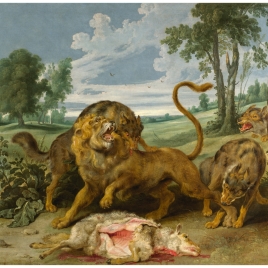
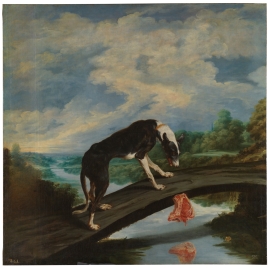
ca. 1596, 1678A Flemish painter and draughtsman, brother of Cornelis and Jan de Vos. Like his brothers, he studied with David Remeeus and achieved the rank of master around 1620. His first paintings were identical in subject matter and motifs to those of Frans Snyders, with whom he worked during his training. Nevertheless, throughout the course of his career, Paul de Vos specialised in hunting scenes, for which he developed innovations with several variations. Like Snyders, Paul de Vos also asked his brother Cornelis to execute the figures in his paintings. However, there are several aspects that distinguish him from Snyders. The colours employed are primarily warm (from yellows to browns), but lighter and paler. This technique is looser, so that the sharp contours and rich textures of Snyders disappear in his work in favour of a more atmospheric and blurred overall appearance. In the works of Paul de Vos, the drama and the tension are even greater because he selects quite violent hunting scenes in which animal fights are depicted in a bloody and ferocious manner. These scenes are very poignant, and their drama extends to the illustrations of fables in which animals are the protagonists. The anatomical representation of the animals is not as accomplished in paintings by Paul de Vos as in those by Snyders. This is particularly evident in the elongation of the figures of the dogs.
Paul de Vos often collaborated with other artists, the most significant of whom was Rubens. There are several cases of works by Rubens in which Paul de Vos painted some parts, usually the animals, as in Diana the Huntress (Museo del Prado). Rubens’s admiration for Paul de Vos led him to acquire eight paintings by the artist, which were among his possessions when he died in 1640. Other artists with whom he is associated include Thomas Willeboirts Bosschaert and Adriaen van Utrecht, with whom he collaborated on several commissions for Frederick Henry, Prince of Orange, in 1648. On other occasions, he worked with Erasmus Quellinus II, with whom he painted Rest on the Flight into Egypt (The State Hermitage Museum in Saint Petersburg). The decorative nature of his hunting scenes and the popularity of these depictions amongst the Flemish and Hispanic nobilities reveal that he was highly appreciated by collectors of the time. In the early 1630s, he produced more than 30 paintings for the Duke of Aarschot while he was in Madrid. These paintings flooded the Madrid market when the Duke passed away. The Marquess of Leganés had a great love for his paintings; he owned many works, as did other important collectors, including the Marquess of Carpio and the Duke of Salvatierra. King Philip IV himself appreciated his artwork, in light of the many paintings by De Vos that decorated the rooms of the main palaces in Madrid, including the Torre de la Parada. As a result of these commissions produced in the 1630s and the 1640s, the Museo del Prado holds the hunting and fable collection painted by Paul de Vos. His works are often part of inventories of painting collections during the 17th century. He is also known for his commercial success, given that the Emperor Maximilian received his works in 1689 through the merchant Gisbert van Colen (Pérez Preciado, J. J., E.M.N.P., 2006, tomo VI, pp. 2209-2210).