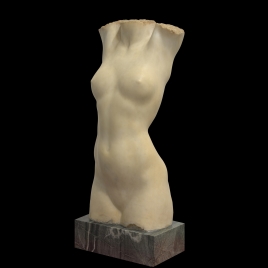
Mateo Inurria Lainosa
Córdoba (Spain), 25.03.1867 - Madrid (Spain), 21.02.1924He was born in Córdoba on March 25, 1867. His father, Mateo Inurria Uriarte, maintained a decorative sculpture workshop and also participated in exhibitions, such as the 1877 Scientific, Artistic and Industrial Exhibition organized by the Sociedad Económica Cordobesa de Amigos del País at the Circle de Amigos, where he was awarded first prize. His father’s work had a significant influence on his development as a sculptor, particularly in his use of marble, clay, and copper.
As a young man, he entered the Academy of Fine Arts in Córdoba and, in 1883, moved to Madrid to study at the Special School of Painting, Sculpture, and Engraving. In 1886, he received a grant to continue his studies in Madrid through the end of the decade. That same year, he created a modeled group of King Alfonso XII and his daughters, for which he was awarded a gold medal. Two years later, he won first prize at an exhibition held by the Ateneo de Córdoba, organized by the Friendship Circle.
In May 1890, he participated in the Scientific, Industrial, Artistic and Commercial Exhibition promoted by the Sociedad Económica del País at the Friendship Circle. That same year, he presented “Un náufrago” at the National Exhibition of Fine Arts. Although the work did not win a prize, it garnered significant public support. A special commission was formed to purchase the sculpture and donate it to the Provincial Museum of Fine Arts, an initiative that received coverage in the regional press. He participated in the 1892 Artistic, Industrial and Agricultural Exhibition at the Circle, and the following year in both the Universal Exhibition in Chicago and the International Fine Arts Exhibition in Vienna. At the 1895 National Exhibition of Fine Arts, he was awarded a second-class medal for “Lucio Anneo Séneca” (E000587).
By 1896, he had become Professor of Modeling and Drawing and interim Director of the Municipal School of Arts and Crafts. In 1897, he served as a jury member for sculpture at the National Exhibition and was also named full member of the Córdoba Academy. In 1899, he exhibited “La mina de carbón”, winning a first-class medal in the Sculpture and Engraving section. He continued to serve on the jury for subsequent National Exhibitions, including in 1901 (with “Retrato” and “Un gitano”), 1904, 1910 (with “Mujer”), and 1922.
As a restorer, he was involved for over twenty years in the conservation of the Mosque–Cathedral of Córdoba, as well as in projects at the Town Hall of Villa del Río, the Church of San Pablo, and the archaeological site of Medina Azahara.
When the Association of Cordoban Writers and Artists was founded, Mateo Inurria served as president of the visual arts division. In 1901, he was appointed Royal Commissioner of Fine Arts, a post he held until 1908.
At the end of 1900, Inurria decorated the library of the Friendship Circle of Córdoba and became a member of the institution in April of that year. He was also commissioned to decorate other rooms, such as the Sala de los Sentidos. The library, inaugurated in January 1901, was described in El Defensor de Córdoba as follows: “It successfully combines the purest Renaissance style with the finest modernist comfort, brimming with luxury and elegance.”
By 1902, he was interim Professor of Modeling and Casting for Elementary Fine Arts Instruction at the General and Technical Institute of the Higher School of Industrial Arts of Córdoba, and a board member of the Excursion Society. In 1911, he was appointed Professor of Modeling and Casting at the School of Arts and Crafts in Madrid.
In 1915, he attended a tribute at the Ritz Hotel in Madrid in connection with that year’s National Exhibition of Fine Arts, where he presented five works, including “Retrato de Conchita Montoya” (E001008). Although he did not receive an award, he was honored at a celebratory event at the Circle’s cloister, with a banquet, poetic tributes, and public acclaim “in recognition of the achievements attained at the current Fine Arts Exhibition."
In 1920, he participated in the National Exhibition with four works, including “Forma” (E000817), ultimately receiving the Medal of Honor. In March of that same year, he became a full member of the Royal Academy of Fine Arts of San Fernando.
He passed away on February 21, 1924, at the age of 56.