formularioRDF
The itinerary <em>TITULORECORRIDO</em> has been successfully created. Now you can add in works from the Collection browser
<em>TITULOOBRA</em> added to <em>TITULORECORRIDO</em> itinerary

Metabuscador

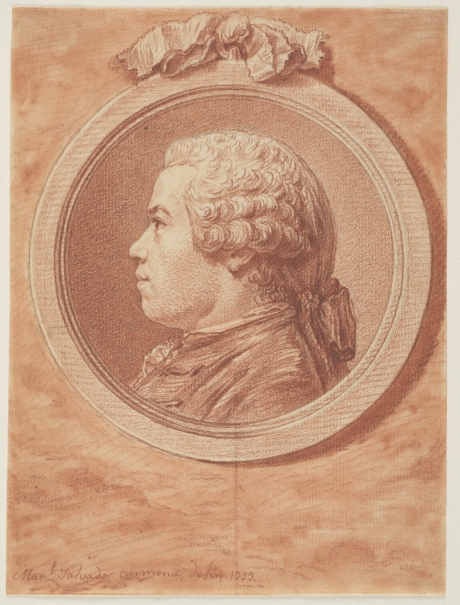
Self-portrait
Pencil ground, Red chalk on laid paper. 1759
Este dibujo es preliminar para la estampa grabada por el propio Carmona en 1761 en la que se representa junto a los otros pensionados de la Academia de San Fernando como Tomás López, Alfonso Cruzado y Juan de la Cruz (Biblioteca Nacional, IH/8433/2). Este dibujo solo era conocido por la litografía que lo reproducía. incluida como ilustración en el artículo de Valentín Carderera dedicado a Carmona en cuyo pie dice “Facsimile del retrato dibujado por el mismo en 1759. De la Colección del Sr. Valen
ARTWORK
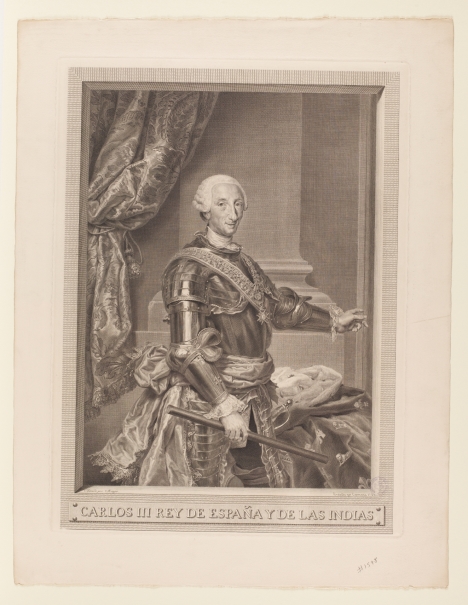
Charles III
Taille douce: etching and engraving on continuous paper. 1783
Estampa grabada por Manuel Salvador Carmona que reproduce el óleo pintado por Antón Raphael Mengs, conservado en el Museo Nacional del Prado (P02200). La lámina de cobre se la encargó a Carmona la Secretaría de Estado en 1782. Fue adquirida en 1875 por la Calcografía Nacional de Madrid, donde se conserva en la actualidad (R. 3796). El Museo conserva otros ejemplares de esta estampa (G02889, G02990 y G5922/93).
ARTWORK
Manuel Salvador Carmona – Engraver – (Author of the original work: Anton Raphael Mengs)
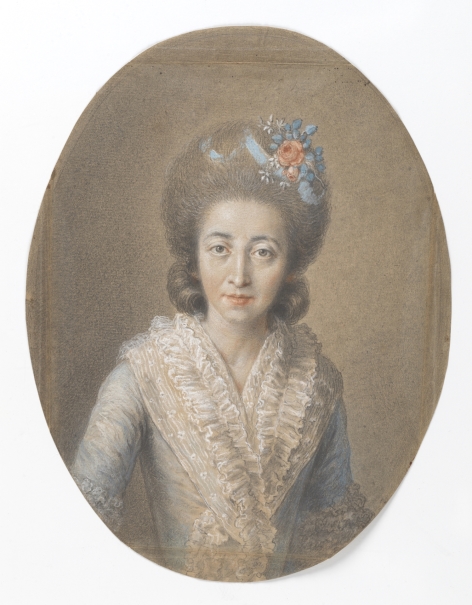
Portrait of Ana Maria Mengs
Black chalk, White chalk, Red chalk, Pastel on laid paper. 1778 - 1792
Retrato de Ana María Teresa Mengs que permite por primera vez identificar con certeza su verdadera efigie, hasta ahora objeto de equívocos en la bibliografía. Coincide con la reproducción sumaria del mismo que aparece en el Autorretrato dibujado para ser grabado por Salvador Carmona hacia 1784, dibujo en el que aparece también su primera esposa (Colección Fernando Carderera, Madrid). Como su padre, Anton Raphael Mengs (D7452), posee una nariz alargada y esbelta, así como ojos caídos y ligerament
ARTWORK
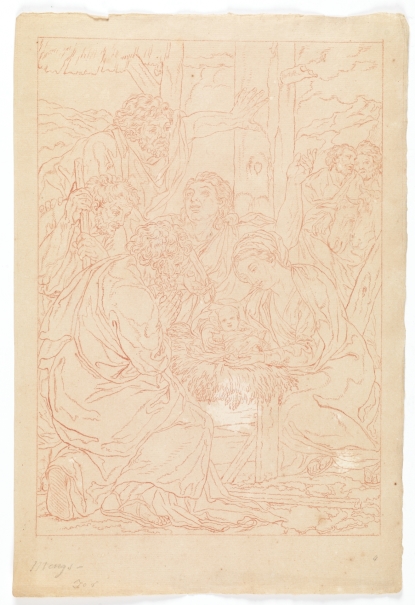
The Adoration of the Shepherds
Red chalk on laid paper. 1786
Los dibujos desempeñan una parte ineludible en el proceso de creación del grabado en la España ilustrada. Para obtener una estampa, el resultado final de un complejo proceso creativo y técnico, los grabadores se sirvieron del dibujo en distintos momentos de acuerdo con las necesidades específicas del trabajo. Ya sea como modelo, copia, medio de reducción, transferencia o verificación, los dibujos fueron empleados por los artistas para configurar unas imágenes que posteriormente eran grabadas en
ARTWORK
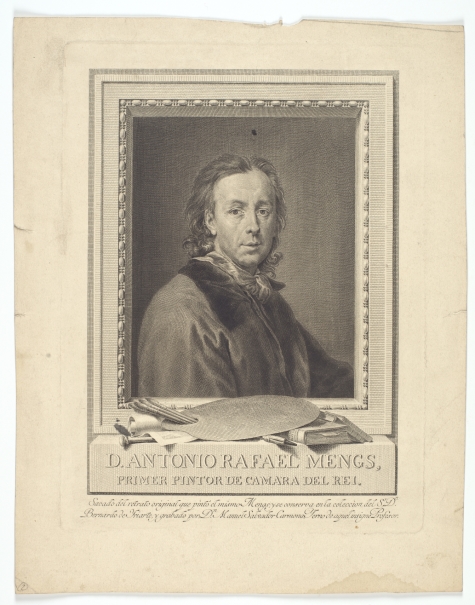
Portrait of Anton Raphael Mengs
Taille douce: etching and engraving on wove paper. 1780
Retrato del pintor Anton Rafael Mengs (1728-1779), en el que se representa su busto, de tres cuartos, mirando de frente al espectador en un marco como retrato pintado. Ante él, los atributos de la Pintura: paleta, libros, rollo de dibujos y carboncillo. La estampa fue grabada por Salvador Carmona para la publicación de Azara “Obras de Antonio Rafael Mengs” en 1780, aunque después se siguieron comercializando el libro y ejemplares sueltos del retrato (G002808). Esta estampa reproduce un dibujo, c
ARTWORK
Manuel Salvador Carmona – Engraver – (Author of the original work: Anton Raphael Mengs)
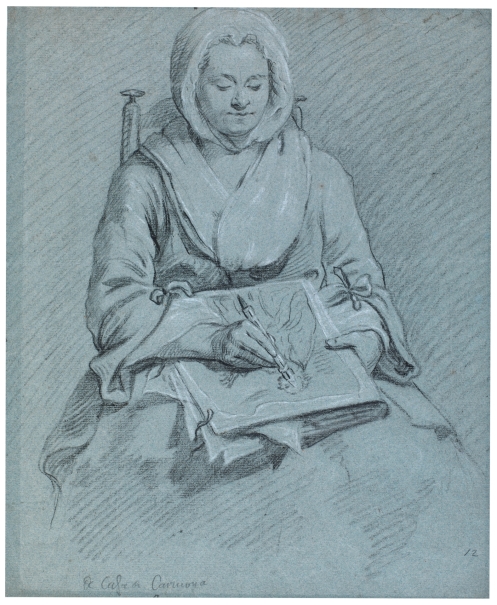
Woman drawing
White chalk, Black chalk on blue laid paper. 1778 - 1792
Manuel Salvador Carmona was the most important academic engraver in 18th-century Spain. In addition to impressions of his prints, the Museo del Prado also has a large group of his drawings, including preparatory studies for prints, life studies and portraits of his family and friends. The latter include this exceptional portrait of his wife, the painter Anna Maria Mengs (1751-1792). Depictions of women drawing are uncommon in Spain and this example is considered unique within the context of 18th
ARTWORK
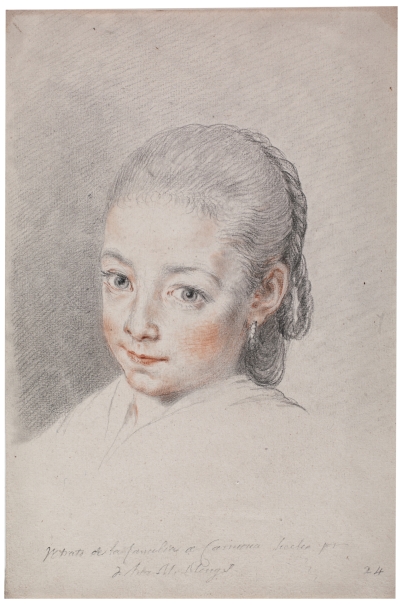
Study of a Girl’s Head
Black chalk, Red chalk on laid paper. Ca. 1790
The inscription, which was probably written by the drawing’s first owner, Valentín Carderera, reads: "Portrait of the Carmona family by D. Ana M. Mengs". This is the most convincing attribution, although other drawings in a similar technique are known by Anna’s husband, the engraver Manuel Salvador Carmona. The young girl could be one of the couple’s children. The daughter of the Neo-classical painter Anton Raphael Mengs, Anna Maria achieved great renown for her miniatures and pastel draw
ARTWORK
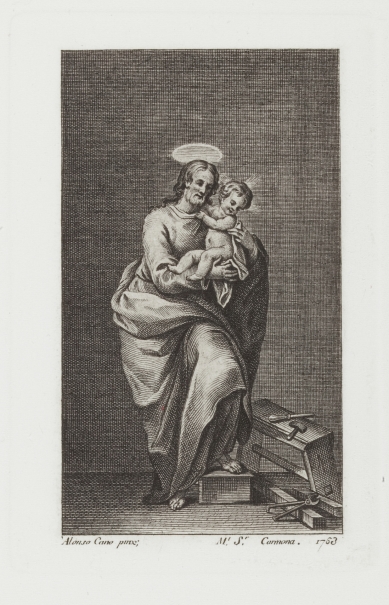
Saint Joseph and the Infant Jesus
Taille douce: etching and engraving on wove paper. 1763
Iconographic representations of Saint Joseph mostly show him accompanied by the Infant Jesus, as in the monumental sculpture by Alonso Cano in the Museo de Bellas Artes in Granada. Usually appears in paintings with his carpentry tools as distinguishing features, as the multifaceted Cano had portrayed him. The fortunes of Cano’s painted composition, there is evidence of how it continued to enjoy influence over time. In 1763 Manuel Salvador Carmona (1734–1820) depicted the same subject in a copper
ARTWORK
Manuel Salvador Carmona – Engraver – (Author of the original work: Alonso Cano)
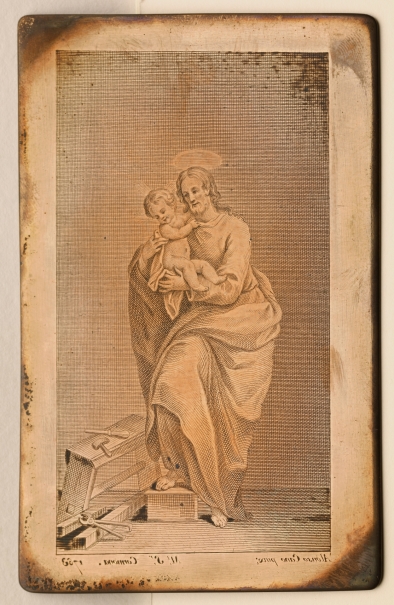
Saint Joseph and the Infant Jesus
Taille douce: etching and engraving on copperplate. 1763
Iconographic representations of Saint Joseph mostly show him accompanied by the Infant Jesus, as in the monumental sculpture by Alonso Cano in the Museo de Bellas Artes in Granada. Usually appears in paintings with his carpentry tools as distinguishing features, as the multifaceted Cano had portrayed him. The fortunes of Cano’s painted composition, there is evidence of how it continued to enjoy influence over time. In 1763 Manuel Salvador Carmona (1734–1820) depicted the same subject in a copper
ARTWORK
Manuel Salvador Carmona – Engraver – (Author of the original work: Alonso Cano)
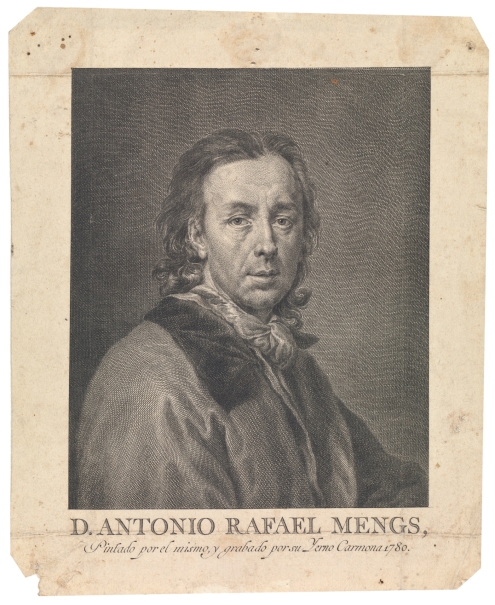
Portrait of Anton Raphael Mengs
Taille douce: etching and engraving on laid paper. 1780
La figura del pintor Anton Rafael Mengs (1728-1779) está estrechamente relacionada con los principios del Neoclasicismo. Mengs fue capaz de captar en su Autorretrato, fechado hacia 1761-65, que se conserva en el Museo del Prado (P002197), «su extraordinaria consciencia de sí mismo» en un momento en que «ya había alcanzado la fama de los artistas más célebres del pasado». Su propia hija, Ana María, realizó dos reproducciones al pastel en las que la expresión del efigiado se hizo más afable. Lo mi
ARTWORK
Manuel Salvador Carmona – Engraver – (Author of the original work: Anton Raphael Mengs)
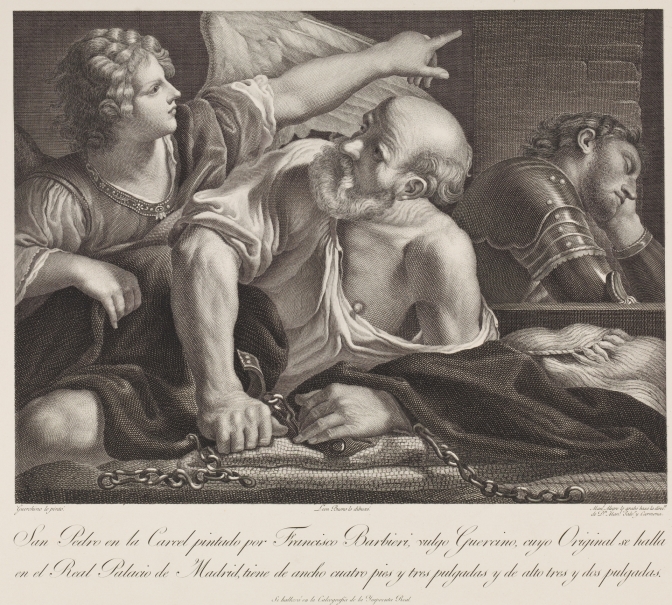
Saint Peter freed by an Angel
Taille douce: etching and engraving on continuous paper. 1793
This print is part of a series published by the Company for the engraving of paintings from the Royal Palaces, although it was only published after that institution was no longer active. The Company for the engraving of the paintings from the Royal Palaces was one of the Spanish Enlightenment’s major undertakings during the second half of the 18th century. It supervised the reproduction of prints of paintings from the Royal Collections and its early projects were carried out by Francisco de Goya
ARTWORK
Manuel Alegre – Engraver – (Author of the original work: Guercino (Giovanni Francesco Barbieri))
León Bueno – Drafstman
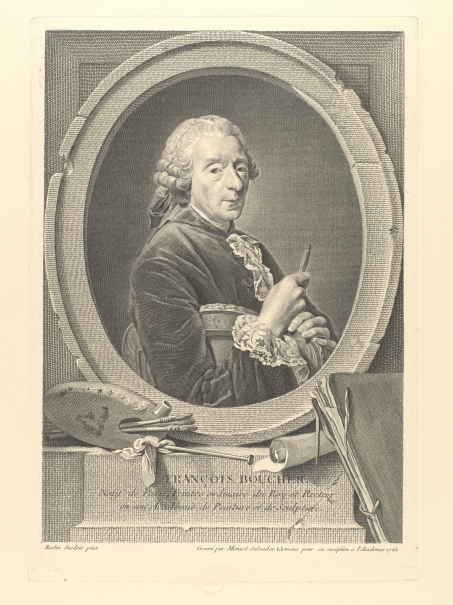
Portrait of François Boucher
Taille douce: etching and engraving on continuous paper. 1761
La estampa, grabada por Manuel Salvador Carmona, reproduce el retrato de François Boucher pintado por Alexander Roslin en 1760 conservado en el palacio de Versalles (Musée national des châteaux de Versailles et de Trianon (MV 4485 ; INV 7714 ; LP 4663). La grabó para ser admitido como académico en la Academie Royale de Peinture et de Sculpture de París en 1761 junto a otra estampa con el retrato del pintor Hyacinthe Collin de Vermont también conservada en el Museo Nacional del Prado (G02692). El
ARTWORK
Manuel Salvador Carmona – Engraver – (Author of the original work: François Boucher)
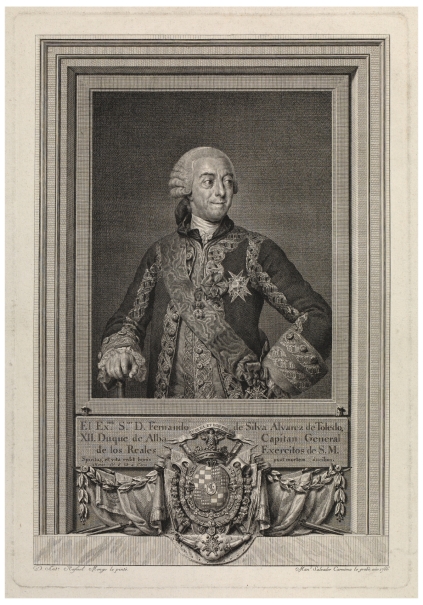
Portrait of Fernando de Silva Álvarez de Toledo, XII Duke of Alba
Taille douce: etching and engraving on laid paper. 1786
La estampa, grabada por Manuel Salvador Carmona, reproduce el retrato de Fernando de Silva Álvarez de Toledo pintado por Antón Raphael Mengs conservado en el Palacio de Liria, Madrid. (n. 263). El Museo Cerralbo de Madrid conserva una primera versión inacabada (00754). El Museo Nacional del Prado conserva tres ejemplares más de esta estampa: G00218, G02991 y G03299.
ARTWORK
Manuel Salvador Carmona – Engraver – (Author of the original work: Anton Raphael Mengs)
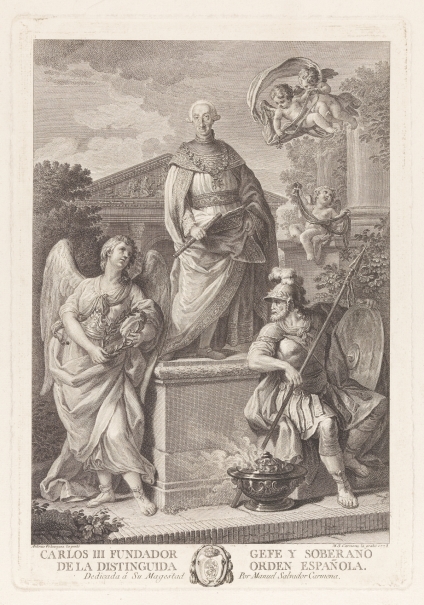
Allegory of the Foundation of the Order of Charles III
Taille douce: etching and engraving on wove paper. 1778
The print is based on a painting by Antonio González Velázquez. Charles III wears the habit of a master of his own Order, and is accompanied by the allegories of Merit and Virtue. Devout and family-minded, the monarch created the Order to give thanks to the Immaculate Conception for the birth of his grandson.
ARTWORK
Manuel Salvador Carmona – Engraver – (Author of the original work: Antonio González Velázquez)
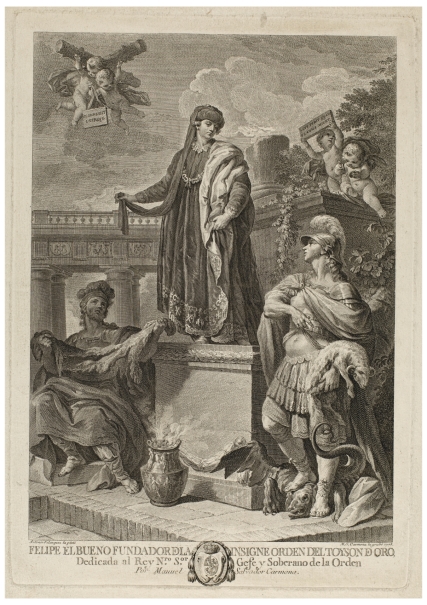
Philip III the Good personifying The Order of The Golden Fleece
Taille douce: etching and engraving on wove paper. 1778
Estampa grabada por Manuel Salvador Carmona que representa la alegoría de la fundación de la Orden del Toisón de Oro por Felipe "el Bueno", duque de Borgoña, pintada por Antonio González Velázquez cuyo óleo se conserva en el Museo Cerralbo, Madrid (n. 4620). El dibujo preparatorio para grabar se custodia en la Biblioteca Nacional de Madrid (DIB/14/2/125). El Museo Nacional del Prado conserva otro ejemplar también de la colección Cervelló (G02586).
ARTWORK
Manuel Salvador Carmona – Drafstman – (Author of the original work: Antonio González Velázquez; Author of the original work: Antonio González Velázquez)
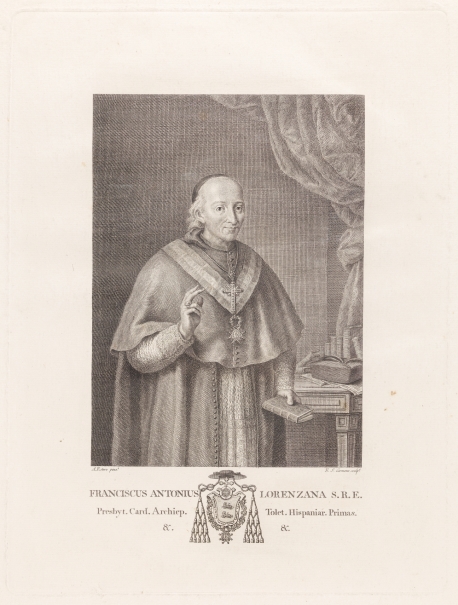
Francisco Antonio de Lorenzana, Archbishop of Toledo
Taille douce: etching and engraving on laid paper. 1800
This is a portrait of Francisco Antonio Lorenzana, Archbishop of Toledo, engraved by Manuel Salvador Carmona in 1800. It was included in the Missale Gothicum secundum regulam Beati Isidori Hispalensis Episcopi printed in Rome by Antonio Fulgoni in 1804. It reproduces Agustín Esteve’s painting (currently in the Count of Finat’s collection in Madrid) with slight additions. It served as a model for many copies either directly or indirectly, such as for the oil painting by Matías Moren
ARTWORK
Manuel Salvador Carmona – Engraver – (Author of the original work: Agustín Esteve)
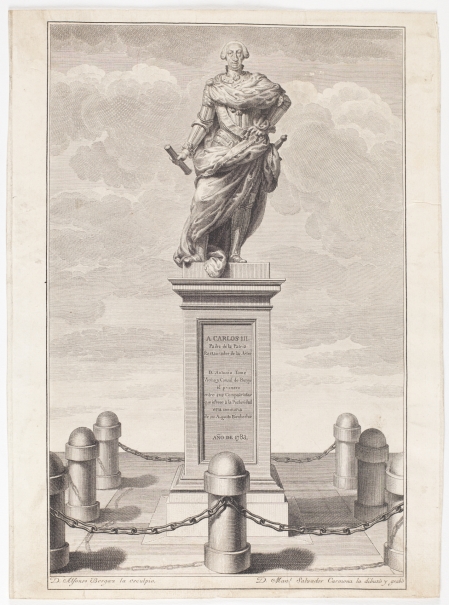
Statue of Charles III
Taille douce: etching and engraving on wove paper. 1784
This print reproduces Alfonso Bergaz’s sculpture of Charles III, which was installed on a large pedestal in the main square in Burgos in 1784 on the initiative of Antonio Tomé, a wealthy merchant and the city’s consul. In addition to the monarch’s regal, military presentation, which evokes classical art, the face is notably realistic and has a liveliness singled out at the time as the sculpture’s finest feature.
ARTWORK
Manuel Salvador Carmona – Engraver and drawer – (Author of the original work: Alfonso Bergaz)
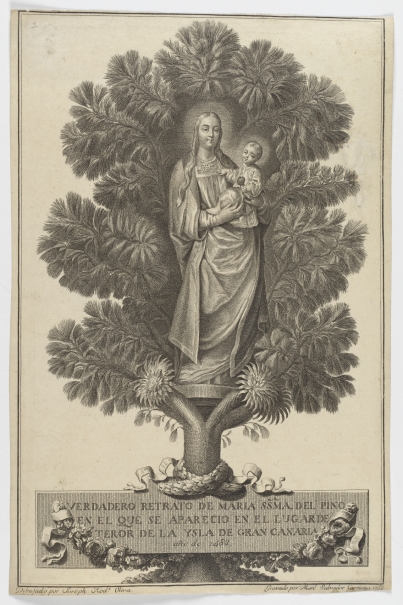
Virgin of the Pine
Taille douce: etching and engraving on laid paper. 1768
The list of Marian dedications with arboreal connections is endless, and their representations were very successfully disseminated through prints. Some images were reported as having appeared inside trunks. Others appeared on trees. Examples range from the Virgin of the Pine in the Canary Islands to the Virgin of Peace in Alcobendas, discovered on a fig tree, to mention just a few. It was as if the material itself expressed an inner connection with what was represented, as in primitive pantheist
ARTWORK
Manuel Salvador Carmona – Engraver – (Author of the original work: Jorge Fernández)
Loading...

Loading...

Up