formularioRDF
The itinerary <em>TITULORECORRIDO</em> has been successfully created. Now you can add in works from the Collection browser
<em>TITULOOBRA</em> added to <em>TITULORECORRIDO</em> itinerary

Exhibition

El Greco at Illescas

Museo Nacional del Prado. Madrid 10/20/2020 - 6/27/2021

Thanks to a refurbishing, the Museo Nacional del Prado is able to play host to the five El Greco paintings normally kept at the Shrine of Nuestra Señora de la Caridad in Illescas, Toledo.

The Prado, with the support of FUNCAVE (Fundación Hospital – Ntra. Sra. de la Caridad – Memoria Benéfica de Vega), the sponsorship of Fundación Amigos del Museo del Prado and the partnership of the Regional Government of Madrid, is thus able to offer its visitors a rare chance to admire the fundamental set of works which El Greco painted for that shrine between 1600 and 1605. These will be on display in Room 9 B until 27 June 2021, along with the canvases from the main altarpiece of the College of Doña María de Aragón (1597/1600) held at the Prado.

This is a remarkable opportunity to compare and contrast two seminal groups of works from the painter’s late period, characterised by a total disregard for spatial conventions, elongated, flame-like models captured using increasingly loose, vibrant brushwork, a limited palette and lightning-flash illumination.


Access

Room 9B . Villanueva Building

RDF

RDF

Sponsored by:
With the collaboration of:
Supported by:

Exhibition

The exhibition

El Greco painted these five extraordinarily fine works for one of the most prominent religious centres in the province of Toledo: the Hospital de Misericordia y Beneficencia in Illescas, called Hospital de Caridad, which was home to a small yet widely revered Marian image (Virgen de la Caridad or Our Lady of Charity). The hospital complex, built at the order of Cardinal Cisneros in 1500 as a centre of Christian charity and mercy, included a shrine to minister to the needs of the townspeople of Illescas and the pilgrims who visited it.

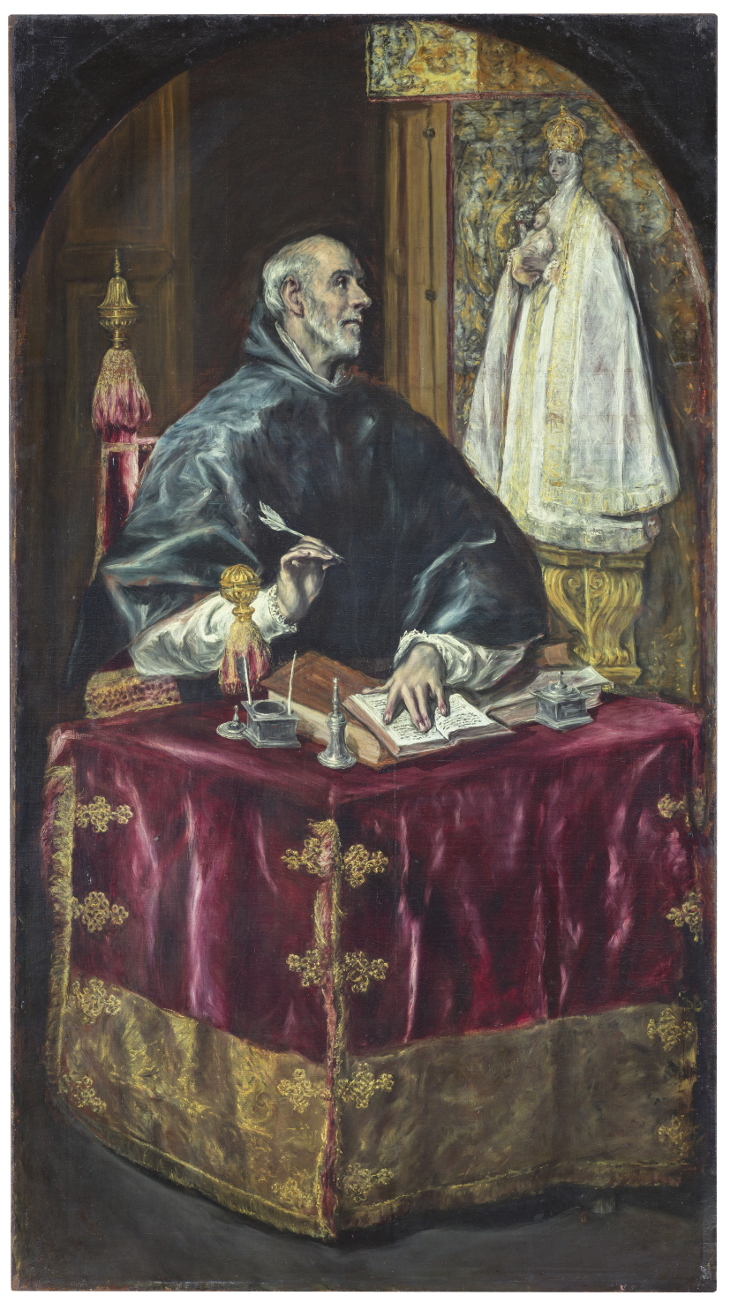
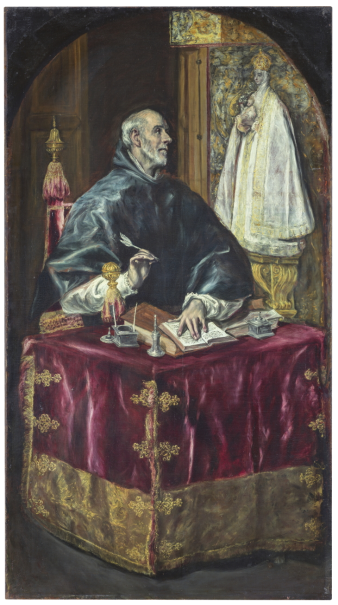
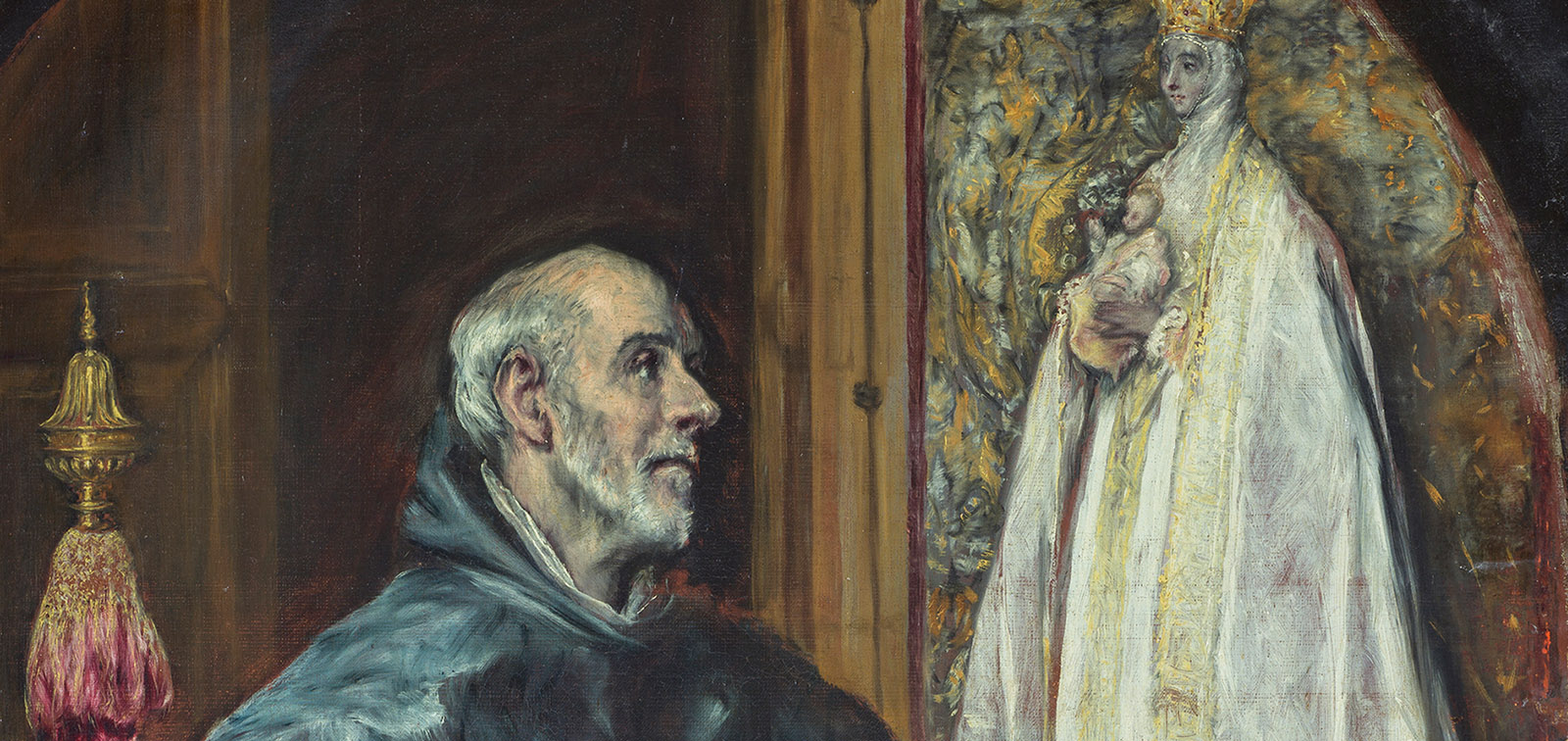
The first of El Greco’s canvases for the Shrine of Nuestra Señora de la Caridad depicts Saint Ildephonsus. The Cretan artist opted for a novel representation of the saint in this composition, a warm, poignant portrait that shows him seated at his desk and writing a text inspired by the image of Our Lady of Charity. The contemporary features, clothing and setting tell us that El Greco situated the subject in his own time, around the year 1600. Three years later, El Greco and his son Jorge Manuel received the commission to decorate the main chapel of the hospital church, which housed the aforementioned carving of the Madonna. They produced four canvases of different sizes and formats, designed to glorify the Virgin, which would be placed at the top of that chapel. These canvases were made shortly after El Greco completed his only known commission in Madrid, the altarpiece for the College of Doña María de Aragón (1597–1600). The Prado owns five canvases from that altarpiece, a project which, along with the Illescas paintings, introduced what would be El Greco’s final style. In mid-1603, El Greco reached an agreement with the archdiocese of Toledo to create the main altarpiece of the hospital church, a building completed not long afterwards to provide a worthy home for Our Lady of Charity, a fervently venerated image with a reputation for working miracles.

Saint Ildephonsus

<em>Saint Ildephonsus</em>
Saint Ildephonsus
El Greco
Oil on canvas. C.1600

Ildephonsus, bishop of Toledo from 657 to 667, was one of that city’s most venerated and frequently depicted saints. He authored a treatise in defence of Mary’s virginity and was also purportedly the owner of the carving of Our Lady of Charity. Both details are reflected in this original work, which El Greco painted as a relatable, palpable scene set in his own era. The flowing, richly nuanced brushwork and limited colour scheme make it one of El Greco’s most refined paintings from this period of his career.

Our Lady of Charity

El Greco revived a medieval iconography to portray the Virgin Mary as protector of the faithful, represented by six gentlemen dressed in contemporary fashion. The one on the right has been identified as Jorge Manuel, the painter’s son and co-author of the commission, who may have had a hand in making this more schematic painting. The hospital administrators were critical of these figures, which they deemed inappropriate. In 1902, the canvas was enlarged and moved to one of the side altars.

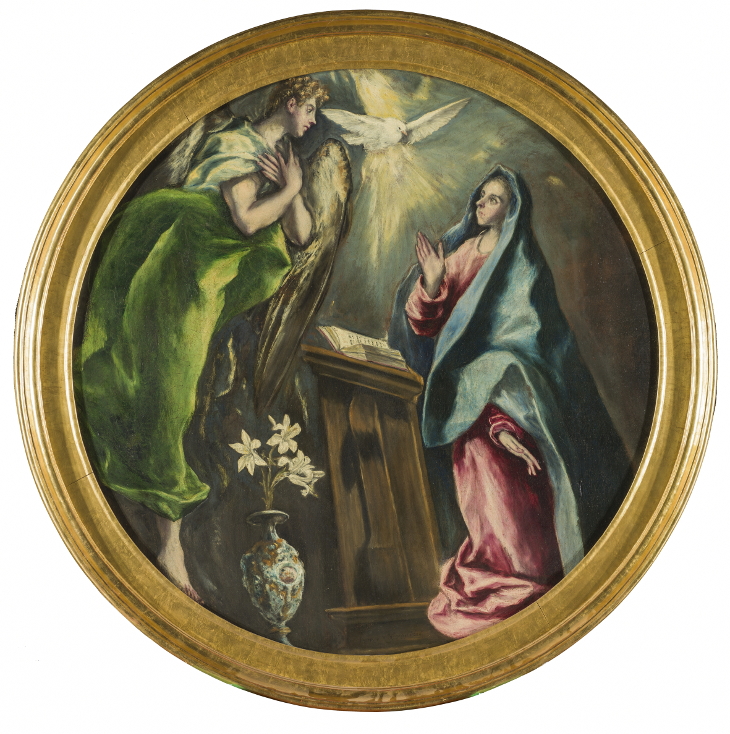
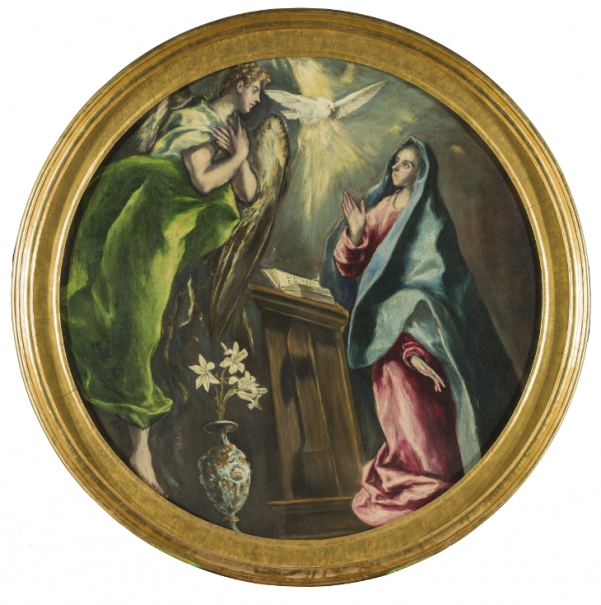
The Annunciation

<em>The Annunciation</em>
The Annunciation
El Greco
Oil on canvas. 1603–05

The archangel Gabriel has just burst into Mary’s room, and we see her humbly accepting that she will be the mother of the Son of God, in the presence of the Holy Spirit embodied as a white dove. The perfectly legible hand and arm gestures, the human models and the painting style all continue what El Greco had begun with the Doña María de Aragón altarpiece now in the Prado. However, the usual cherubs are missing, and the only props are the lectern and the vase with lilies, symbols of Mary’s virginity.

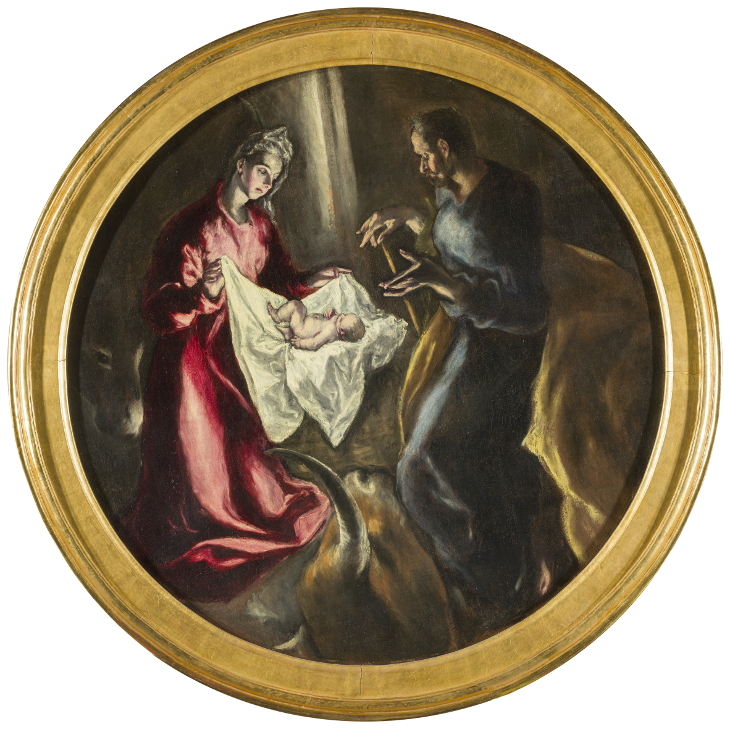
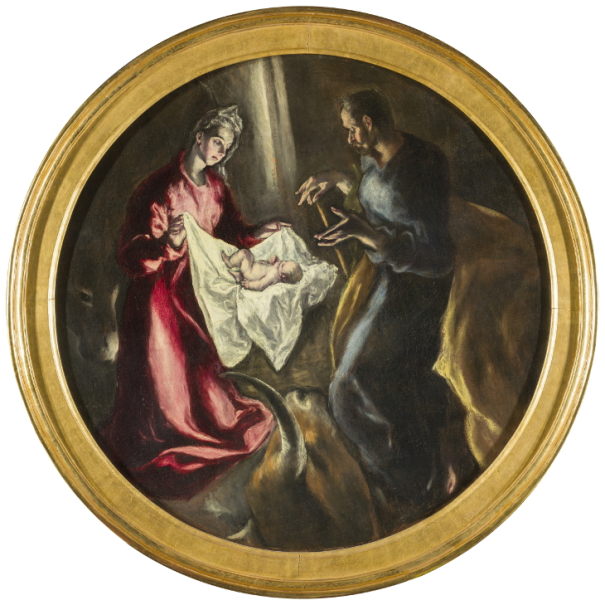
The Nativity

<em>The Nativity</em>
The Nativity
El Greco
Oil on canvas. 1603–05

El Greco adjusted the figures of the Virgin and Saint Joseph to fit inside the circular canvas, intended to be viewed in the Epistle aisle, on the right when facing the main chapel. The format and height at which the work was designed to be seen explain the sinuous arrangement of the human forms. El Greco set the scene in a poetic nocturnal atmosphere, making the Christ Child a source of radiant light. He also painted the ass, whose head is visible behind Mary, and the dramatically foreshortened head of the ox in the foreground.

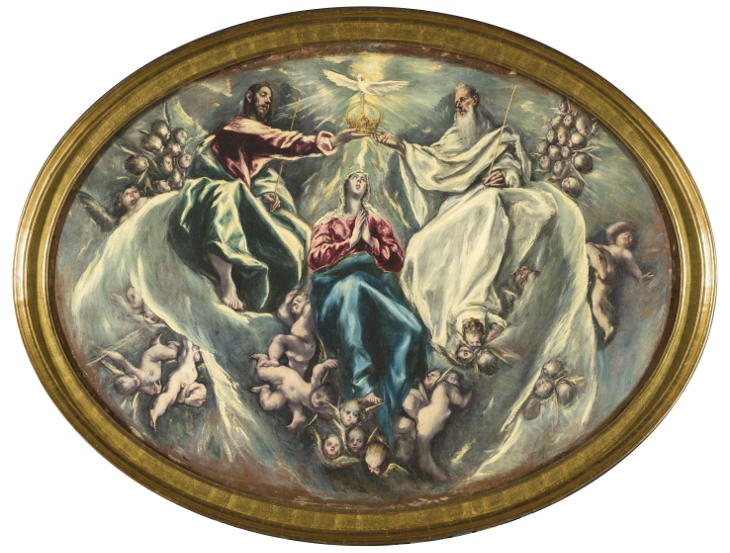
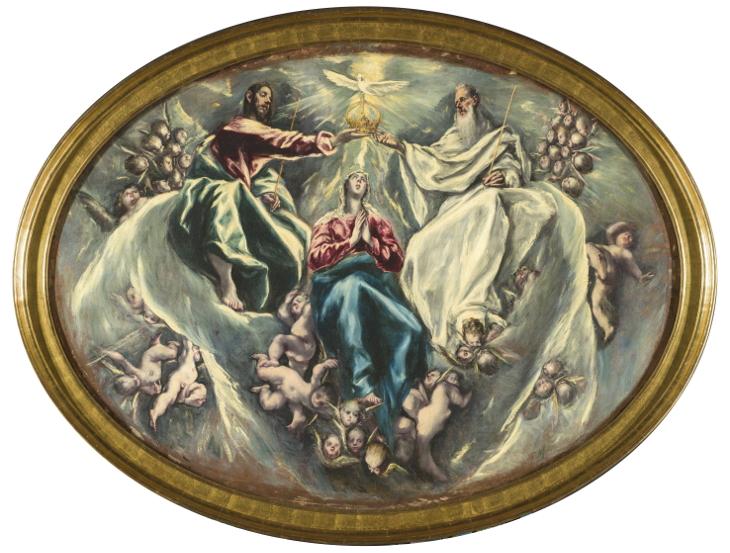
The Coronation of the Virgin

<em>The Coronation of the Virgin</em>
The Coronation of the Virgin
El Greco
Oil on canvas. 1603–05

El Greco depicted the enthronement of Mary—her ultimate triumph as the Queen of Heaven—on several occasions. At Illescas, he created an oval composition destined for the centre of the vaulted ceiling, at the greatest height. This placement explains why the painter ‘deformed’ the main characters and used acrobatic angels. A comparison of this piece with the Prado version confirms El Greco’s ability to vary his own creations.

Artworks

1

2

3

4

5

Print on demand

Print artworks available in our catalogue in high quality and your preferred size and finish.

Image archive

Request artworks available in our catalogue in digital format.

Up