formularioRDF
The itinerary <em>TITULORECORRIDO</em> has been successfully created. Now you can add in works from the Collection browser
<em>TITULOOBRA</em> added to <em>TITULORECORRIDO</em> itinerary

Exhibition

Juan Muñoz. Stories of Art

Museo Nacional del Prado. Madrid 11/18/2025 - 3/8/2026

Juan Muñoz (1953–2001), one of Spain’s most influential contemporary artists, “returns” to the Museo del Prado, a place of inspiration that he frequently visited. Muñoz’s work reveals an ongoing conceptual relationship with Renaissance and Baroque painting with regard to the way in which he approached perspective, composition and staging. 

Curated by Vicente Todolí, former director of Tate Modern (2003-2010), Juan Muñoz. Stories of Art brings together installations, figures, books from the artist’s library, artifacts in the form of display cases filled with objects, canvases, drawings and prints. It will be presented in Rooms C and D of the Jerónimos building and several rooms in the Villanueva building until 8 March 2026. The works on display reveal the profound connection between the artist and the great masters represented in the Prado, such as Velázquez and Goya, as well as with the traditions of the Renaissance, Mannerism and Baroque. In addition, further works by the artist have been allowed to leave the temporary exhibition galleries in order to be displayed more dynamically in rooms of the Permanent Collection (Room 12/Velázquez and Room 28/Rubens), in specific locations such as the South Staircase near the Murillo entrance, and in the exterior area in front of the Goya entrance. The exhibition is presented in collaboration with the City Council of Madrid.

Featuring emblematic works by Muñoz, such as The Prompter, Conversation Piece  and The Nature of Visual Illusion, the exhibition offers an experience in which visitors encounter silent figures that seem to observe us from a universe suspended between illusion and reality.

The exhibition presents a journey through the work of one of the most unique sculptors in contemporary art; an artist whose practice was marked by illusionism, theatricality and architecture as a space of fiction. Influenced by Borromini, Bernini, Velázquez and Goya, Muñoz created settings in which the viewer becomes an actor, witness and protagonist of scenes charged with psychological tension and mystery. 

Born in Madrid in 1953, where he always had his studio, Juan Muñoz is inseparable from his native city and within it from the Museo del Prado, which he visited throughout his life and which was a constant source of inspiration. This exhibition reveals the connection between a contemporary artist and the history of art, which Muñoz studied with passionate interest and in a transversal manner from a young age. His visits to the Prado made him a fervent admirer of the great masters, whose lessons he irreverently combined, stating: “I can take from previous artists whatever I want and whatever I need… I have no problem admitting that the Dama de Baza is as important to my work as a neon tube: I steal everything I can from the history of art.” 

A sculptor conceptually nourished by painting, Muñoz acknowledged his intention to incorporate its illusionistic elements into his work. From the Renaissance artists he adopted one of their principal concerns: how to position the viewer in relation to the work as a whole, "in relation to the moment of creation, of wonder." Particularly inspired by Mannerism and the Baroque, he experimented with the distortion of forms, the manipulation of space, and the tension between viewer and object. From Borromini and Bernini he learned to conceive of architecture as a theatrical framework, capable of provoking both belief and disorientation: "I think the great Baroque artists were asked to do the same as modern artists: to construct a fictional place. To make the world larger than it is." 

Enigmatic, life-size figures appear throughout his work, positioned in relation to one another in intimate settings or wandering about in groups. The viewer encounters them frozen in mysterious actions or with their mouths slightly open, as if struck dumb mid-sentence. Muñoz's avatars evoke classical Greek sculpture while simultaneously engaging in a dialogue with Borges and Beckett’s absurdist and existentialist texts. 

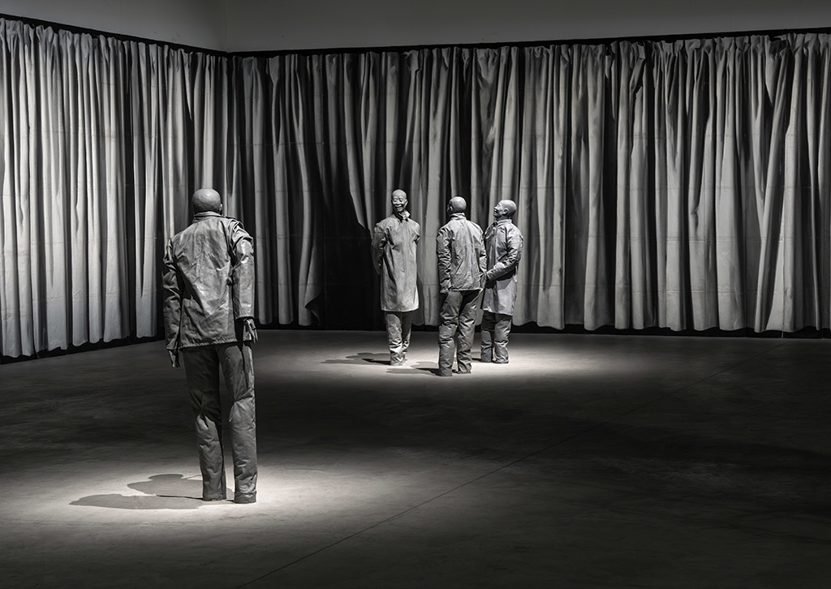
In the mid-1980s Muñoz began to include optical floors in his installations which are reminiscent of Borromini's but also of Minimalist structures in the manner of Carl Andre, designed to be walked across. He continued to use architecture as an integral part of his work, creating dramatic environments that envelop the viewer. Works such as The Prompter and The Nature of Visual Illusion allude to the theatrical devices of the Baroque period, turning the visitor into both actor and witness.

Another recurring motif in Muñoz’s work is the balcony, evoking those depicted by both Manet and Goya, as well as the wrought-iron ones typical of Madrid. For the artist, the balcony was "a metaphor for looking at that which looks at you", a setting for mutual observation.

Influenced by Giacometti, the Conversation Pieces which Muñoz created throughout his career were conceived in a non-naturalistic manner, stripped of recognisable associations in order to construct compositions of intense psychological charge. Initiated in 1991, these groups of figures with identical faces and individual gestures seem to converse with each other and invite the viewer to become part of the scene, but ultimately reject our entry and oblige us to experience our own presence in the space.

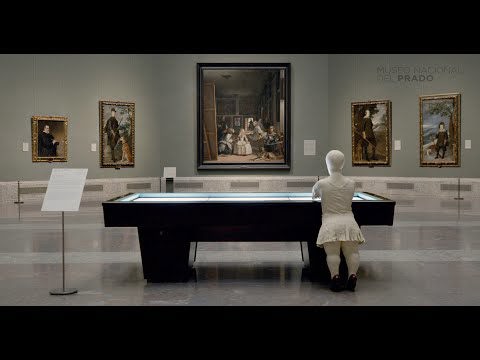
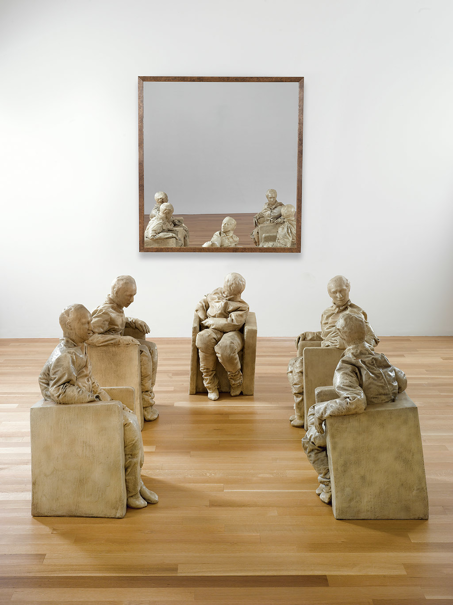
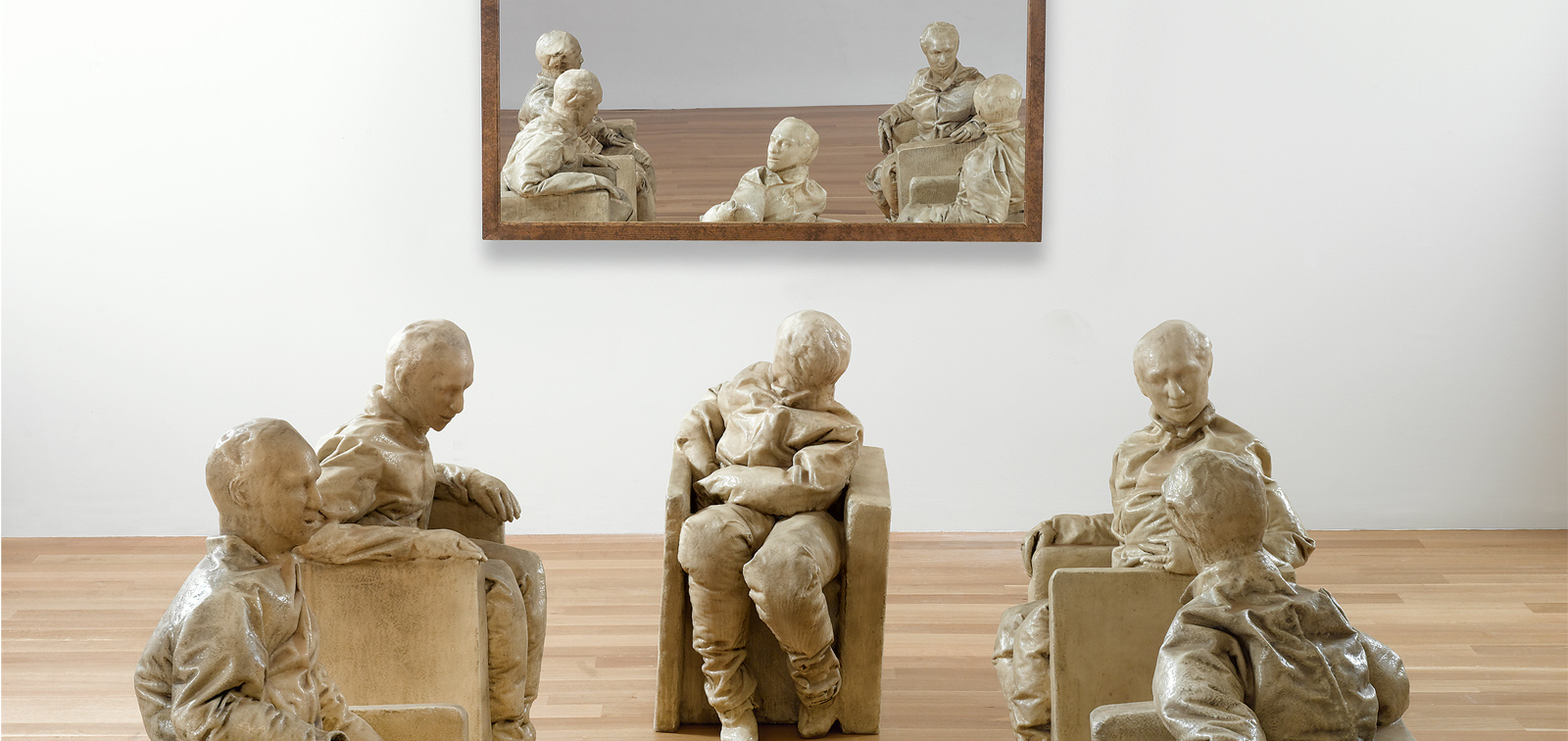
Echoes of Velázquez and Goya resonate throughout Muñoz’s work, from the mirrors that involve the viewer - as in Five Seated Figures, evoking Las Meninas - to the scenes of silent absurdity reminiscent of Goya’s Los Caprichos and The Disasters of War, dramatising that fine line between laughter and suffering that so fascinated Muñoz and which he learned from that artist.

Despite his profound commitment to art history, Juan Muñoz was an innovator who transcended the aesthetics of his time. A creator of sculptures, installations, drawings, writings and sound works, he considered himself a storyteller whose narratives ask us to suspend our disbelief and enter into his Baroque illusionism.

Curator:
Vicente Todolí

Access

Room C, D . Jerónimos Building. Villanueva Building, various rooms

RDF

RDF

With the collaboration of:

Multimedia

Exhibition

The exhibition

The exhibition
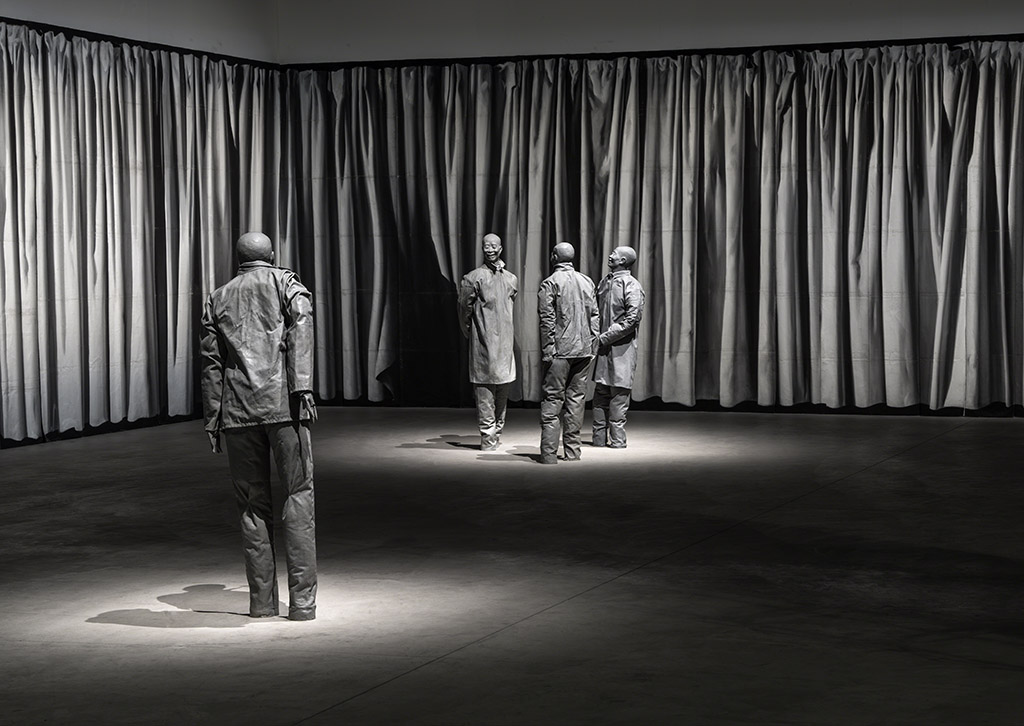
The Nature of Visual Illusion (1994-1997). Acrylic paint on canvas (curtains), polyester resin (figures). 4 figures. © Juan Muñoz Estate, VEGAP, Madrid, 2025

Born in Madrid, where he always had his studio, Juan Muñoz (1953–2001) is inseparable from his city and within it from the Museo del Prado, which he visited throughout his life and which was a constant source of inspiration. This exhibition reveals the connection between a contemporary artist and the history of art, which Muñoz studied with passion and without any established order from a very young age. His constant visits to the Prado made him an admirer of the great masters, whose lessons he irreverently combined, declaring: “I can take from previous artists whatever I want and whatever I need... I have no problem acknowledging that the Dama de Baza is as important to my work as a neon tube: I steal everything I can from the history of art.” 

Conceptually, Muñoz’s sculpture was enriched by painting, and he admitted his intention that his work preserve its illusionistic elements. From the Renaissance artists he adopted one of their principal concerns: how to position the viewer in relation to the totality of the work, “in relation to the moment of creation of wonder.” Particularly inspired by Mannerism and the Baroque, Muñoz’s work is based on experimentation with the forms and volumes of figures, unusual spatial relationships, and the sensation of tension. Attracted by Bernini and Borromini, he employed architecture as a resource capable of offering a theatrical frame of reference: “I think the great Baroque artists were asked to do the same thing as modern artists: to construct a fictitious place. To make the world larger than it is.”

Despite this profound engagement with art history, Muñoz was a great innovator who transcended the aesthetic of his time. The echoes of the masters he most admired, especially Velázquez and Goya, resound throughout his entire body of work. For the artist, the present must necessarily relate to the past; new art must teach us something about its tradition. Creator of sculptures, installations, drawings, writings and sound works, Muñoz considered himself a storyteller, a narrator whose tales were told through works filled with silent suggestions, in which he made full play of perplexity while invoking the entire history of art.

Artworks

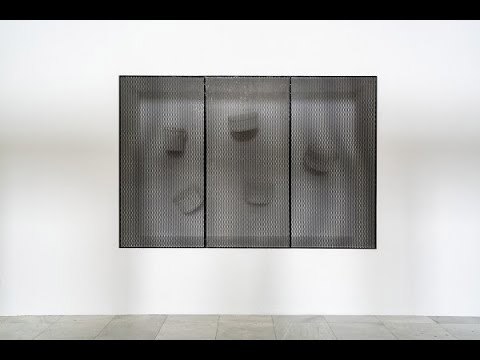
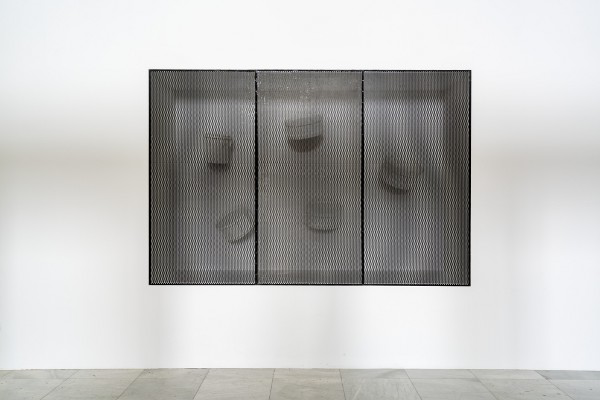
Many Drums
1
Many Drums

Juan Muñoz

Metal screen, drums, plaster, paint, and plasterboard, 200 × 300 × 50 cm                           

1994      

Private collection. JME DB.0614             

2
Ventriloquist looking at a Double Interior

Juan Muñoz

Resin, silicone, motor, wood, oilstick and chalk on fabric mounted on board, 63 × 25 × 25 cm (figure); 147 × 100 × 5 cm (each drawing); 107 × 150 × 30 (plinth)

1988-2000         

Private collection. JME DB.0090.2

3
The Prompter

Juan Muñoz

Papier-mâché, bronze, linoleum, wood and metal, 104 × 41,5 × 28,5 cm (figure); 37,5 × 37,5 × 37,5 cm (drum); 60 x 62 x 30 cm (box)

1988      

London, Tate. Presented by the artist’s estate, 2008, T12797. JME DB.0102         

4
Staring at the Sea I

Juan Muñoz

Polyester resin, cardboard, mirror and plastic, 159 × 57 × 33 cm, 155 × 55 × 43 cm (figures); 71 × 66 × 1 cm (mirror) 

1997-2000         

Private collection. JME DB.0596

5
Untitled (Balconies and Optical Floor)

Juan Muñoz

Iron, cloth and linoleum, 120 × 42 × 21,5 cm (each figure, approx.); 70 × 119 × 30 cm (each balcony )

1992      

Valencia, IVAM, Institut Valencià d’Art Modern, Generalitat, Donación del artista en 1992

JME DB.0241

The Nature of Visual Illusion
6
The Nature of Visual Illusion

Juan Muñoz

Polyester resin and acrylic on canvas, 299,5 × variable width (each panel); 147 × 47 × 30 cm, 149 × 46 × 26 cm, 142 × 42 × 20 cm, 145 × 40 × 20 cm (figures)

1994-97              

Private collection. JME DB.0285             

7
Die Winterreise

Juan Muñoz

Polyester resin, silicone, wood, steel and motor, 190 × 54 × 40 cm (double figure)

1994      

Nimes, Carré d’Art, Musée d’art contemporain de Nîmes. Achat de l’Etat en 1994, attribution à la Ville de Nîmes en 2008, inv. 2008.23. JME DB.0293

8
Conversation Piece

Juan Muñoz

Bronze and steel cable, 164 x 80 x 80 cm (each figure)

2001      

Private collection. JME DB.0650             

9
Dwarf with Parallel Lines

Juan Muñoz

Resin, steel, wood and linóleum, 103,5 × 43 × 35 cm (figure); 80 × 67 × 22,5 cm (plinth); 19,5 × 70 × 28 cm (support and bars)              

1989      

Madrid, private collection. JME DB.0136            

10
Broken Noses carrying a Bottle no. 2

Juan Muñoz

Polyester resin, plastic and paper, 247,5 × 66,5 × 40,5 cm                       

1999      

Vitoria-Gasteiz, Artium Museoa. Colección Museo de Arte Contemporáneo del País Vasco

JME DB.0406   

11
Standing Figure

Juan Muñoz

Bronze with yellow patina, 171 × 45 × 55 cm                       

1999      

Mexico, courtesy of the Fundación Calosa. JME DB.0702

12
Untitled

Pigmented polyester resin, 170 × 98 × 47 cm

2000     

Private collection. JME DB.0450

Five seated Figures
13
Five seated Figures

Juan Muñoz

Polyester resin and mirror, 102 × 55,5 × 82 cm, 107 × 72 × 68,8 cm, 110 × 68 × 60 cm, 107 × 67 × 70 cm, 110 × 65 × 72 cm (figures); 176 × 192 cm (mirror)

1996      

Madrid, Museo Nacional Centro de Arte Reina Sofía, AD05433. JME DB.0337    

14
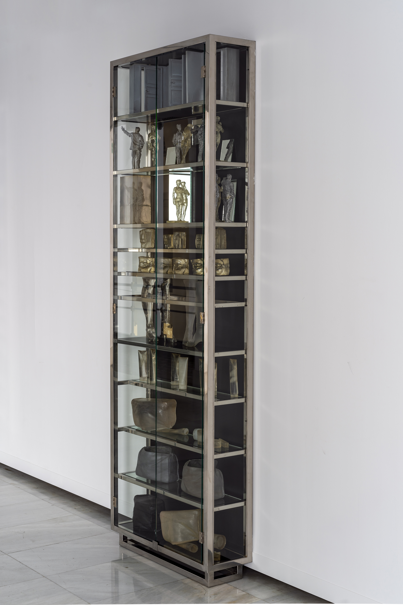
First Cabinet

Juan Muñoz

Steel, glass, resin, lead, wood, mirror, tape, ink, plaster and plastic, 249,5 × 80 × 22 cm  

1999      

Private collection. JME DB.0514

15
The Crossroads Cabinet: January

Juan Muñoz

Steel, glass, resin, lead, wood, mirror, tape, ink, plaster, copper and plastic, 248 × 80 × 25 cm

1999      

Private collection. JME DB.0515

16
The Crossroads Cabinet: March

Juan Muñoz

Steel, glass, resin, lead, wood and tape, 248,9 × 80 × 25,1 cm

1999      

Courtesy of the Galería Carreras Múgica y Galería Guillermo de Osma. JME DB.0525

17

Juan Muñoz

Steel, glass, resin, wood and mirror, 248 × 80 × 25,5 cm

1999      

Private collection. JME DB.0516

18
The Crossroads Cabinet: July

Juan Muñoz

Steel, glass, resin, wood and mirror, 248 × 80 × 25,5 cm 

1999      

Private collection. JME DB.0526

19
The Crossroads Cabinets: September

Juan Muñoz

Steel, glass, resin, lead, mirror and plastic, 248,9 × 80 × 25 cm

1999      

Sotheby’s. JME DB.0522

The Crossroads Cabinet: October
20
The Crossroads Cabinet: October

Juan Muñoz

Steel, glass, resin, lead, wood and mirror, 248 × 80 × 25,5 cm

1999      

Private collection. JME DB.0517

21
The Crossroads Cabinet: December

Juan Muñoz

Steel, glass, resin, lead, wood and mirror, 248,9 × 78,7 × 25,1 cm

1999      

Private collection. JME DB.0524

22
Raincoat Drawing

Juan Muñoz

Chalk and oilstick on dyed fabric stretched on board, 141 × 180,5 × 1,5 cm

1989      

BPD Art Collection. JME DB.3035          

23
Raincoat Drawing

Juan Muñoz

Chalk and oilstick on dyed fabric mounted on stretcher, 141 × 201 × 4 cm                            

1989      

Private collection. JME DB.3004

24
Back Drawing

Juan Muñoz

Oilstick and chalk on dyed fabric stretched on board, 140 × 100 × 5 cm  

1990      

Kunstmuseen Krefeld. JME DB.3203

25
Untitled


Juan Muñoz

Oilstick, chalk and ink on dyed fabric stretched on board, 140 × 100 × 5 cm          

1990      

Private collection. JME DB.3045

26
Back Drawing

Juan Muñoz

Oilstick, chalk and ink on dyed fabric stretched on board, 140,5 × 100 × 5 cm                     

1990      

Kunstmuseen Krefeld. JME DB.3010

27
Back Drawing

Juan Muñoz

Oilstick, chalk and ink on dyed fabric stretched on board, 140 × 110 cm

1990      

Marc Van de Velde Lovendegem. JME DB.3047 

28
Raincoat Drawing

Juan Muñoz

Chalk and oilstick on dyed fabric stretched on board, 140 × 100 × 4 cm   

1989      

London, private collection. JME DB.3034

29
Raincoat Drawing

Juan Muñoz

Chalk and oilstick on dyed fabric stretched on board, 150 × 122 × 4 cm

1992      

Private collection. JME DB.3038

30
Furniture XV

Juan Muñoz   

Aquatint, mezzotint, drypoint and watercolor, 165 × 126 × 3,5 cm

1996      

Private collection. JME DB.2614

31
Furniture XVI

Juan Muñoz   

Mezzotint, drypoint and watercolor, 165 × 126 × 3,5 cm                               

1996      

Private collection. JME DB.2615.3

32
Furniture XVII

Juan Muñoz

Aquatint, drypoint and watercolor, 165 × 126 × 3,5 cm                   

1996      

Private collection. JME DB.2616.9

33
Sara with Billiard Table

Juan Muñoz

Polyester resin, acetate sheets, billiard table, wood, iron, acrylic and light, 125 × 45 × 51 cm (figure); 79 × 268 × 148 cm (billiard table) 

1996      

Private collection. JME DB.0346

34
Conversation Piece III

Juan Muñoz

Welded bronce, 146 × 102 × 77 cm, 153 × 77 × 80 cm, 145 × 85 × 84 cm, 151 × 90 × 94 cm, 152 × 82 × 72 cm, 142 × 93 × 72 cm (figures)

2001      

Private collection. JME DB.0743

35
Après Degas (jaune)

Juan Muñoz

Pigmented polyester resin, motor and steel wire, 152 × 72 × 35 cm

1997      

Ville de Grenoble, Collection Musée de Grenoble, MG 2009-43-1. JME DB.0354

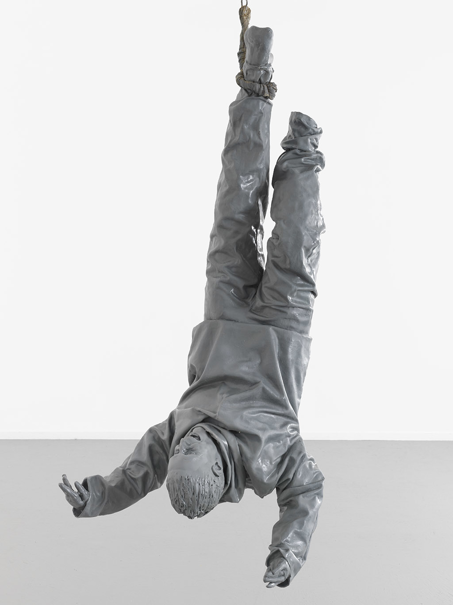
Figure hanging from One Foot
36
Figure hanging from One Foot

Juan Muñoz

Polyester resin, cloth and steel cable, 160 × 80 × 50 cm  

1999      

Private collection. JME DB.0634.r          

37
Thirteen laughing at Each Other

Juan Muñoz

Bronze and corten Steel, 280,5 × 168 × 190,5 cm (each bench); 132 × 52 × 63 cm, 91 × 67 × 56 cm, 108 × 60 × 60 cm, 111 × 57 × 60 cm (figures)

2001      

Private collection. JME DB.0626             


Print on demand

Print artworks available in our catalogue in high quality and your preferred size and finish.

Image archive

Request artworks available in our catalogue in digital format.

Up