formularioRDF
The itinerary <em>TITULORECORRIDO</em> has been successfully created. Now you can add in works from the Collection browser
<em>TITULOOBRA</em> added to <em>TITULORECORRIDO</em> itinerary

Judith at the Banquet of Holofernes. Rembrandt

Judith at the Banquet of Holofernes is a painting by Rembrandt, a painter from Flanders.

The painting is from 1634.

ETR (Easy to Read) icon
© Easy-to-read european logo: Inclusion Europe. More information at: Easy-to-read

What is the subject of the painting?

This painting shows the main character of a Bible story.

It is about Judith, the Israelite woman who killed and beheaded the Assyrian general Holofernes.

Holofernes invited Judith to a banquet, and he got drunk.

Judith took advantage of that moment to kill him.

This way, the Israelites could free themselves from the rule of the Assyrians.

In this painting, Rembrandt depicted a young woman sitting on a chair with her hair untied and falling over her shoulders.

She wears a luxurious dress and rich ornaments such as a necklace, earrings, and pearl bracelets.

A gold chain with rubies and sapphires is draped over her shoulders, held in place by a brooch on her chest.

A young servant kneels in front of Judith.

The servant offers her a wine glass.

The glass is made from a nautilus shell with a gold stem.

The nautilus is a type of squid with a shell.

In the dark background, we can see an elderly servant with her hair covered by a white turban.

A turban is a long cloth wrapped around the head.

The older woman holds a sack where she will put the cut head of Holofernes.

Initially, it was not clear who the woman in the painting was. 

Experts thought that Rembrandt painted it to show the happiness of his marriage because he just married Saskia that year.

But, over time, experts concluded that it was Judith.

The clue that confirmed this idea was the elderly servant with the sack in her hand to put the cut head of Holofernes.
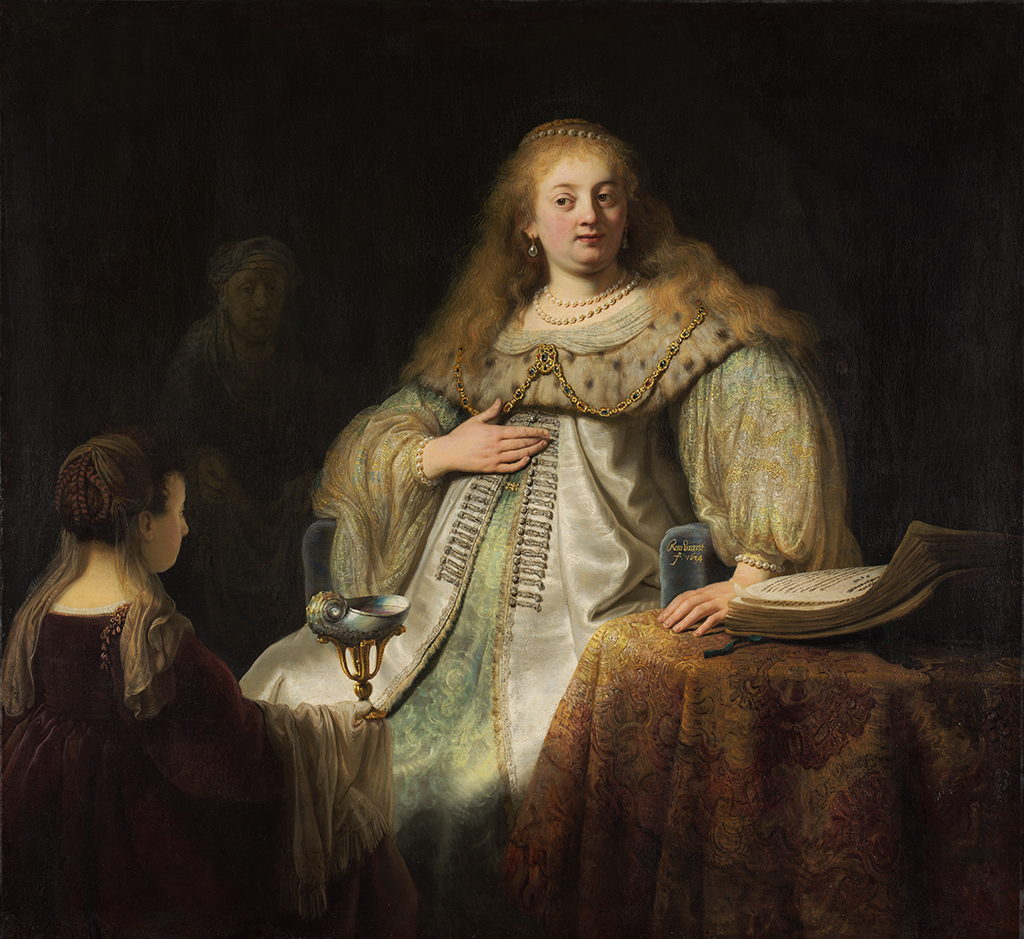
Judith at the Banquet of Holofernes
Judith at the Banquet of Holofernes by Rembrandt

Why is the painting relevant?

Rembrandt used a low point of view in this painting to depict the figures from a lower perspective, as if the viewer looked up at them.

Rembrandt also emphasised the light falling on the central figure, creating a strong contrast with the dark background.

Tenebrist artists commonly used this technique to make the figures in the painting stand out.

This painting is part of a series of works that Rembrandt dedicated to goddesses and heroines from antiquity and the Bible.

The biblical story of Judith and Holofernes was very important for the Dutch.

It had a political meaning for them, representing the Dutch struggle against Spanish rule.

Detail cup
Detail of the cup
Funded by the European Union - NextGenerationEU Government of Spain - Ministry of Culture Recovery, Transformation and Resiliency Plan Museo Nacional del Prado

Funded with the National Recovery and Resilience Plan (NRPP) , Spain’s Next Generation EU financing and according to the initiatives within the component C.24.I3 Digitization and valorization of major cultural services. The project is part of Campus Prado within Accessibility and Signage: Revitalization of the Urban Environment action line and as a universal accessibility activity.

Up