Loading...
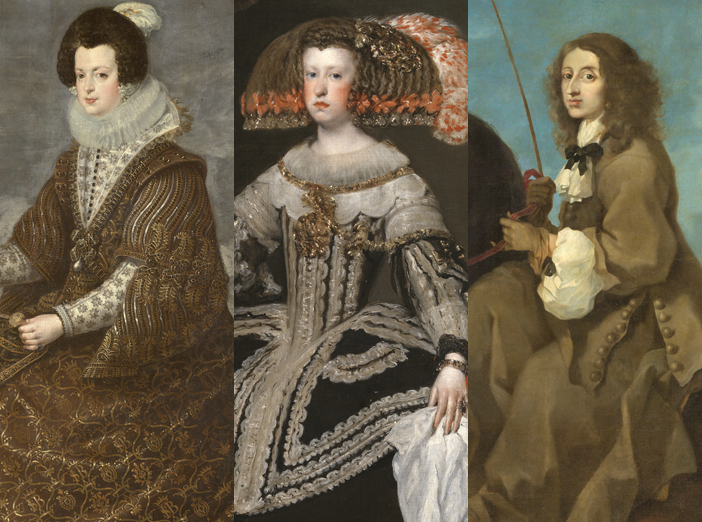
Elizabeth of Bourbon, Mariana of Austria, and Christina of Sweden
Promoters of the Museum's Collections (1602-1700). Life, Relationships, and Works
In this second edition of the thematic route The Female Perspective, we advance in the chronology to focus on new protagonists, whose lives are framed between the figures of Queens Elisabeth of Bourbon and Maria Anna of Neuburg (1602-1700).
This page has interactive relational maps where you can explore the timelines of the lives of Elisabeth of Bourbon, Mariana of Austria, and Christina of Sweden as well as their most significant personal relationships. Besides connecting them with contemporary figures, these resources put in relation these women and the works selected for the itinerary with different milestones shown in a chronological line.
How to navigate the interactives?Elisabeth of Bourbon
In the case of Elisabeth of Bourbon, the analysis is focused on one of the most outstanding artistic commissions she undertook as queen consort. The ensemble, comprising at least twenty-six paintings, was intended to decorate the newly renovated Queen's Tower in the Alcázar of Madrid.
The importance of this project, entrusted to Isabel Clara Eugenia, lies in various aspects that make it an exceptional ensemble: firstly, the high number of pieces that constitute it and the quality of the artists involved; secondly, the significance of the works, whose iconographies were carefully chosen by the mediator of this commission; thirdly, the inclusion amongst these artworks of the largest set of paintings attributed to Rubens to arrive to the Spanish court, except for the Apostolate; and in fourth and last place, the opportunity it provides us to explore the artistic and cultural exchanges that occurred between the Baroque European courts and, at the same time, among three of the most fascinating women of seventeenth-century Europe: Marie de' Médici, Isabel Clara Eugenia, and Elisabeth of Bourbon.
Relationships and chronology of Elisabeth of Bourbon
 View all the infography
Mariana of Austria
One of the most prominent figures in the political landscape of the seventeenth century: Mariana of Austria. She was Queen Regent of Spain between 1665 and 1675 assuming governmental functions as a widow, as other women of her dynasty had done before her, with one fundamental difference: she wielded power alone, governing in the name of her son Charles II.
She was strongly challenged due to her feminine condition, foreign origin, and lack of political experience, and Mariana faced fierce opposition from the beginning of her regency. In this clearly adverse context, it is fascinating to see, through the portraits preserved in the Prado Museum, how Mariana created her own image of power that helped legitimize her political position and strengthen her authority at court.
Relationships and chronology of Mariana of Austria
Christina of Sweden
Christina of Sweden was an extraordinary art and culture enthusiast and one of the most prominent collectors of the Early Modern period. She was Queen of Sweden from 1632 to 1654, and her abdication from the throne and conversion to Catholicism brought her closer to the Spanish court of Philip IV seeking the monarch's support. She gifted him some of her most imposing portraits and valuable pieces like the Adam and Eve panels by Albrecht Dürer.
Thanks to the king’s mediation, she established herself in the city of Rome where she assembled one of the most outstanding artistic collections of the time in the Riario Palace, particularly famous for the selection and uniqueness of the pieces in her sculpture collection. Many of these works were acquired in 1724 by King Philip V and Queen Isabella Farnese and today constitute the most valuable collection of classical sculptures in the Prado Museum.
Relationships and chronology of Christina of Sweden
How to navigate the interactive?
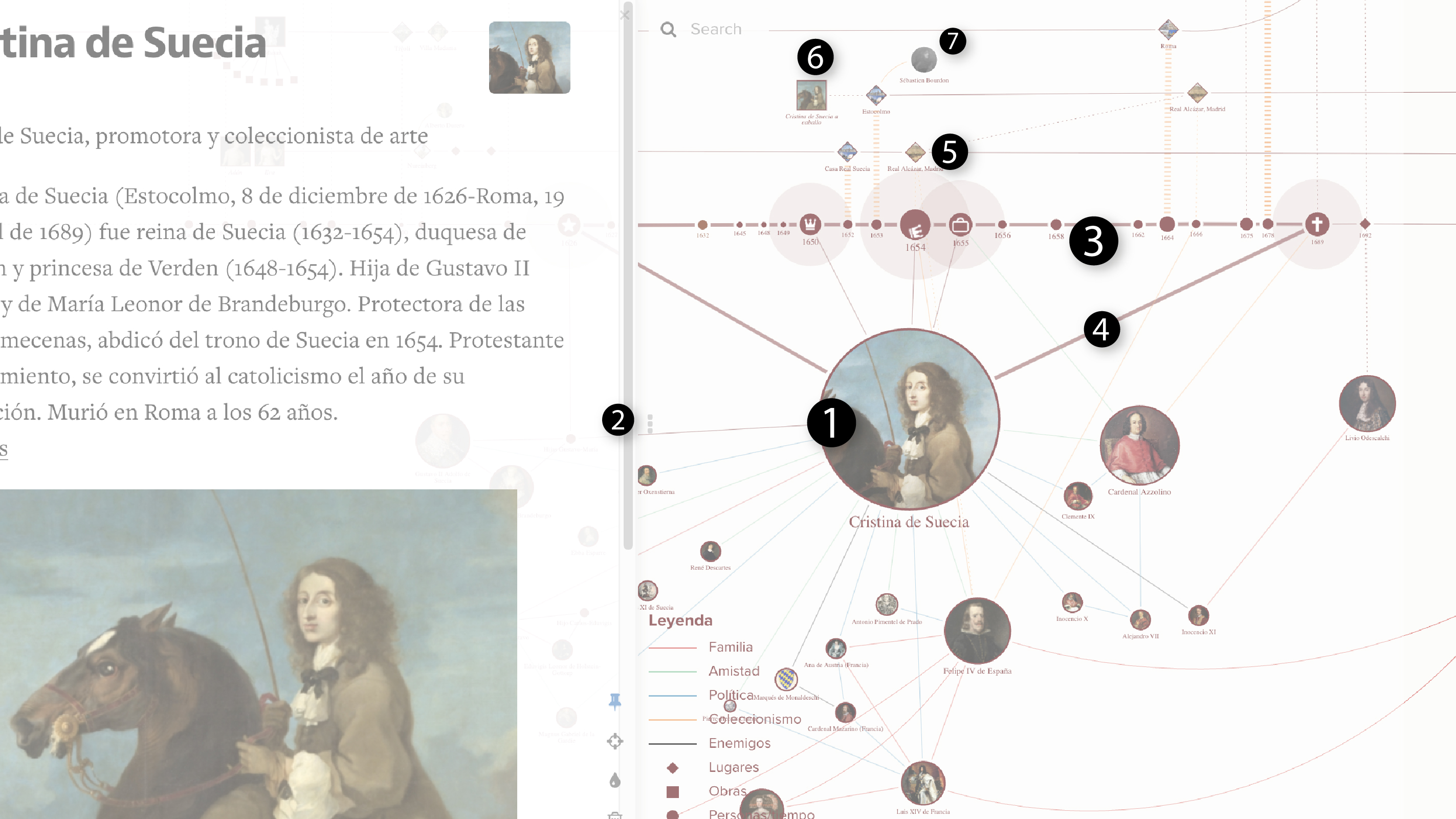
In this interactive map we find different elements that we can explore by zooming in and clicking on them. If we choose any of the characters 1, a detailed information card will open on the left. This card can be opened and closed using the three dots button 2. The same applies to the other elements such as the timeline 3, connections 4, places 5, works 6, and artists 7.