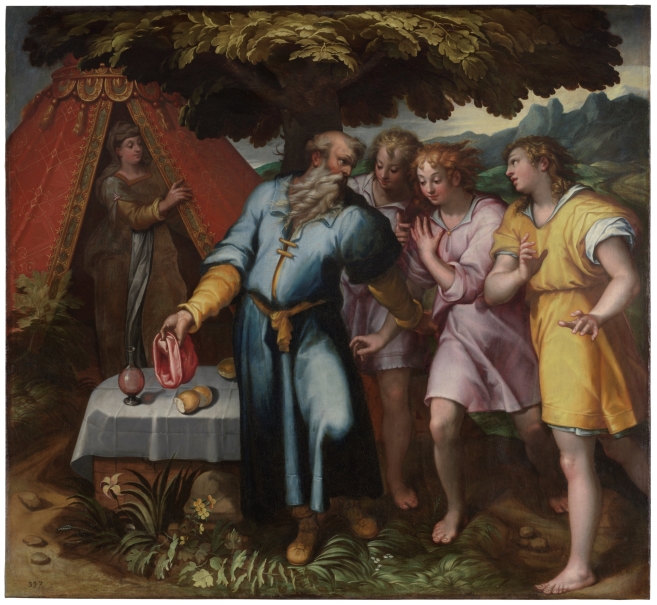
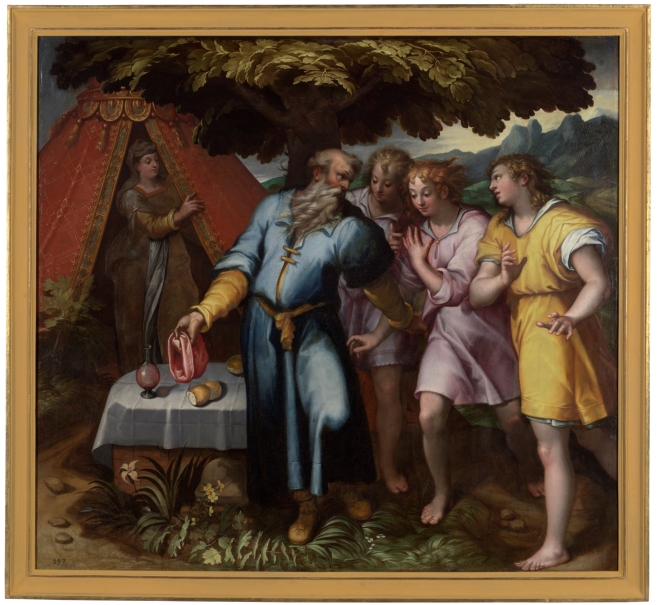
Abraham and the three Angels
1578 - 1585. Oil on canvas.Not on display
The composition is structured around the oak of Mamre, whose leafy boughs form a canopy beneath which the scene from Genesis (18:1–15) unfolds. Abraham, the central figure, serves as a metaphor for the presence of God in this prefiguration of the Eucharist. He welcomes three approaching pilgrims, offering them a place to rest beneath the oak, where he has set up a table bearing bread and wine. After eating, the pilgrims – angels sent by Yahweh – depart, but not before announcing that one of them will return, by which time Abraham’s wife Sarah will have borne a child. This news astounds both Abraham and Sarah – who, hidden inside the tent, has heard the angel’s revelation – since they are both very old.
The monumental figures, which occupy virtually the entire foreground, and the predominance of saturated shades of indigo, yellow, pink, and mauve are typical of the Italian school. It is hardly surprising, then, that the painting should always have been listed as a Florentine work in the inventories of the Museo del Prado. But other features – such as the technical precision and attention to detail, the depiction of nature, the careful rendering of hair and beard, an interest in capturing the subtle effects of light as it passes through the wine bottle and reflects onto the tablecloth, and the luminosity of the sunrise in the background, bathing the fields and hills in a hazy mist – are more characteristic of the Flemish school in which Denys Calvaert trained. He first studied under the landscape painter Christian van den Queborn (1515–1578) in Antwerp, entering his workshop as an apprentice in 1556 and staying there until 1558 at least. Little is known of his subsequent training, though he probably continued to study in Italy. After spending some years in Rome, in 1568 he is recorded as working with Lorenzo Sabatini (c. 1530–1576) in Bologna, where he appears to have settled permanently by 1575.
The Florentine influence discernible in Calvaert’s work can be attributed to the years he spent working under Sabatini, and before that under Prospero Fontana (1512–1597). It was the seamless blend of the Italian language with an essentially Flemish heritage which led to Calvaert eventually being appropriated by the Bolognese school of painting.
Abraham and the three Angels is closely related to the paintings Calvaert produced once he had established his own workshop in Bologna, in around 1575. There are, for example, strong resemblances – in terms of facial features, gestures and compositional schemes – to the drawing of Jacob and Rachel at the Well in the Musée du Louvre, dated 1578, and to two versions of Noli me tangere, one in the Pinacoteca Nazionale di Bologna and the other, dated 1585, in the church of Santa Maria Maddalena di Cazzano in Budrio.
The scene depicted in the Prado canvas is repeated in an inverted drawing in the Louvre (inv. 9437), which differs slightly from the final painting. The most significant variations are found in the figure of Sarah – who in the drawing is pictured emerging from the tent holding a tray – as well as in the foreground vegetation and some items on the oblong stone over which the cloth has been laid. Michele Danieli was the first to relate this drawing to Calvaert’s oeuvre, in private correspondence with the Louvre in 2020, though without linking it specifically to the Prado painting.
As Wouter Kloek noted in 1993, Calvaert used mirror images of figures and entire compositions both for teaching purposes at his studio-academy in Bologna and for experimentation; inverted images are common in his large-format compositions, since many of his drawings were used for engravings. A drawing with the same orientation as the Prado canvas may well survive, though it has yet to be located.
Diéguez Rodríguez, Ana, 'Denys Calvaert. Abraham and the three Angel'. In: Guido Reni, Madrid, Museo Nacional del Prado, 2023, p.154-156 nº 4