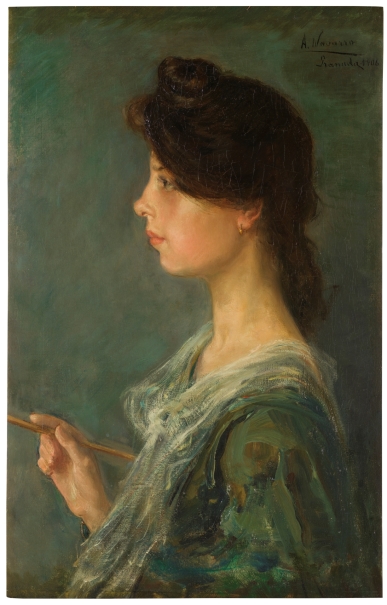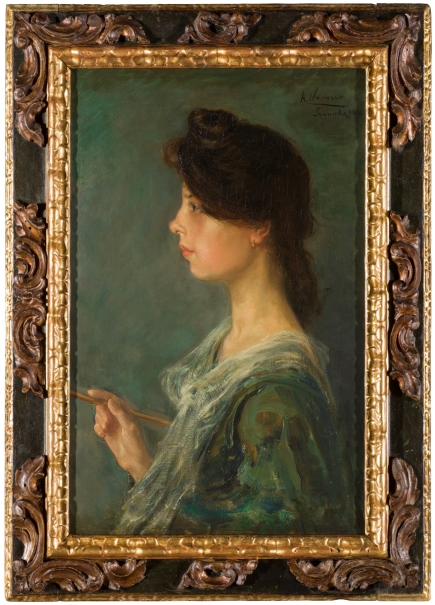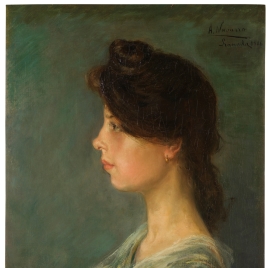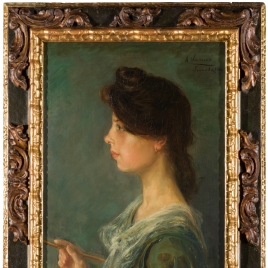
Self-portrait
1906. Oil on canvas.Room 062A
Aurelia Navarro was a significant painter in the beginning of the 20th century, during time which she developed a notable public career. Coming from a well-off family and still a teenager, she first attended in Granada the studio of José Larrocha (1850–1933), who trained her as a draughtswoman and landscape painter. Later, Tomás Muñoz Lucena (1860–1943), from whom she acquired her taste for colour and lighting effects, would become more influential. He awakened her interest in genre subjects, which appear at the beginning of her production. Nonetheless, Aurelia soon developed her own iconographic universe, full of intimacy and exclusively populated by women. Most likely encouraged by her master, Navarro took part in three National Exhibitions of Fine Arts, which would become the most significant moments in her career.
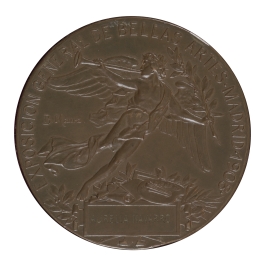
In 1904 she received an honourable mention for Quiet Dream (collection of the artist’s descendants in Madrid) from a jury chaired by Sorolla. Encouraged by her first success, she competed again in the National Competition of 1906 with four works, one of which was awarded a third-place medal and for which she received a thousand pesetas. Santos Moreno identifies this painting – now in the Prado – with the one that won the prize at the time, according to the recollections of the descendants who kept it. It is an image of a painter in the act of reflecting on her work, executed with fluid, gestural brushstrokes yet with a firm drawing. Navarro keeps and disrupts the predominant greens with soft blues in the background and in the dress, guided by a bold, original sense of colour and concentrates the interest of the portrait on the serious, intellectual gesture of the model. Located in rigorous profile, she seems to allude to the traditions of early Italian Renaissance portraiture. According to Santos Moreno, this would be the one inscribed as Portrait of Miss A. M., exactly matching its measurements and reasonably identifiable. Of the others submitted by the painter, the one titled A female artist would concur with the portrait of her aunt Amalia Moreno in front of a piano with Chopin’s scores (private collection in Santiago de Compostela). It was made known by Santos Moreno herself and its measurements – dated 1906 – exactly coincide with those in the catalogue of said competition. In 2019, Illán also identified this work as the 1906 prize-winner – with which Santos Moreno agrees – but in 2021 he proposed that the prize-winning painting was a portrait with a still-life background (collection of the artist’s descendants), implying an error in the description of the measurements in the catalogue of the Exhibition and therefore a slip in the identification of the prize-winning painting. Regarding the identification of the woman depicted, Illán, in the same 2021 text, also raises doubts as to whether it is the painter herself, although in 2019 he identified it as a self-portrait, as does Santos Moreno. At least five other known works demonstrate that self-portraiture was a subject that interested her throughout her career and also reveal her changing appearance. Her best-known work, Nude Woman (Diputación de Granada), succeeded at the National Exhibition of 1908, where it was awarded a medal that is now also in the Museo del Prado thanks to a generous donation by her descendants. Following this success, Navarro became for a short time a member of the Asociación de Pintores y Escultores de Madrid (Madrid Association of Painters and Sculptors) between 1910 and 1911 and took part in several exhibitions at the Centro Artístico y Literario de Granada (Granada Artistic and Literary Centre) in 1908, 1914 and 1916, where she submitted a female nude entitled Ecstasy, which unfortunately has since been cropped.
Between 1913 and 1915 she produced her most important painting, a monumental apotheosis of the Eucharist for the Sanctuary of the church of Perpetuo Socorro (Our Lady of Perpetual Succour) in Granada, no longer extant. In April 1923 she entered the convent of the Adoratrices Esclavas del Sacramento (Adorers Slaves of the Sacrament) in her city, where she was professed in 1925. In 1932 she was assigned to the convent of Alcalá de Henares, where she stayed until 1936, when she moved to Córdoba, thus saving her life from the shootings that killed many of her sisters there. Earlier, in 1934, she had painted her last great canvas, a portrait of the foundress Santa María Micaela, inspired by another by Luis de Madrazo. Whilst the public and art history forgot her, the family zealously preserved the painter’s memory by not selling the work she had kept for herself and by paying for some costly restorations of her works. In 2003, the painter’s nephew José Navarro Jiménez, concerned about the memory of his aunt and with the help of the rest of his siblings, compiled a complete compendium of the works preserved in the family’s possession, of which his descendants have also deposited a copy in the Library of the Museo del Prado for public consultation.
G.Navarro, Carlos, 'Aurelia Navarro. Retrato de la señorita A.M.'. en: Memoria de actividades 2021 Museo Nacional del Prado, Ministerio de Cultura y Deporte, 2022, p.52-54