Aurelia Navarro Moreno
Pulianas (Granada, Spain), 1882 - Córdoba (Spain), 9.2.1968Aurelia Navarro was initially a private student of José Larrocha, where she studied alongside José María López Mezquita and José María Rodríguez-Acosta, and later studied under Tomás Muñoz Lucena. After modest success in the 1904 and 1906 National Exhibitions in Spain, she presented her work "Desnudo femenino" ("Female Nude") at the 1908 exhibition (Granada, Diputación de Granada Collection, inv. 325), which drew some attention from the critics. Although many recognized its merit, some favorable comments were tinged with sexism, likely because the artist behind this sensual female image was a woman. The model’s position, nude on a bed with her unrecognizable face reflected in a mirror, made an evident allusion to Velázquez's famous "Venus at her Mirror," which had been acquired by public subscription for the National Gallery in London just two years prior.
Aurelia Navarro's works defied norms and achieved great heights, resulting in brief success but also precipitating her downfall due to family pressures related to her controversial nude painting. Unable to withstand these pressures, she ultimately abandoned her career for a religious life. Her success at the National Exhibitions of Fine Arts in Spain was seen by her parents not as confirmation of her talent but as a threat to her moral standing. Consequently, in fear that the city’s cultural scene was a source of potential corruption they forced her to return to the quiet of her hometown and domestic life. The intense family (and societal) pressure on a young painter like Navarro reached its peak in 1908, effectively derailing a promising artistic career. At 26, and single, Aurelia dared not only to participate in these highly visible official exhibitions but also to tackle a taboo subject: the representation of the nude body. However, her artistic career ended abruptly. In 1923, she professed as a nun in the Order of the Adoratrices (Jiménez-Blanco, María Dolores, and G. Navarro, Carlos, in Carlos G. Navarro (ed.), "Invitadas. Fragmentos sobre mujeres, ideología y artes plásticas en España (1833-1931)," Museo Nacional del Prado, 2020, pp. 364-365 and 382, n. 119).
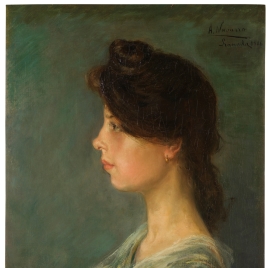
Her self-portrait is catalogued as work P008373 in the Prado Museum.