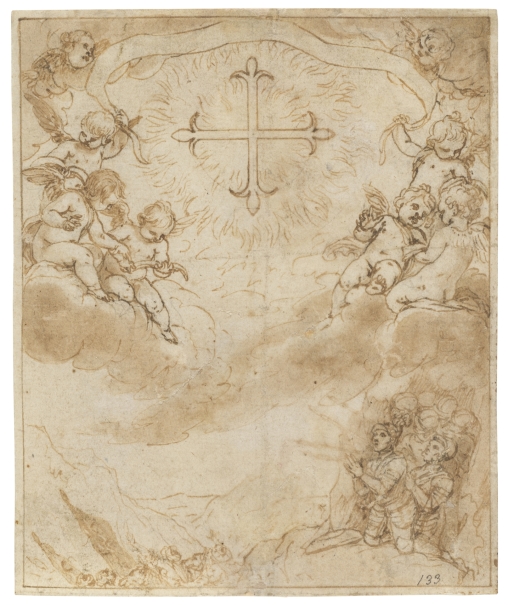
Apparition of the Victory Cross to Don Pelayo in the Battle of Covadonga
1657 - 1661. Grey-brown wash, Pencil on laid paper.Not on display
A research study published by Javier González Santos has revealed that the 19th-century inventories of the Museo del Prado accurately cited the subject of this drawing as alluding to the Holy Cross and the cave of Covadonga. In fact, this painting depicts the Apparition of the Victory Cross to the foot soldier Pelagius of Asturias in the Battle of Covadonga and is directly related to the engraving bearing the same title included in Spain restored by the Cross by Juan de la Portilla Duque (Madrid, 1661).
This drawing depicts the Victory Cross in the upper central part of the sky, with flaming haloes behind it and with cherubs holding a banner that waves above the cross surrounding it. In the lower right register, there are several knights (with the foot soldier Pelagius of Asturias at the front) who appear in the middle of a mountainous landscape and kneel before the cross as sign of veneration. Further to the lower left, in a mountain valley, there are several horsemen wearing the typical Islamic turban.
This drawing is an example of Cano’s work as an engraver for frontispieces or as an illustrator for books published in Spain, especially in the final stage of his career. The publication of Spain restored by the Cross, was financed by the Kingdom of Castile. Therefore, it was an official work commissioned by public officials. Thus, Cano’s association with this project highlights the continuity of the royal support that the artist had in the 1650s and the 1660s.
Veliz, Zahira, Alonso Cano (1601-1667): dibujos, Santander, Fundación Marcelino Botín, 2009, p.388-389; nº 80