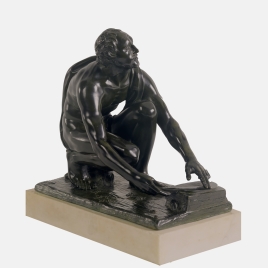
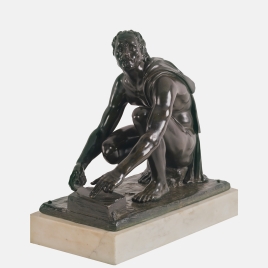
Arrotino (The Knife Grinder)
XVIII century. Bronze.Not on display
It is a reproduction of an ancient marble model from the Pergamon school, which is in Florence, in the Tribuna degli Uffizi. The figure he represents has been variously identified as a Dacian slave, a naked gladiator, a spy, etc., the most widely accepted title since the 17th century being Arrotino, meaning "the knife grinder". He appears for the first time in a drawing by Marten van Heemskerck, who visited Rome between 1532 and 1536. From the Villa Medici, where it was first found, it passed to Florence in 1677, like other important pieces in the collection of the Tuscan mandarins, and was circulated in the usual publications among the most famous statues of antiquity. The small bronze in the Museum is unmarked and unsigned, but appears to be a poorly detailed casting. Since it was paired at Versailles with a copy of the Venus de la Torsuga by Coysevox, numerous reductions of both subjects have been made.