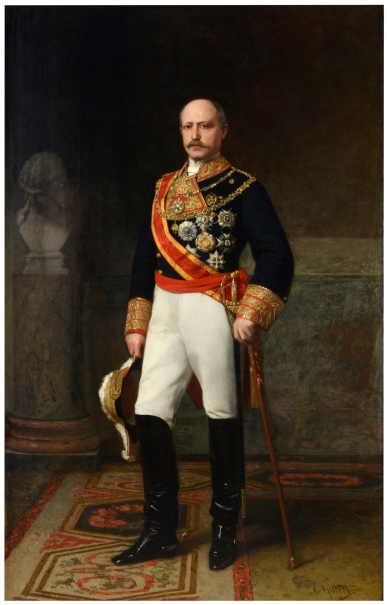
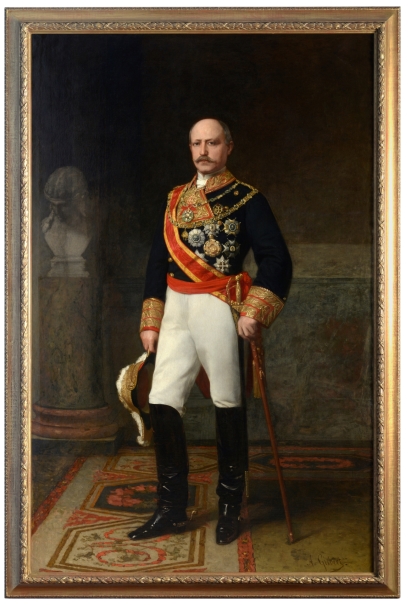
Captain General Francisco Serrano y Domínguez, 1st Duke of la Torre
1870 - 1871. Oil on canvas.On display elsewhere
Francisco Serrano y Domínguez, I Duke of la Torre (Isla de León, San Fernando, Cádiz, 1810 - Madrid, 1885) was a soldier and politician, Protector of the Realm (1868-1874) and President of the Council of Ministers. He was the father of Concepción Serrano (P6711). He was born on Isla de León, now San Fernando (Cádiz) on 17 December 1810 and began his studies at The Colegio de Vergara. At the age of twelve, he joined the Sagunto Cavalry Regiment, and then the Prince´s Cavalry Regiment, later (October 1830) joining the Carabinier Corps of the Coasts and Borders, as a second lieutenant. In Malaga, he also collaborated in the execution of members of the unsuccessful Torrijos expedition. In 1833, he settled in Madrid, in the Regiment of Cuirassiers de la Guardia. From there, he began to rapidly rise through the ranks and honours for his service in the First Carlist War, where he earned the rank of Captain and the Cross of San Fernando. He then remained in Catalonia under his father’s orders until 1837. His series of promotions continued, with his participation in the sieges of Calaf and Castilseras, earning him the Laureate. When the Vergara Agreement was signed in 1839, he was already a Colonel, and he was promoted to Brigadier that same year, at which time he attended the Congress sessions as a deputy for Malaga. Following which, circumstances began to dictate a change in his political views. Thus, in 1843, he conspired with Prim and González Bravo to overthrow Espartero, as his ambition was as great as Espartero´s. From Barcelona, he formed a "universal ministry" with them, which put an end to Espartero´s regency.When Isabella II came of age, he became her favourite, and he enjoyed royal favours. This contrasted with the Queen´s marital disagreements with the Infante Don Francisco de Asís. Intrigue erupted around the court, and in 1847 the Duke of Sotomayor tried to remove him from the palace, without success, appointing him as the Captain General of Navarre. It was The Government of the Moderates, however, with its centralising policy, which reconciled Isabella II with her husband in 1848. After Narváez’s return, Pacheco’s cabinet removed Serrano, appointing him as Captain General of Granada. That same year, however, he retired from this post, withdrawing to his estate in Arjona. He took the opportunity to travel to Russia, where he did an in-depth study of its military system. Shortly after his return, he married his cousin Antonia Domínguez Borrell, daughter of the Counts of San Antonio.
After the revolution of 1854, he supported Espartero’s return and became Director General of Artillery. Later, in 1856, he was appointed ambassador in Paris, where he remained for a year. Interested in the internal affairs of Spanish politics, he returned to Spain. Between 1856 and 1868, a period dominated by Spanish moderantism movements, he helped to form the Liberal Union party, under whose rule he became Captain General of Cuba (1859-1862). During this three-year mandate he made his fortune in the slave trade. Upon his return, he obtained the title of Duke of La Torre, and the Grandee of Spain. He helped to quell the Rebellion of Cuartel de San Gil (1866), for which he received the Order of the Golden Fleece. On O´Donnell´s death he became the leader of the Liberal Union. He lacked deep-rooted convictions and was more of a skilful manipulator of political events than a true party leader. He was one of the men who organised the revolution of 1868 during which he defeated The Marquis of Novaliches’ government forces at Alcolea Bridge. Supported by his triumph, he was appointed President of the provisional government and, as Spain was without a monarch, he became regent with the title of Highness. He backed the Duke of Montpensier as a candidate for the Spanish throne. When the throne was succeeded by Amadeo of Savoy, he presided over his government on several occasions. When the Third Carlist War broke out, he commanded the armies of Navarre, Aragon, and Burgos, and ended the struggle through the disputed Amorebieta Agreement in March 1872. This was intended to avoid further problems. The dethroned Isabella II approached him about a possible restoration, but influenced by his wife, he showed no interest. When the First Republic was proclaimed in 1873, he attempted, together with Martos, to incite the National Militia. Failing, he fled and settled in Biarritz. He returned to Madrid shortly before General Pavia´s coup, attended the meeting of all the politicians in Congress and was elected president of the executive branch. His government was a kind of "right-wing republican dictatorship", but, despite his personal interest in a lifelong presidency, his ministry was no more than a bridge government due to the restoration. After the Pronunciamiento of Sagunto by General Martínez Campos, he stayed away from political life for some months, but he ended up acknowledging Alfonso XII. Although he was the nominal leader of the Liberal Party, when the conservatives were dismissed, the King called on Sagasta to form a government. Rebuffed, the Duke de la Torre formed the group, The Dynastic Left. He died on the same day that Alfonso XII was buried (25-XI-1885).
In this full-length portrait, on the Captain General’s uniform, there are, among other decorations, the collars of the Golden Fleece, the Santissima Annunziata of Sardinia, the Brazilian Imperial Order of the Rose, and the Grand Cross Laureate. There is also the Band of Saint Ferdinand, the Grand Crosses of Charles III and Saint Hermengild, and the Badge of The Cavaliere Supreme Order of the Most Holy Annunciation. He also has the Order of Saints Maurice and Lazarus, the Order of Knights of the Hospital of Saint John of Jerusalem, and the Order of St Andrew of Russia, half-hidden by the band.
Díez, José Luis (dir.), Pintura del Siglo XIX en el Museo del Prado: catálogo general, Madrid, Museo Nacional del Prado, 2015, p.230