formularioRDF
The itinerary <em>TITULORECORRIDO</em> has been successfully created. Now you can add in works from the Collection browser
<em>TITULOOBRA</em> added to <em>TITULORECORRIDO</em> itinerary

Close Continuar a ficha de la obra Continuar a ficha de la obra
17-02-2026
Luca Giordano

Naples (Italy), 1634 - Naples (Italy), 1705

Luca Giordano See author's file

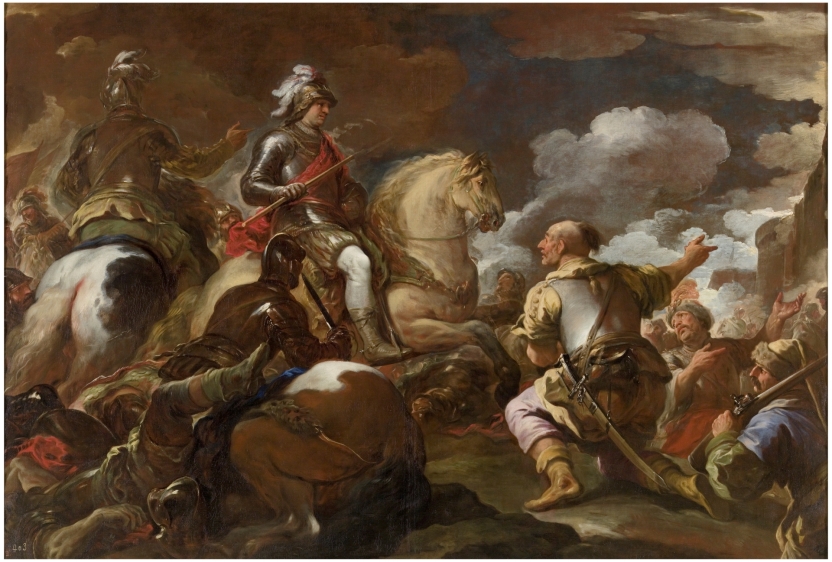
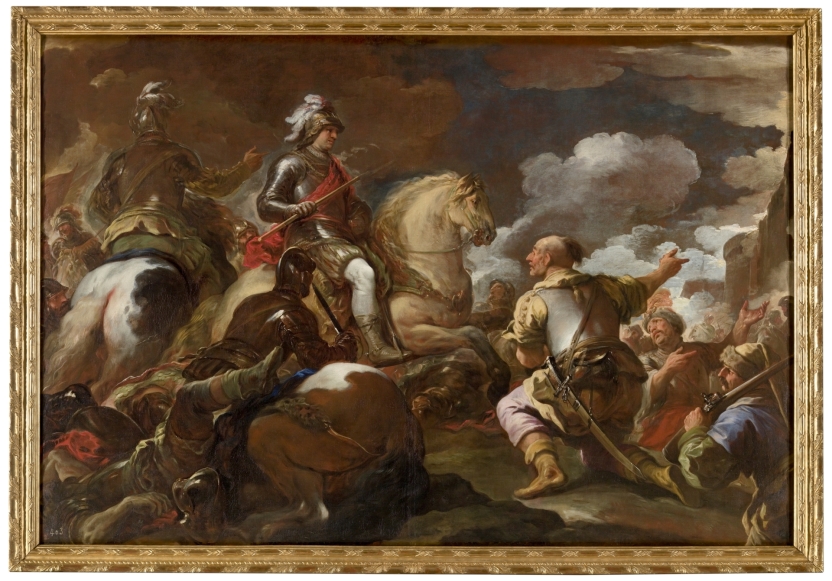
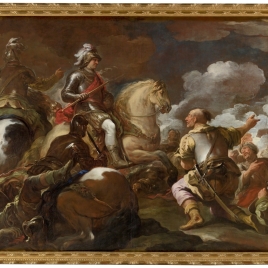
Capture of a Stronghold

Ca. 1697. Oil on canvas.
Room Luca Giordano

Luca Giordano decorated three spaces in the Casón, an outbuilding of the Buen Retiro Palace, Madrid. The first was the central hall, which still exists, where he painted the fresco Apotheosis of the Spanish Monarchy, as well as sixteen scenes of the Labours of Hercules, now sadly lost.

Two galleries that flanked this hall were destroyed in the late nineteenth century. The eastern one led to a garden, and the western to the palace. For the latter, Giordano painted The taking of a stronghold, c. 1697-1700, and two other canvases that now hang at the Aranjuez Palace, Madrid.

These also depict battles from Ferdinand the Catholic’s capture of Granada in the late fifteenth century. The fourth painting for that pavilion has been lost. Above those works, Giordano painted frescoes with the same subject in two sections of the dome, and variations on the Four Cardinal Virtues in two other sections. He occupied the pendentives with images of the Four Parts of the World. Besides the three surviving canvases, we know parts of the rest from eight prints and some preparatory drawings of details.

The compositions of the three extant paintings are clearly related. Each has a leading figure on horseback that is perfectly differentiated from the rest. The particular clothing that they wear suggests Giordano may have consulted period portraits or books. In contrast, he made no effort at all to illustrate specific scenes, instead repeating a series of battle images that capture the confusion and violence of war while making it impossible to identify them as particular events. The only narrative element is in the Museo del Prado’s painting: a kneeling figure who looks more Turkish than Nasrid and who points to the fortress in the background as though accepting his defeat and surrendering his stronghold.

The authors of the decorative program at the Casón, which was intended to praise Charles II, were unable to equal the panorama at the same palace’s Hall of Kingdoms, which commemorated battles won by the King’s father, Philip IV. The succession of humiliating defeats suffered by Charles II throughout his reign made such a project impossible. So, given the inescapable need to represent Spain’s military power in a space with such symbolic uses, the artists opted for depictions of Ferdinand the Catholic (1452-1516). This deliberate vagueness must be understood as a careful strategy followed in all of the Casón’s decoration.

Significantly, the King himself is absent from its abundant references to the grandeur of the Spanish Monarchy, appearing only in the form of mythological associations (Hercules). This well-preserved work shows numerous pentimenti in the haunches and ears of the leading figure’s horse, in the torso and arms of the rider whose back is turned to the viewer and in the back legs of the dead horse in the foreground. It was restored between October 2006 and July 2007. Giordano’s technique in works from this time is very characteristic of his final period in Spain, distinguished by a rapid and direct touch. The foregrounds are more carefully crafted, with precise contours that bring out the highlights and volumes. The taking of a stronghold becomes increasingly sketchy from the middle to background, and the diminishing amount of paint makes the primer more visible (Úbeda de los Cobos, A.: Italian Masterpieces. From Spain`s Royal Court, Museo del Prado, 2014, p. 216).
Multimedia

Technical data

Imagen del carrusel
Imagen del carrusel
Inventory number
P000183
Author
Luca Giordano
Title
Capture of a Stronghold
Date
Ca. 1697
Technique
Oil
Support
Canvas
Dimension
Width: 343 cm; Height: 235.00002 cm
Provenance
Royal Collection (Palacio del Buen Retiro, Madrid, 1701-1703, [nº 923]; Buen Retiro, 1794, nº 403).

Bibliography +

Ponz, Antonio, Viage de España: en que se da noticia de las cosas mas apreciables, y dignas de saberse, que hay en ella, VI, Atlas, Madrid, 1794; ed. facs. 1972, pp. 135.

Ceán Bermúdez, Juan Agustín, Diccionario historico de los mas ilustres profesores de las Bellas Artes, II, en la imprenta de la Viuda de Ibarra, Madrid, 1800, pp. 335 (Giordano).

Madrazo, Pedro de, Catálogo de los cuadros del Real Museo de Pintura y Escultura de S.M redactado con arreglo a las indicaciones del Director actual del este Real Establecimiento, Oficina de Aguado, Impresor de Cámara, Madrid, 1843, pp. 3 nº12 (Giordano).

Onieva, Antonio J., La Pintura Española en el Museo del Prado., Mayfe,, 1956, pp. 244 (Giordano).

Ruiz Alcón, Maria Teresa, Colecciones del Patrimonio Nacional. Pintura VIII. Lucas Jordán (5), Reales Sitios, nº 32, 1972, pp. 37-48 [38] (Giordano).

Sánchez Cantón, Francisco Javier, Museo del Prado. Catálogo de las pinturas, Museo del Prado, Madrid, 1972.

Museo Nacional del Prado, Catálogo de las pinturas, Museo del Prado, Madrid, 1985, pp. 251.

Barghahn, Barbara Von, Philip IV and the Golden House of the Buen Retiro in the Tradition of Caesar, I-II, Garland Publishing Inc., New York-London, 1986, pp. 399.

Palomino de Castro y Velasco, Antonio, El Museo Pictorico y Escala Optica. V. III. El Parnaso Español Pintoresco y Laureado, Aguilar, Madrid, 1988, pp. 522 (Giordano).

Museo Nacional del Prado, Museo del Prado: inventario general de pinturas (I) La Colección Real, Museo del Prado, Espasa Calpe, Madrid, 1990, pp. nº12.

Ferrari, O. Scavizzi, G., Luca Giordano. L'opera completa, I, Electa, Nápoles, 1992, pp. 348-349 nº A634.

Ferrari, O. Scavizzi, G., Luca Giordano. L'opera completa, II, Electa, Nápoles, 1992, pp. 807 fg.811 (Giordano).

Pérez Sánchez, Alfonso E (com.), Luca Giordano y España, Patrimonio Nacional: El Viso, Madrid, 2002, pp. 306 nº R120 (Giordano).

Ferrari, O. Scavizzi, G, Luca Giordano: Nuove Ricerche e Inediti., Electa, Nápoles, 2003, pp. 87 nº A0280 (Giordano).

Hermoso Cuesta, Miguel, La pintura de Lucas Jordán en las colecciones españolas, Prensas Universitarias de Zaragoza, Zaragoza, 2006, pp. 1600-1601 nº P344 ( Giordano).

Úbeda de los Cobos, Andrés, Luca Giordano y el Casón del Buen Retiro, Museo Nacional del Prado, Madrid, 2008, pp. 98.

Luna, Juan José, Guerra y pintura en las colecciones del Museo del Prado. Siglo XVI a Goya, Arte en tiempos de guerra, Jornadas de Arte, Madrid, 2009.

Gayo, Mª Dolores; Jover de Celis, Maite, Evolución de las preparaciones en la pintura sobre lienzo de los siglos XVII y XVIII en España., Boletín del Museo del Prado, XXVIII, 2010, pp. 39-59.

Ubeda de los Cobos, Andrés, 'Luca Giordano. The taking of a stronghold', Italian masterpieces from Spain's royal court, Museo del Prado, National Gallery of Victoria Thames & Hudson, 2014, pp. 216.

Úbeda de los Cobos, Andrés, Luca Giordano en el Museo Nacional del Prado: catálogo razonado, Museo Nacional del Prado, Madrid, 2017, pp. 272-276 nº56 (Luca Giordano).

Úbeda de los Cobos, Andrés, Luca Giordano at the Museo Nacional del Prado, Museo Nacional del Prado, Madrid, 2017, pp. 236-276 [272-276 n.56] (L.Giordano).

Other inventories +

Inv. Testamentaría Carlos II, Buen Retiro, 1701-1703. Núm. [923].
Ottra Pinttura de ttres baras menos quartta de largo y quattro Uaras poco mas de ancho de la historia de empresas del señor rey Don fernando el Cattolico sin marco tasada en settenta Doblones...4.200 [también coincide con los números de inventario 924, 925 y 926]

Inv. Testamentaría Carlos III, Buen Retiro, 1794. Núm. 403.
Otra [pintura] de Jordan: con la Historia de las Empresas del Rey Dn. Fernando el Catolico, de dos varas y tres quartas de alto, y quatro varas poco mas de ancho, con marco dorado...9000

Museo Real de Pinturas a la muerte de Fernando VII, 1834. Núm. 403.
DEPÓSITO GRANDE / ESCUELA ITALIANA [...] Cuatro cientos tres. Historia de las empresas del Rey Don Fernando el Católico. / Jordán / Lº. / 3.200

Catálogo Museo del Prado, 1854-1858. Núm. 12.

Inv. Real Museo, 1857. Núm. 12.
Giordano / 12. Toma de una plaza fuerte. / Manda la espugnacion el rey d. Fernando el católico. En el centro se ve al príncipe cristiano montado a caballo, y á su lado un moro arrodillado que le muestra la fortaleza rendida. / Alto 8 pies, 5 pulg; ancho 12 pies, 4 pulg.

Catálogo Museo del Prado, 1872-1907. Núm. 207.
207.-Toma de una plaza fuerte. / Alto 2,35. Ancho 3,43.-Lienzo. / Manda la expugnación un rey, montado en un caballo overo, y á su lado un moro arrodillado le muestra la fortaleza rendida.-Figuras de tamaño natural. / No es fácil averiguar cuál de los innumerables hechos de nuestra reconquista, desde don Pelayo hasta los Reyes Católicos, quiso representar el autor, si bien, por la poca importancia que daba Giordano á los caractéres y accidentes históricos, es de suponer que lo mismo pintaría él á don Alfonso el Sexto sobre Toledo que á don Fernando el Santo sobre Sevilla.

Inscriptions +

12.
Inscribed in orange. Front, lower left corner

403
Inscribed in white. Front, lower left corner

Exhibitions +

Italian Masterpieces from Spain's Royal Court. Museo Nacional del Prado
Melbourne
16.05.2014 - 31.08.2014

Luca Giordano in the Casón del Buen Retiro
Madrid
21.02.2008 - 01.06.2008

Location +

Room Luca Giordano (On Display)

Update date: 17-02-2026 | Registry created on 02-12-2015

Visor 360

Drag with the cursor to rotate the piece

Other works by Luca Giordano

Print on demand

Print artworks available in our catalogue in high quality and your preferred size and finish.

Image archive

Request artworks available in our catalogue in digital format.

Up