Celebration of a Mass
Ca. 1500. Oil on panel.Room 058A
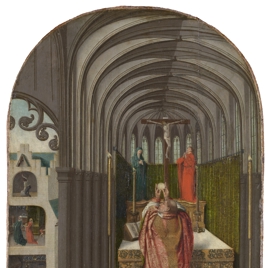
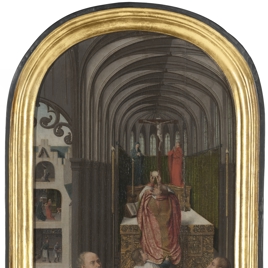
The panel painting depicts a mass being held inside a Gothic church at whose far end are stained-glass windows with Gothic tracery and vaguely visible figures. The altar appears to be located just behind the crossing, in the chancel. It is covered in gold brocade and on it stands a group of polychrome woodcarvings of the Crucifixion. The priest conducting Mass is performing the consecration of the host – which bears a depiction of Christ on the cross between two figures, presumably the Virgin and Saint John – elevating it in both hands. The front of the gilt pedestal supporting the Crucifixion sculptures is carved with several scenes set in frames with semi-circular arched tops. It is not possible to identify their iconography as they are hidden behind a pair of candlesticks and the priest, whose chasuble is held by a tonsured acolyte, as is commonly found in other representations of the same moment of the Eucharistic celebration.
Two figures kneel in attendance. One is praying and the other is raising his hands in a gesture of piety. The first man, with white curly hair, is clad in rich robes with a ceremonial appearance. The possibility that the man in the Prado painting is a councillor is highly lausible. The chaperon hanging down his back, by then outmoded, is similar to the one found in a few depictions of the members of the Great Council of Mechelen. The second man, on the right, is dressed in a rather shabby-looking short blue garment. From his belt hang a dagger and a purse. His open mouth reveals his teeth and he wears a beard, fairly unusual in the fifteenth century. He could be a beggar.
This is an unusual and enigmatic picture whose iconography is difficult to interpret. The picture may possibly represent a miracle or story related to the priest who is consecrating the host, ut the relationship with the foreground figures and in particular the house on the left is elusive. The architecture of the chancel where the scene takes place greatly recalls that of the church of Notre Dame du Sablon in Brussels; it might be related to the subject, but it might equally be merely a visual source.
The picture has interesting formal similarities with other works by Van den Bossche. The trange manner in which his legs are cropped at the ankles by the right Edge of the painting may have a parallel in Van den Bossche’s polyptych. There are also certain formal similarities in the handling of the drapery folds of the man in red and the acolyte aiding the priest in the Prado work, simplified in straight lines in the same way that Van den Bossche treats them in other figures. All this allows us to conclude tentatively that this enigmatic work, hitherto anonymous, was executed by Aert van den Bossche or his workshop around 1500.
Pérez Preciado, José Juan, Fifteenth-century netherlandish painting at the Museo Nacional del Prado. Catalogue raisonné, Madrid, Museo Nacional del Prado, 2024, p.65-69 nº.4