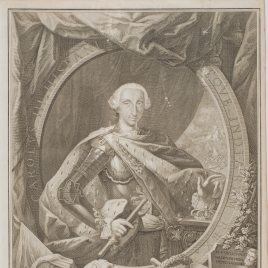
Charles III, King of Spain and the Indies
1756. Etching, Burin on laid paper.Not on display
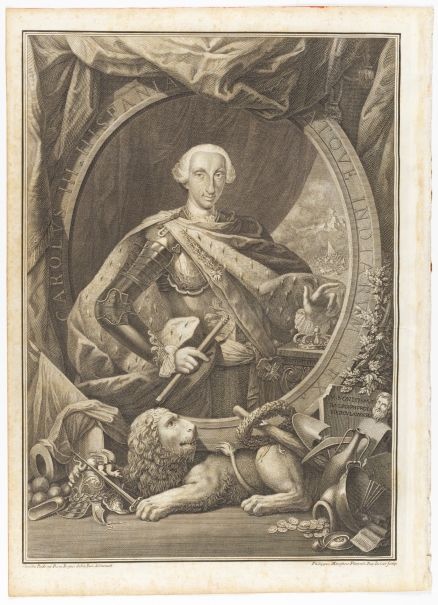
This portrait accompanies the dedicatory text to the king that appears in the preliminaries of seven of the eight volumes that make up the publication Le antichità di Ercolano esposte…, published in Naples between 1757–92. This richly illustrated work publicised for the first time the archaeological discoveries found at Herculaneum, Satbias and Pompeii. It was a major publishing enterprise that the monarch himself sponsored. In 1755, Charles VII of the Two Sicilies – soon-to-be King Charles III of Spain – chose 15 scholars amongst the members of his court so as to establish the Accademia Ercolanese. Its purpose was to study and publish the findings, thanks to the collaboration of the best draughtsmen and engravers who were already working for the king on the excavations.
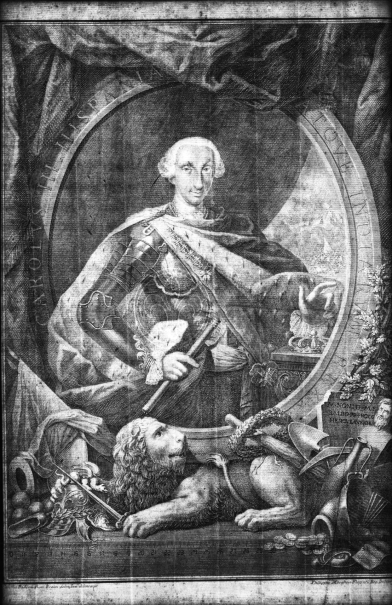
Two different states of the plate engraved by Morghen are known, with changes in the lettering of the oval frame surrounding the sitter. The copy now in the Museo del Prado collection bears the inscription ‘CAROLVS III. HISPANIA ATQVE INDIARVM REX’ and is therefore a second state, after the proclamation of Charles III as King of Spain in 1759, published from that year onwards in volumes two to seven. In addition, a first state prior to the one described is known, dating from when he was still Infante of Spain and King of the Two Sicilies, with the letter ‘CAROLVS. HISP. INFANS VTRIVSQ. SICIL. ET HIER. REX’, which was only stamped on the first volume of the series in 1757.
This image of the monarch – invented by the Roman painter and draughtsman Camillo Paderni and transferred to copper by the Florentine engraver Filippo Morghen – was subsequently widely copied and reproduced and is one of the most representative prints of Bourbon propaganda. Paderni had moved to Naples in 1740, attracted by archaeological explorations. In 1748 he was admitted as a royal draughtsman to participate in another antiquities copying project prior to La antichità, until he was eventually summoned by the Accademia Ercolanese in 1755. As for Morghen, he came from a well-known Florentine family of engravers and was the younger brother of Giovanni Elia Morghen, a famous draughtsman who was already working on the Portici excavations in 1752. Filippo Morghen was also employed as a royal engraver in Portici and was paid per finished plate, as was the case with this portrait of the king, for which he received 280 ducats in 1756.
The print shows the king illustrated with the symbols of royal power and war, as well as with several archaeological pieces in reference to the findings at Herculaneum. The king, with his crown on the table, wears armour with a sword, an ermine cloak and the sash with the Golden Fleece and the insignia of the Order of Saint Januarius, clearly alluding to the crowns of Spain and the Two Sicilies, respectively. The military character of the king is further emphasised by the baton of command, the war scene in the background, and the elements in the lower left margin: the two flags, the drum, the cannon, the balls, and the lion which, like the sovereign, shows his bellicose character by holding a sword and a helmet between his paws. It is also worth mentioning other iconographic details that highlight the honours obtained by the monarch in his military campaigns, such as the oak branch to the right of the oval and the Herculean mace below with a crown of leaves from the same tree. It is likely that the presence of the oak in this image is linked to the military motto that compares the strength of its wood with the saviour of the homeland, Quercus robur salus Patriæ, as well as to the civic crown in Iconology by Cesare Ripa who said that it was awarded to those who saved a citizen in battle.Finally, there are several objects related to the excavation activity (a pickaxe and a shovel as well as some of the most important pieces found at the time) touching the word ‘REX’ on the oval frame. There is a herm, an amphora, several vessels, coins, and two gravestones and a set of papyri and tablets. The largest gravestone, with the inscription ‘M NONIO M F BALBO PR PRO COS HERCVLANENSES’, corresponds to the one found in 1746 (Museo Archeologico Nazionale di Napoli, inv. 3731) related to the statue known as The Son of Balbo, a personality who had been a generous patron of the antique city of Herculaneum. The presence of this tombstone in the print suggests a parallel between the patron and the Bourbon king, then defender of science and arts. The same idea is repeated with the papyri and tablets in the lower left margin, alluding to the famous discovery of the Villa of the Papyri in 1752.
Solache Vilela, Gloria, Filippo Morghen según dibujo de Camilus Paderni. Carlos III, rey de España y de las Indias. en: Memoria de actividades 2021 Museo Nacional del Prado, Ministerio de Cultura y Deporte, 2022, p.79-81