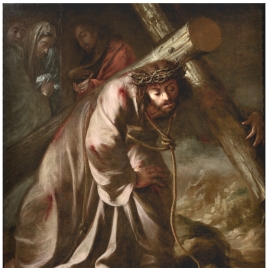
Christ on the way to Calvary and Saint Veronica
Ca. 1660. Oil on canvas.Not on display
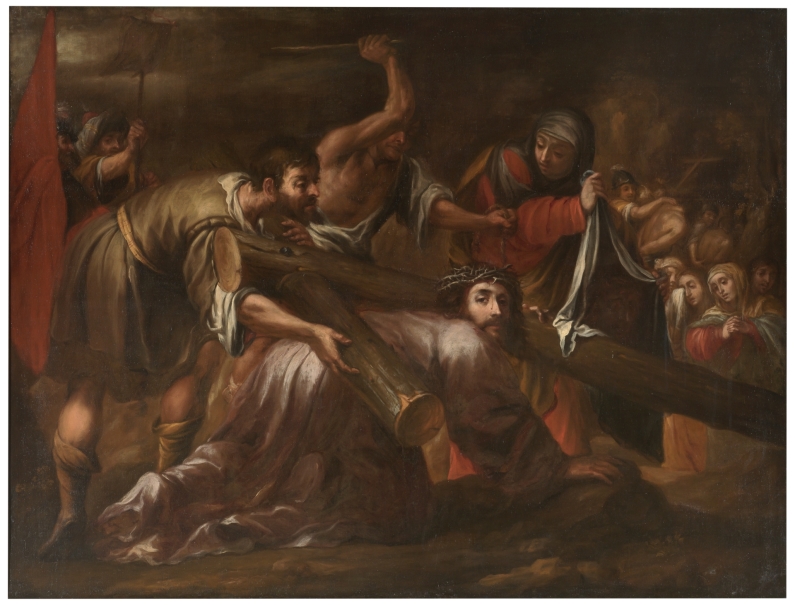
The scene could be an illustration of Sevillian religious sentiment. Perhaps the painter was commissioned to satisfy certain specific devotional needs, and for this he has used compositional resources, technique and lighting, which insist on enhancing the terrible nature of the passage of the Passion of Christ represented here. The composition is complex with many characters, painted on different planes. Full of strong diagonals and foreshortening, this is an example of the triumph of the absolute Baroque. The technique used is that of long, loose and even daring brushstrokes.
In the foreground, Jesus Christ appears fallen on his way to Calvary. The Cyrenean, in a forced posture, tries to help him carrying the Cross, while a thief comes to scourge him violently. Veronica, on his right, has already wiped his face, which is reflected in the lilac in her hands. The light, penetrating from the left side, is strongly directed to the faces and arms. This emphasises even more the dramatism of the faces, which are not beautiful at all, yet very expressive. The Saviour turns to the viewer with a sad and serene expression, which contrasts with the tension and pain of the rest of the figures. In spite of the monumentality with which the characters are treated, the sensation of instability predominates in them. In the background, on the right, the author has arranged a group centred by the Virgin, showing her pain. Behind them, the convoy that leads the thieves whose distorted figures are treated with a faster and sketchier brushstrokes than the rest? is still perceivable. On the left, the composition closes with two figures dressed in turbans, which probably allude to paganism or Judaism, as is common in the religious floats. (Orihuela, M. in "Pintores del reinado de Carlos II" [Painters during the rule of King Charles II], 1996: 102).