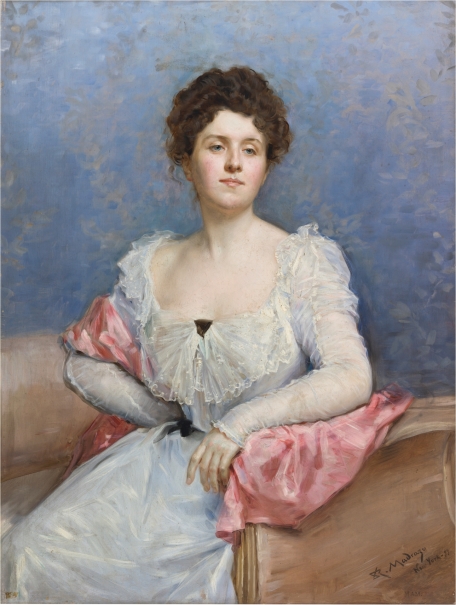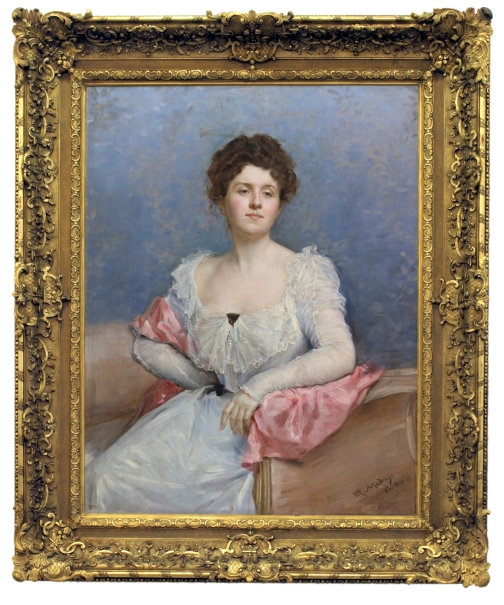
Elsie Woodbury Brown
1899. Oil on canvas.On display elsewhere
Preceding other Spanish painters such as Sorolla and Zuloaga, who acquired great renown as portraitists in Madrid and Paris and later painted several portraits in the United States of America, Raimundo de Madrazo travelled to this country on several occasions. He then painted portraits of the great world of New England, including this one, executed in 1899 in New York. Two years earlier, he had made his first trip to that city and the work was exhibited at the Ochme Gallery. In 1898 and 1899 he returned to work there and painted new portraits, for which he moved into the studio of his friend, the painter Charles Dana Gibson. In 1898, the artist went to the Stewart sale, where he acquired The Pearl and the Wave female nude by Paul Baudry for his friend Ramón de Errazu. During these years, he painted several portraits of women, whom the artist preferred as subjects, as he considered the male models to be tiresome and more conceited, as he pointed out in a letter to Martín Rico dated 4 December 1897 in New York. The representation of the elegance of the ladies of the great American bourgeoisie, among whom he portrayed Caroline Schermerhorn Astor and Alva Vanderbilt Belmont, was surely more in keeping with the painter´s sensibilities than representing the energetic characteristics of the rich industrialists and bankers.
In an article published at that time in the American press, the marked difference between the character of the female and male portraits was pointed out, and that the artist had made preliminary sketches in pencil. Regarding the study, the painter emphasised the somewhat flirtatious sensuality of the sitter by narrowing her eyes which, instead of facing the viewer, look to her right. He also painted her opening her lips slightly and her head turned. A year earlier, the artist had portrayed the same lady in a different dress and with her hands arranged differently, but with a similar hairstyle and a similar tilt of the head, this time to the left. In a photograph published by his biographers Carlos González and Montserrat Martí, the artist is shown working on the latter painting, with the lower part barely sketched.
The work in Museo del Prado was painted in the light tones, which were typical of Madrazo´s period. The work reveals the sitter’s delicate femininity in tones of almost pastel-like quality with a refinement of taste that evokes, like other works by the artist, French portraiture in the 18th-century tradition. The painter kept in touch with the trends in the United States, where he returned to paint in 1901, 1902, 1907 and 1911 as far as it is known. He was one of the main advisers on the art purchases made by Archer Milton Huntington for The Hispanic Society in New York, to which he sold part of his collection in 1913.
The sitter has been identified by F. Alcolea Albero (2020) as Elsie Woodbury Brown (1881–?), a member of a wealthy New York family.
Barón, Javier, Retrato de señora (1899). En Barón, J.: El retrato español en el Prado. De Goya a Sorolla, Madrid, Museo Nacional del Prado, 2007, p.158, n. 52