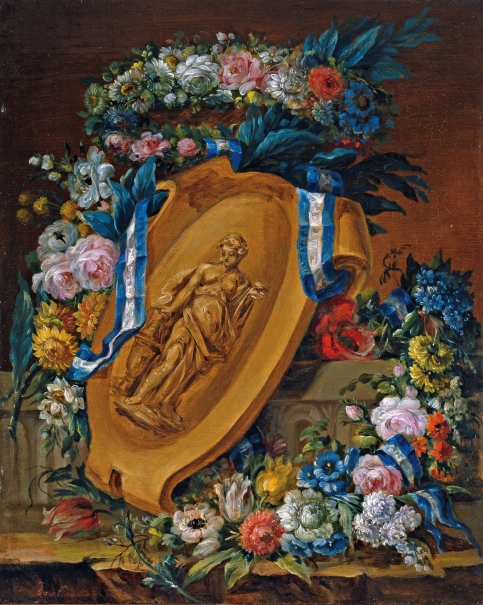
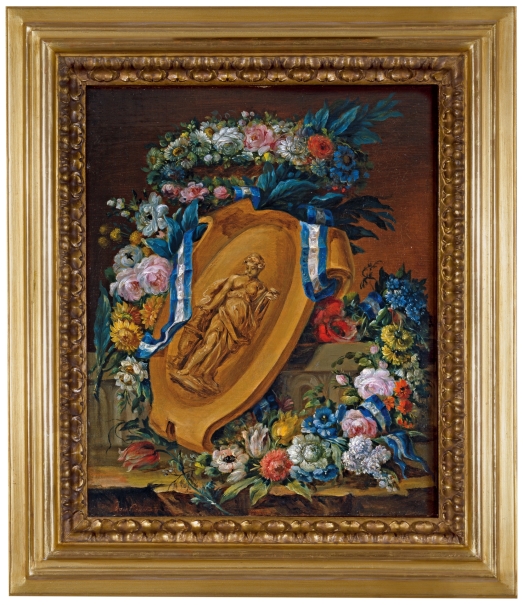
Flower garland with sculptural buckler
Ca. 1805. Oil on canvas.Not on display
This canvas of undoubtable ornamental effectiveness is faithful evidence of the trend towards decorative complexity in Valencian flower painting over the course of the 19th century. Its tangled composition comprises a rich variety of flowers as well as three stony elements which appear formally distinguished and a minor textile presence.
The most outstanding element is a stone moulding with two upper and one lower rinceaux that twist backwards. It evokes analogous existing motifs in mannerist decoration from the 16th century, which in turn were inspired by leather works, back then popularised as a result of their dissemination through etching. The female figure of a classical typology (judging by her characteristics, she could be Hebe) leans on a high vase and holds a cup with her hand. This element is intended to suggest a sculptural shape with a low relief and strongly contrasts with the diverse floral environment surrounding her as a joyful garland on both sides and as a crown in the upper register.
As is common in such depictions, the base of the arrangement is a pedestal with a broken profile in different irregularities and a flat surface. This allows the flowers to settle, as well as another stone piece – here with an elaborate front – over which the cartouche has been obliquely arranged. As a matter of fact, the three stony elements are depicted in uneven colours; this was probably done for the purpose of enhancing their differences by allowing each one’s personality to stand out.
The narrow bicolour cloth sash that meanders through the canvas could be understood as a simple decorative addition that lightens up the assemblage with its nature that is somewhere between joyful and sophisticated. Given its distinct colouring, it could also be an allusion to the prestigious Order of Charles III, a prestigious civil honour awarded by the Spanish monarchy and founded by the king with that name in the previous century.
There may be an allegorical intention in this work that has not yet been deciphered. It is worth mentioning that the artist was director of the Flowers Room in the Academia de San Carlos in Valencia between 1837-52, during Queen Isabella II’s rule (1833–68). Throughout his entire career as a public official in this position and others, he served with great skill and dedication, which only his death interrupted.
Luna, Juan J., El bodegón español en el Prado: de Van der Hamen a Goya, Madrid, Museo Nacional del Prado, 2008, p.152/153