For the homeland
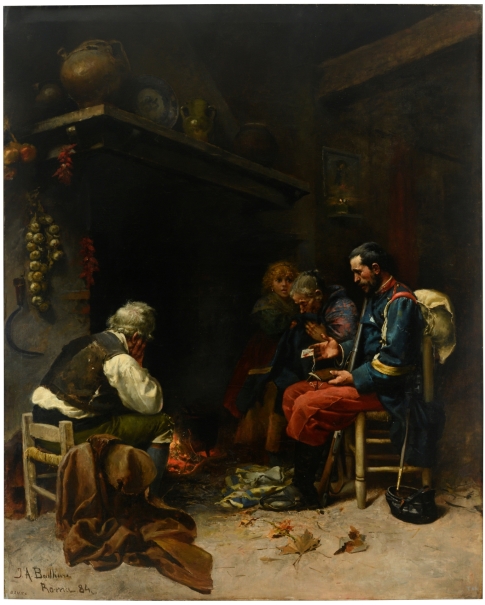
1884. Oil on canvas.On display elsewhere
The painting was awarded the 2nd at the 1884 National Exhibition of Fine Art.
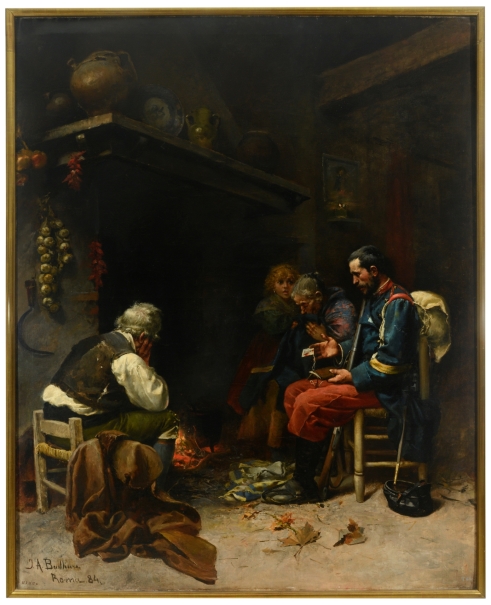
The Spanish army was not involved in any action in the year this painting was exhibited. The theme, therefore, was probably chosen by the artist to commemorate, from their own perspective, the anonymous victims who had fallen years earlier in the Carlist skirmishes. It is possible that Juan Antonio Benlliure, more receptive to the realist innovations that distanced his painting from the epics of the great figures, wished to place himself in the human drama of the hinterland. In any case, he eschewed the prosopopoeia of official language, based on rhetoric that was already becoming abstract, as there appears no irony in the title. The core of the painting´s storyline lies in the cost to the homeland, as specifically and precisely expressed in the pain suffered with the loss of a beloved, removed from reference to any cause. The work depicts a soldier who gives his son´s bloodstained scapular and military cape to his elderly parents as the only mementoes of a brave man. The figure of the father is especially touching. He appears resting his head on his right hand, while the weeping mother and a little sister are moved by his immense grief. This scene reveals qualities sentimental expression and execution of the highest order. The artist elevates the soldier to the rank of sergeant. There is a perceptible sense of a reconstruction of the scene in time, according to a before and after: the soldier comes home, he is received and they sit together in the room; the father and mother, as well as the younger daughter, listen the story he narrates on the campaign. From a formal point of view, the peculiarity of the colour, which is considered a characteristic feature of the Benlliure dynasty, stands out.
Reyero, Carlos, 'Juan Antonio Benlliure y Gil.!Por la Patria!'. En: J.L.Díez (dir.) Ternura y Melodrama. Pintura de escenas familiares en tiempos de Sorolla, Valencia, Conselleria de Educacio y Cultura, 2003, p.270-272 nº.46