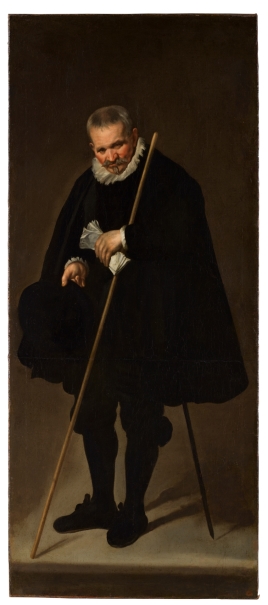
Francisco de Ocáriz y Ochoa
XVIII century. Oil on canvas.Not on display
The painting is a copy of the original – probably by Velázquez – recorded in the Buen Retiro Palace in 1701 under the title Ochoa, Keeper of the Court along with a series of buffoons by Velázquez (Pablo de Valladolid, Juan de Austria, Barbarroja, Calabazas, Cárdenas). It measures two-and-a-half varas high by one-and-a-third vara wide. In 1772, the same work appears recorded with a measure of just one vara wide. Many years later, it would be used as a model for one of Goya’s prints copying Velázquez’s paintings. Since the Peninsular War, it was lost track of among the royal collections, as it was the case in the portrait of Calabazas (now in Cleveland) and in the portrait of Cárdenas (missing). At that time, it was also known on several occasions as The Mayor Ronquillo.
Sometime before 1922 this work passed to a collector (Eugenio Iruñigarro), who purchased it in Astigarraga (Gipuzkoa). Later on, the marquess of Casa Torres acquired it and published it in 1922, believing it to be the original from the Buen Retiro. It appeared as such in the Velázquez y lo velazqueño exhibition in 1960, the last time it was publicly displayed. During those decades, it was attributed to Velázquez’s circle and Juan Carreño de Miranda (Mayer). There have been several attempts at attributing it, and attributions have varied from Francisco Ochoa, chamber keeper since 1665, to Francisco de Ocáriz y Ochoa, buffoon at the same time as Juan de Austria, Pernia or Pablo de Valladolid, in the 1630s.
Notwithstanding the aforesaid paragraph, this work is not an original, but a copy, made once the original painting’s width was narrowed. López-Rey had already acknowledged it as a copy in 1963. This derivative character is suggested by its somewhat uneven pictorial execution: in some areas the artist applied continuous brushstrokes, whereas in others he imitated the frank brushstrokes associated with Velázquez. The study of its side borders leaves no doubt about its status as a copy: as was already stated, between 1701-72 the width of the original painting was reduced by one-third of a vara. The width of this painting shows these last dimensions. However, the study of its side borders indicates that they were unmodified; that is to say, that the painting was initially conceived as having the same width as the original once it was amended. The examination of its support suggests that it is an old cloth, and that the copy was executed during the same period as the original was registered into the royal collections, namely between that undetermined moment in which the original was cut (1701–72) and the Peninsular War.
The interest in this piece lies in it being the best (even better than Goya’s etching) evidence of the original painting, which used to be part of a significant decorative ensemble that was as important as the buffoon series in the Buen Retiro palace. Its quality and the possibility of comparing it with the surviving works from said ensemble allow us to precisely imagine the stylistic formula and the compositional solutions employed in the original. This comparison supports the idea that Velázquez made the original work, since its pictorial execution or its compositional resources – for instance, the subtle modelling of space through the cast of shadows – recall his work more than Carreño’s. Accordingly, even though the papers that the character grasps in his hand correspond with what would be expected from a keeper of the court, this is most probably not ‘keeper Ochoa’, but instead is buffoon Francisco de Ocáriz y Ochoa, whose chronology corresponds with Velázquez and with the rest of the buffoons that accompanied him in the Buen Retiro.
Portús Pérez, Javier, Anónimo (copia de Velázquez). Francisco de Ocáriz y Ochoa (XVIII). en: Memoria de actividades del Museo Nacional del Prado 2020, Madrid, Ministerio de Cultura y Deporte, 2021, p.32-34