Hamlet (last scene)
1884. Oil on canvas.Not on display
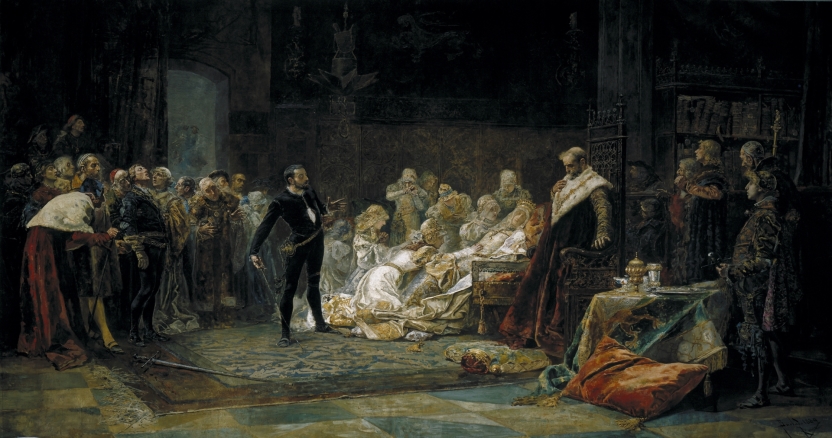
This ancient tale, popular among the Icelanders and made famous by Shakespeare, was the subject chosen by Salvador Sánchez Barbudo for one of the largest works in the collections of Museo del Prado. It was painted in 1884 in Rome, where Barbudo had settled two years earlier with his master from Seville, José Villegas. The piece was exhibited that same year in Rome and then moved to Madrid for its inclusion in the National Exhibition organised by the Ministry of State. The piece represents the first and only occasion on which the painter took part in this event. It was also his masterpiece as, right up until his death in Rome in 1917, he devoted himself chiefly to painting decorative scenes of greatcoat traditional paintings or tableautins for European and American buyers. In that year, 1884, Moreno Carbonero´s Conversión del duque de Gandía (‘Conversion of the Duke of Gandía’) and Muñoz Degraín´s Los amantes de Teruel (‘The Lovers of Teruel’) were also submitted to the 1884 National Competition. These works must have impressed Barbudo, a fact to which we find clear references. Despite the title by which this work is commonly known, it actually represents the penultimate scene of Act 5 of Hamlet.
The scene takes place in a room in the castle where a sword contest between Hamlet and Laertes has just been played out. Claudius, the King of Denmark had placed a wager on the contest, after the third round, in an act of foul play, Laertes wounds Hamlet with his sword prepared with poison, but in turn is also wounded by Hamlet with the poisoned blade which the prince has seized. Sánchez Barbudo depicts Laertes leaning on a group of servants, looking up, as if resigning himself to the fact that he is justly killed by his own treachery. Shortly before, during the contest, Queen Gertrude, had toasted Hamlet, drinking from a cup presented to her by a page, but that had not been intended for her. The cup contained a poisoned pearl placed by Claudius, with the intention of presenting it to Hamlet to drink a toast if he were victorious, avoiding Laertes blade. The dying Laertes then confesses to Hamlet that the contest had been a plot concocted by himself and Claudius to assassinate him. With the last of his strength, Hamlet takes the poisoned sword and plunges it into the usurper king. Sánchez Barbudo represents the scene with a mood of restrained tension, just before the sequence of deaths befalls. At the door in the background of the painting, Fortinbras, the Prince of Norway, can be glimpsed, along with the ambassadors of England, who, according to Shakespeare´s work, do not witness the moment and arrive when the bodies are lying on the floor.
All newspaper chronicles describing the 1884 National Exhibition emphasize the complexity of the composition and the painter´s skill in handling colour. The vibrancy of the palette is striking, though its extremely intense chromatic values do not always model reality. The forms are defined only through this use of colour, producing both modelling and drawing. With the rapid and sure applications of colour to the canvas, the artist demonstrates solid knowledge of light theory, the decomposition of colour, and the effects achieved by bringing the primaries closer to their complements. The resolution of the cushions and the tapestry are a vivid instance of this technique. In the colours, which almost spring directly from the bladder – used to contain paint - or the tube, we can feel the plasticity of the new industrially produced materials which, with their better maceration and mixing, manage to give a more unctuous and creamy appearance to the brushstroke. Except for the brownish gradations in the background, there is no glaze painting; on the contrary, the figures are constructed using dense, opaque colours applied with flat, sometimes very thick brushstrokes. The preparation is made visible either because it is left uncovered or because it is perhaps removed with a piece of cloth, or a spatula, and the weave of the canvas can be seen across the entire surface. On the left of the composition, the manner in which the head of the elderly man is painted stands out. Bent and dressed in red, his head is placed in a powerful, unreal backlighting, created with only three colours and a minimal mixture in the palette. By chromatic abstraction, Sánchez Barbudo achieves that the mixture of colour is produced in the eye of the spectator.
Martínez, L, La restauración de Hamlet: última escena de Sánchez Barbudo. Boletín del Museo del Prado, Museo del Prado, 2007, p.46-59