Interior
1909. Oil on canvas.On display elsewhere
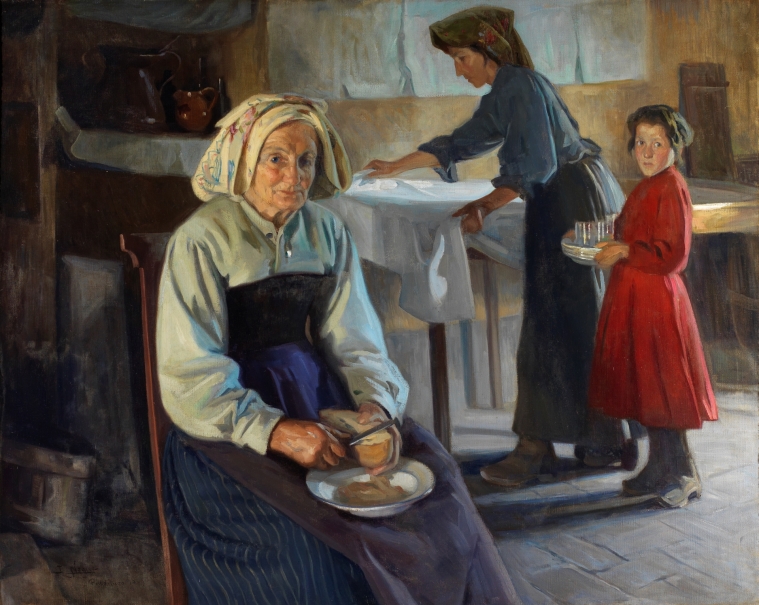
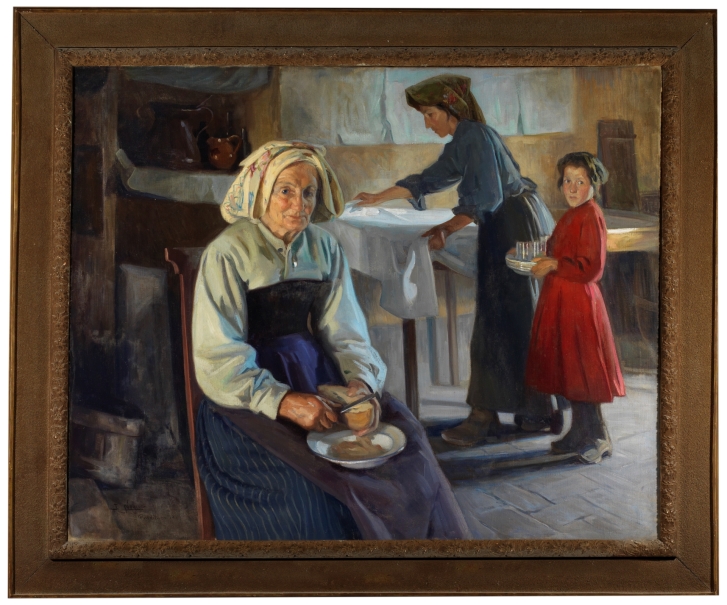
In the autumn of 1908, José Nogué, a brand-new pensioner from the institution Academia de España en Roma, arrived in Piediluco, a small village in the Umbrian Apennines. There, the artist began to work on his annual dispatches of oil paintings. In his memoirs of 1909, he described this work as follows: ‘the scene takes place inside the house, where Sora Rosa in her peasant costume can be seen. In the centre of the composition, she is depicted seated while making soup. Meanwhile, her daughter and granddaughter prepare the table for the next meal. The whole scene was enclosed in a typical background. Moreover, the figures receive the daylight coming in through the street door’. Sora Rosa was an old woman who worked the lands of the Marquis of Cini. Nogué had met her shortly before, while she was hoeing the land. This caught the painter’s attention and led him to portray her in a painting that preceded this one.
The viewer is contemplating a family scene related to several people with whom the painter had direct acquaintance, and it is quite likely that the artist asked the subjects to pose for this piece, or worked from studies of them, enabling him to compose two simultaneous scenes. The grandmother in the foreground is engrossed in thought while preparing the meal. Meanwhile, behind, stand her daughter and granddaughter, the latter gazing in surprise at the viewer. The two lead us into the background of the painting where the light enters, while the women are busy with separate household chores. The juxtaposition of the two disconnected stories, although both banal and trivial in themselves, create a monumental ruins of the family.
The terseness of the brushstrokes accords with the simplicity of the atmosphere, and their plainness with the sobriety of the gestures, evoking the drudge of the everyday. The work belongs to the poetry born from that passion for the authenticity of human feeling, which the fin-de-siècle considered to be preserved in the small rituals of peasant life. The expression of the figures is thus impregnated with that sense of the transcendent, Nogué´s generation believed could be observed in common folk, which constituted a way of approaching the very essence of life itself.
Reyero, Carlos, 'José Nogué y Massó. Interior'. En: J.L.Díez (dir.) Ternura y Melodrama. Pintura de escenas familiares en tiempos de Sorolla, Valencia, Conselleria de Educacio y Cultura, 2003, p.218 nº.30