Landscape with river and town
XVII century. Oil on canvas.On display elsewhere
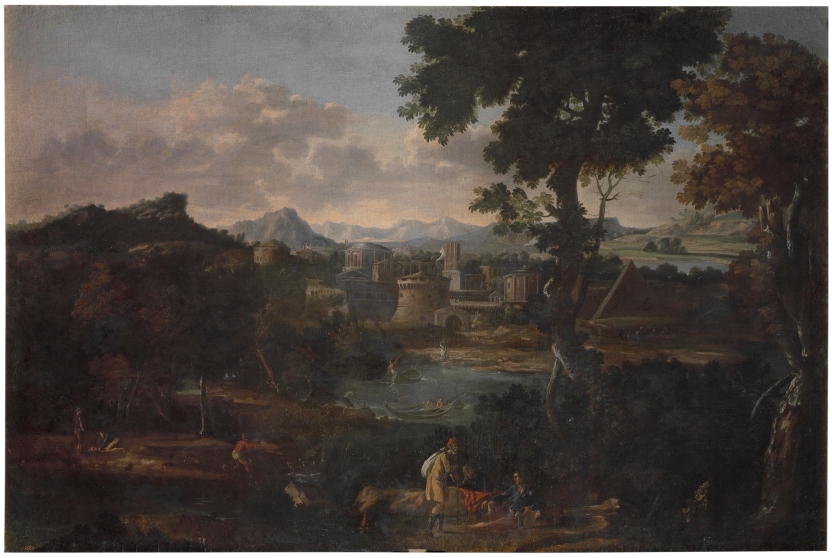
Near a wide river, several shepherds are resting under the shade of a large tree. Seated on the ground and leaning comfortably on a rock, one of them seems to be telling a story, and the other two listen with great interest. This attention is particularly noticeable in the attitude of the man who stares at the speaker, with his head resting on his hand, whose arm is resting on a boulder covered with a red mantle as a table. Behind them, a deep landscape opens up, primarily dominated by the river and the various activities taking place there. In this respect, several boatmen can be seen, two of whom are approaching the shore with their boats while another is rowing in the opposite direction. It might be thought that they are fishermen finishing their day’s work, but none of them are carrying the tools of their trade. The last one is approaching a place where a woman who holds a pitcher over her head is waiting for him.
Beyond the water and opening up through the vegetation, a majestic city appears in the centre of the canvas and comprises various buildings from classical antiquity and others from the Middle Ages, perhaps intended to evoke the city of Rome. These include the pyramid and the circular temple on the right, which are possibly inspired by the Pyramid of Caio Cestius and the temple of Hercules Victor (converted into a church in the 17th century) in the Forum Boarium, respectively. Although the models for these architectural structures are taken from repertoires widely used in the workshops of the period, here an abandoned or ruined city has not been depicted (unlike other representations of this type) but rather traces of human activity have been added to the perfect state of the buildings. The most striking of these is the smoke rising from a chimney, an element that is poignantly located right in the centre of the composition.
The upper half of the painting is almost entirely occupied by treetops and a cloud-filled sky whose brilliant tones, in addition to offsetting the chromatic emphases of the lower half with a certain balance, depict the represented moment during the evening. Both sections are divided by the narrow line of a mountain range, a perspectival device used by the painter to extend the depth of the landscape.
Many of these formal and technical characteristics bring this painting closer to the circle of the Carraccis. With this general attribution, it first appeared in the inventory of the Real Museo in 1857, and there is no record of its presence in the royal collections at an earlier date. Pérez Sánchez considered that it might have been a poor-quality reworking of a Carracci work by his own workshop. Nonetheless, he changed his mind for the 1970 exhibition, when he hesitantly suggested that it might have been painted by Giovanni Francesco Grimaldi, the Bolognese; but in the Museo del Prado catalogue of 1990 it was listed as an anonymous Roman work. However, this canvas reveals a profound knowledge of the landscape paintings of the Carraccis’ pupils such as Domenico Zampieri, or Domenichino (1581–1641), and others such as Gaspard Dughet (1615–1675), with characteristics that converge in Grimaldi’s brushstrokes. There are other examples of this artist in the Museo del Prado, and he is frequently mentioned in the inventories of the assets of King Philip V and Queen Isabella Farnese. Some of these come from the collection of Carlo Maratta, and although it is not possible to identify any of these references with this canvas, it has been erroneously thought in the past that it may have been one of those acquired from the painter’s heirs. On the other hand, we know that the Bolognese artist executed several paintings for the Marquess del Carpio, with whom he seems to have shared a friendship.
Japón, Rafael, ' G. F. Grimaldi, el Boloñes. Paisaje con rio y ciudad' En:El factor Prado: los depósitos del Museo Nacional del Prado., Museo de Bellas Artes de Asturias,, 2022, p.62-65 nº 11