Landscape
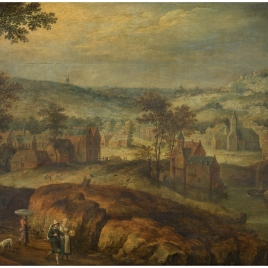
Ca. 1604. Oil on copperplate.Room 083
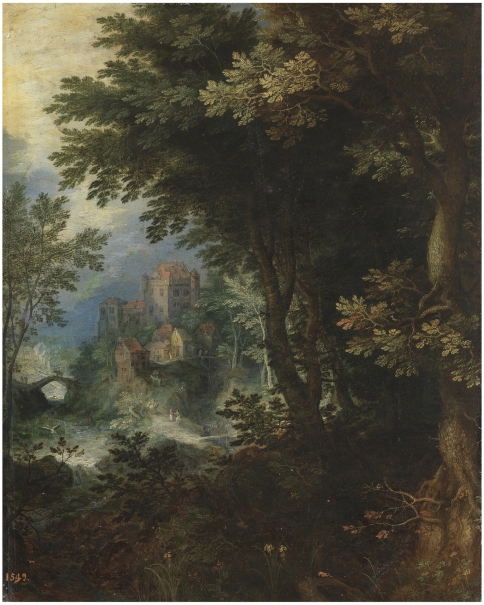
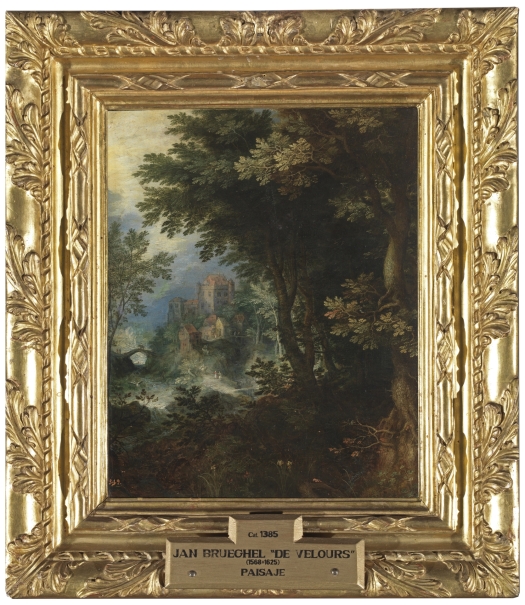
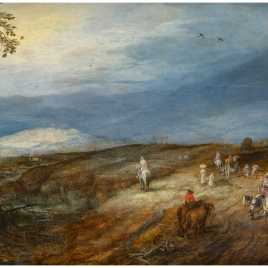
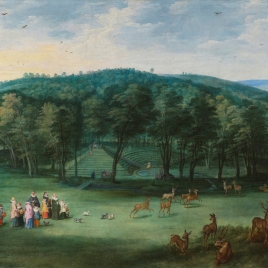
In this work, the painter depicts a landscape with compositional and stylistic characteristics that recall two small panels, The Sacrifice of Abraham (Musée d’Art et d’Histoire in Geneva) and Forest (Kunsthistorisches Museum, Gemäldegalerie in Vienna), painted by Jan Brueghel the Elder around 1604–1610. It is possible that he painted this work in the summer of 1604 during his stay at the court of Rudolf II, the Mad Alchemist, Holy Roman Emperor, in Prague, where Roelant Savery was able to have a look at it and employ it as a model for his Forest with Fruit Seller (Kunsthistorisches Museum, Gemäldegalerie in Vienna). The vertical size and spatial structuring of three parallel chromatic planes (brown, green and blue) are typical of 16th-century paintings. However, Brueghel softens the transition between them, thus providing the whole painting a greater spatial unity. As the Italian painter and treatise writer Giovanni Paolo Lomazzo recommended, the trees in the foreground have been raised to the edge of the canvas in order to assign an adequate proportion to the figures next to them. This is an outstanding example of the Nordic Stimmungswald – that is, of the real, albeit idealised forest – painted to move the viewer. Thus, it is the painter himself, or the viewer, who, before entering or leaving the forest, can contemplate the view of the melancholic valley that unfolds before their eyes, framed by the undergrowth and the tree branches that lengthen to occupy more than half of the pictorial surface, where the inhabitants of a small, fortified village come and go in their daily lives.
Posada Kubissa, Teresa, El paisaje nórdico en el Prado. Rubens, Brueghel, Lorena, Madrid, Museo Nacional del Prado, 2011, p.40-41, 156, n. 5