Manrique
Ca. 1887. Oil on canvas.Not on display
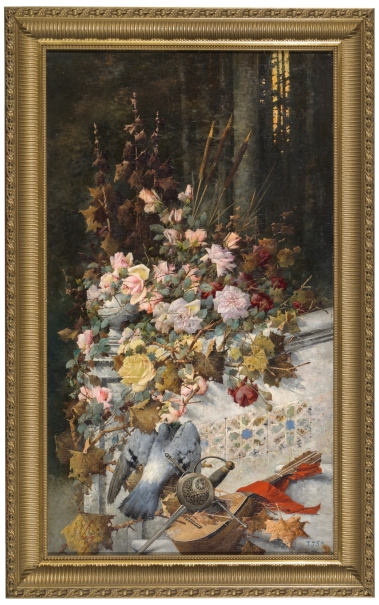
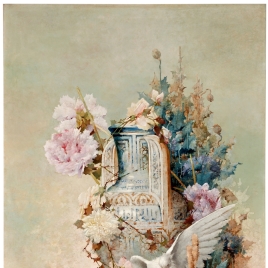
Together with the work that complements this piece, Leonora (P006880), this set of paintings represents the most characteristic facet of the painter´s work, specialised as he was in a very personal interpretation of the genre of vases and still lifes, art objects and birds almost always the subjects. In this work, Lengo allegorises the spirit of the young Manrique in love, the protagonist of the chivalric romance El trovador [The Troubadour], a work by Antonio García Gutiérrez (1813–1884). It was first performed at the Teatro del Príncipe in Madrid on 1st March 1836 and proved a great popular success. Nevertheless, the work acquired immortal fame thanks to its adaptation as a lyric libretto by Salvatore Cammarano for Giuseppe Verdi´s opera of the same title, which was first performed on 19th January 1853 at the Teatro Apolo in Rome.
The plot revolves around the story of the love affairs of Manrique, an officer in the army of the Count of Urgel. The young man longs for the noble lady Leonora and tries to make the young lady fall in love with him at night by singing serenades in the guise of a troubadour, at the foot of the Aljafería palace in Saragossa. In the painting, the young Manrique appears depicted as a pigeon, singing his song under a ledge made with Arabic tiles and next to a splendid bouquet of roses. The lute and the sword, weapons of love and war, are identified with the knight, who, mysterious in origin, is finally discovered to be the son of a gypsy woman.
Díez, José Luis (dir.), Pintura del Siglo XIX en el Museo del Prado: catálogo general, Madrid, Museo Nacional del Prado, 2015, p.316