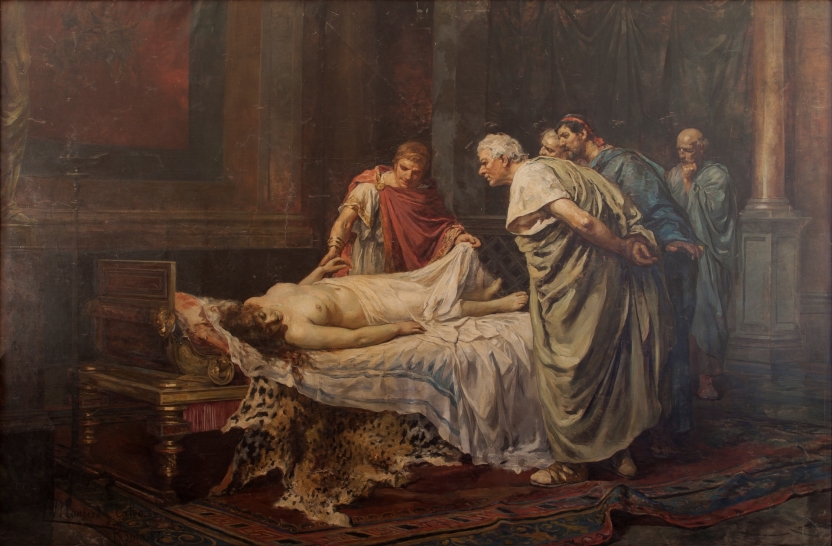
Nero before the Corpse of his Mother, Agrippina the Younger
1887. Oil on canvas.On display elsewhere
This work was included in the 1887 National Exhibition of Fine Arts (n. 532), where it was awarded the second-place medal. In the exhibition catalogue it was described with an extract from the Life of the Twelve Caesars by Suetonius Tranquilus: ‘Nero, seeing that three times his mother had managed to escape the death he had ordered, neutralising the effects of the poison she had been given with antidotes, resolved that she should die by drowning or crushing. To this end he ordered a ship to be built which, at a given moment, by manoeuvre, would sink, as if by an accidental collision. Nevertheless, against all precautions, and in a rare case, Agrippina saved herself swimming. This left Nero not knowing what course to take. C. Suetonius Tranquilus relates that at this moment Lucius Agerinus, Agrippina´s freedman, arrived. He was very pleased to announce to the Emperor the news that his mother had been saved. Then the tyrant, throwing a dagger on the ground, began to shout to make it appear that he was the victim of an assassination attempt ordered by his mother. He had Lucius Agerinus
seized and loaded with chains. Moreover, he ordered his mother to be killed in such a way that it would appear that she had caused her own death in order to escape the consequences of her crime. There are also atrocious circumstances narrated by men of undoubted veracity. It is said that Nero rushed to see Agrippina´s corpse, that he felt her cold limbs, praising the beauty of some and criticising others, and that, feeling thirsty, he asked for a drink right there at that moment’.