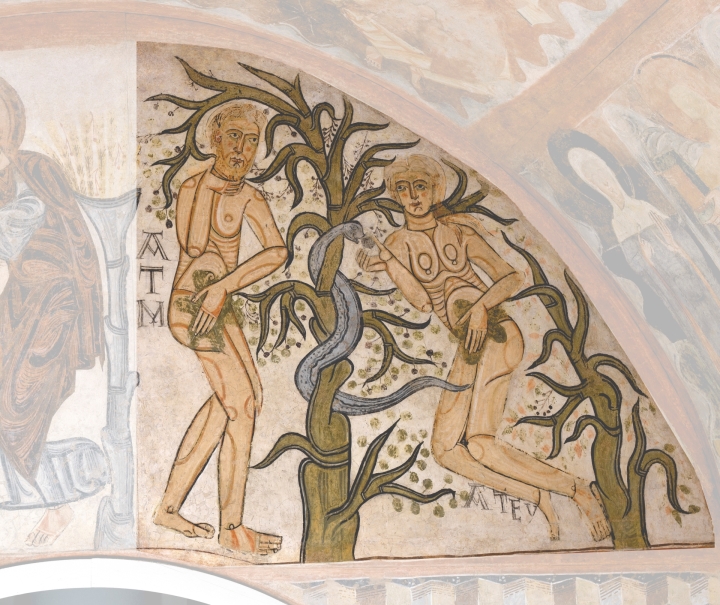
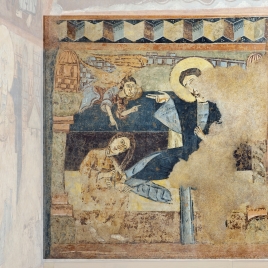
Original Sin, Hermitage of Vera Cruz, Maderuelo (Segovia)
XII century. Fresco painting on mural transferred to canvas.Room 051C
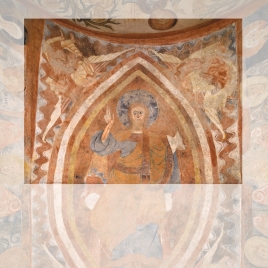
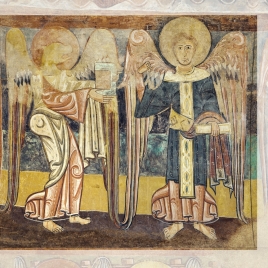
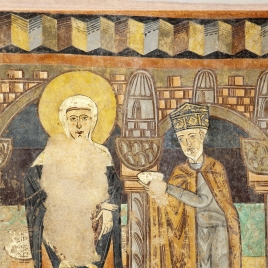
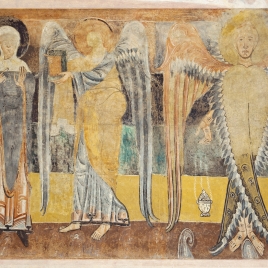
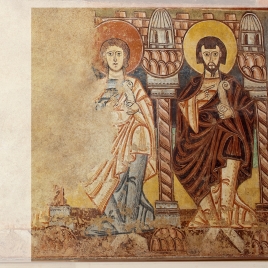
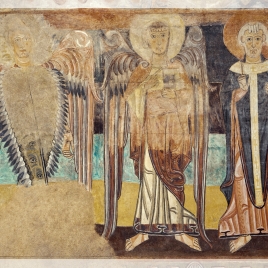
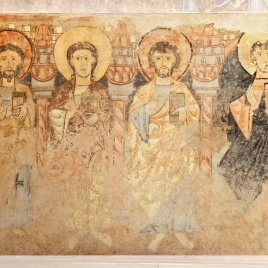
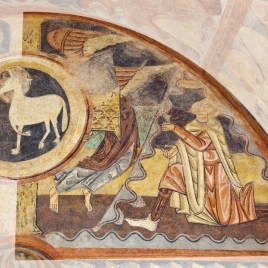
The mural paintings from the Hermitage of the Vera Cruz de Maderuelo were transferred to canvas in 1947 and reconstructed at the Prado Museum in a layout as faithful to the original as possible. The walls of the chapel are decorated with figures of angels, Apostles and evangelical scenes. The front bears two biblical themes. Dome, center: God the Father held by four angels. Left side: The Annunciation, Incense-bearer Angel. Saints Matthew and Luke. Right side: Saint Mark, Angel with a roll, Saint John the Evangelist (?), Incense-bearer Angel, Angel with book, Holy Bishop. Arches: Cain (or Melquisedec) and Able make offerings to the Lamb inserted in the Cross, The Creation of Adam and Original Sin. Left wall: Six Apostles, Mary Magdalene salves the Lord´s Feet, The Adoration of a Mage to the Virgin and Child. Right wall: Four Apostles. The figures represented are typically Romanesque, with neither volume nor depth. They are delimited by a few simple contours that divide their corresponding spaces. The artist´s style has always been considered very similar to that of the Master of Tahull.
Between this panel depicting Original Sin and that of The Creation of Adam (P007285), the representation of a palm tree stands out. This could be because it is identified with the Tree of Life and the eastern location of Eden (Genesis 2:8), where this tree was supposed to have originated. Using the palm tree and the assistance of colour, pre-fall Eden of Creation was separated from post-fall Eden, represented by the Tree of Knowledge, which is depicted dry. Its deterioration, caused by man´s disobedience and represented chromatically, reflects the knowledge of the ancient stories related to the Tree of Death. This motif was also used in other Castilian sets, such as those of San Miguel de Gormaz and San Baudelio de Berlanga. Given the popularity of the theme of the Tree of Death in Byzantine art, the proposition of the Italo-Byzantine ancestry of these artists seems increasingly certain.
Ávila Juárez, Antonio de, La palmera un elemento iconográfico desconocido de las pinturas románicas de Maderuelo. Boletín del Museo del Prado, 2017, p.6-15