Petronella de Waert
1670. Oil on canvas.Not on display
This painting formed part of the collection of the Marquis of Castro-Serna (Madrid) where, according to Michel (1887) -who repeats information given by Alfonso de Stuers- it appeared in 1887 as a pendant to the portrait of Nicolaes Pancras (whereabouts unknown). Gudlaugsson (1959) assumes that both were replicas of the original portraits of Nicolaes Pancras and Petronella de Waert (current whereabouts unknown) that came to light at the sale of the J. Bleuland collection.
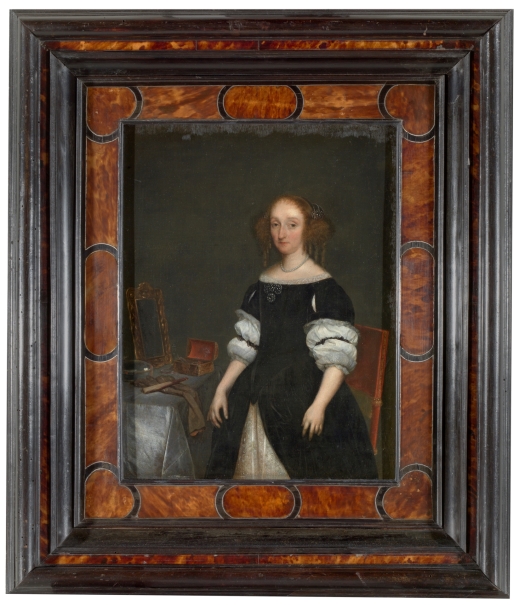
From a pictorial viewpoint, there is a striking contrast between the fine quality of the figure and the imprecise modelling of the chair and objects that appear on the table. Gudlaugsson, whose knowledge of this painting was limited to an old photograph, considers that only the glove and fan are actually the work of Gerard ter Borch. In fact, none of these elements appear in the drawing of this portrait included in Gesina ter Borch`s watercolour album. However, a morphological analysis of micro-samples reveals that the preparation layer of the tablecloth and objects on the table is the same as that of the dress and that, in the case of the objects arranged on the table, there is no intermediate glaze or other separation layer which would vouch for subsequent additions to this area. Furthermore, an X-ray of the portrait does not suggest the work of two different people, although it does show minor corrections on the left-hand sleeve of the dress and the left-hand side of the skirt, the curve of which was slightly lowered. This correction, evident to the naked eye, suggests that rather than a replica, as Gudlaugsson believes, this may in fact be an original, perhaps even the very picture that used to be a part of the J. Bleuland collection now regarded as lost.
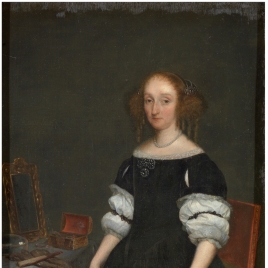
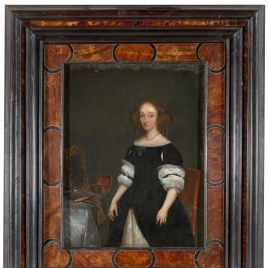
Ter Borch popularised the subject of women at their dressing tables. Here, Petronella de Waert (1628-1709) is portrayed standing against a black background in a sumptuous black velvet dress with a white satin underskirt adorned with lace picots and silver brocade. The diverse materials and fabrics are represented with this painter`s customary skill.
The model is wearing a short pearl necklace and black amber adornments in her hair and on her chest. From a stylistic point of view, the work is typical of the restrained and honest bourgeois portraiture -with the sitter depicted three-quarter length-cultivated by the artist during his stay in Amsterdam. As is also common in his work, the model`s features are portrayed realistically, since, unlike Amsterdam portraitists, Gerard ter Borch was always more interested in capturing the individuality of his sitters than in conveying their social status.
In autumn 1670, Gerard ter Borch received a commission to portray different members of the family of Nicolaes Pancras (1622-1678), Burgomaster of Amsterdam and President of the East India Company.
Of these portraits, the following have been identified: that of Nicolaes Pancras himself (Hamburg, Kunsthalle); his children, Gerbrand Pancras (Manchester Art Gallery) and Aletta Pancras, and the latter`s husband, François de Vicq, also Burgomaster of Amsterdam (both Amsterdam, Rijksmuseum) (Posada Kubissa, T.: Pintura holandesa en el Museo Nacional del Prado. Catálogo razonado, 2009, p. 297).