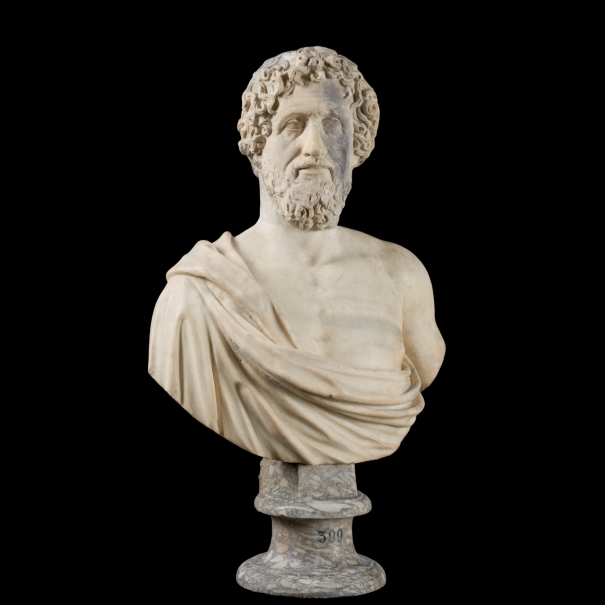
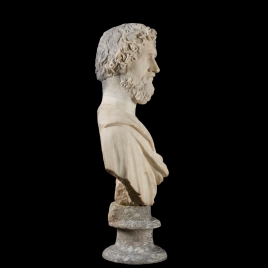
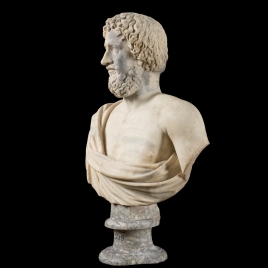
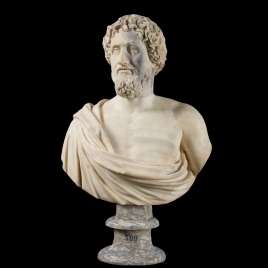
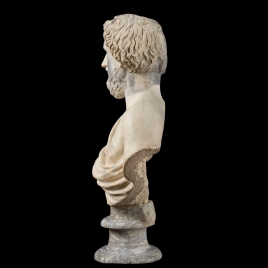
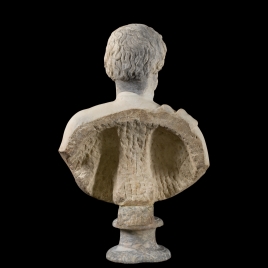
Portrait of One of the Seven Sages of Greece
II century. Marble.Not on display
A saltire carved into the right shoulder of the bust tells us that this marble figure belonged to King Philip V, and must therefore have been in the royal collection since at least the eighteenth century; however, since it has not yet been clearly identified in any of the early inventories, its exact provenance remains unknown.
The piece comprises two different parts: the head, its nose a later replacement, and the bust draped in a paludamentum, presumably of Baroque origin. The marble displays some greyish streaks, but the blackened debris visible on the surface was caused by fire, suggesting that the figure survived the blaze which destroyed the Alcázar in Madrid in 1734.
Stephan Schröder has dated the head to the second century AD, noting a number of specific features – such as the way the curls fall over the forehead – reminiscent of other figures produced at that time, which might provide some indication of its possible authorship. However, even the iconographic identification of the portrait is unclear. Given its resemblance to the head of a double herm at the Villa Albani in Rome, whose reverse bears a portrait of Periander of Corinth (7th century BC), one of the so-called "Seven Sages of Greece", this may well be another illustrious member of that select group, though his exact identity has yet to be confirmed.
As we are often reminded, Pliny credited Asinius Pollio with the idea of placing portraits of well-known authors in Rome’s public libraries, alongside their books. The aim was somehow to capture their soul through their likeness, so that readers might fruitfully engage not just with their written work but also with their physical presence.
Ever since, the major figures of classical antiquity – not just intellectuals but also politicians, military strategists, and artists – have graced our galleries and graphic repertoires, illustrating our need to identify excellence through a tireless quest for a plausible likeness that might ultimately enhance the credibility of the written word. It was that same need to "engage" with those now in a higher order of being which prompted, from the Middle Ages onwards, the assembly of collections of busts-reliquaries, endowing the anthropomorphic representations with all the transcendence required in order for a mortal to communicate with the inmortal.
Arias Martínez, Manuel, 'Anónimo. Uno de los siete sabios de Grecia'. En: Guido Reni, Madrid, Museo Nacional del Prado, 2023, p.246 nº 37