Queen Maria Luisa Gabriella of Savoy
1700 - 1701. Oil on canvas.On display elsewhere
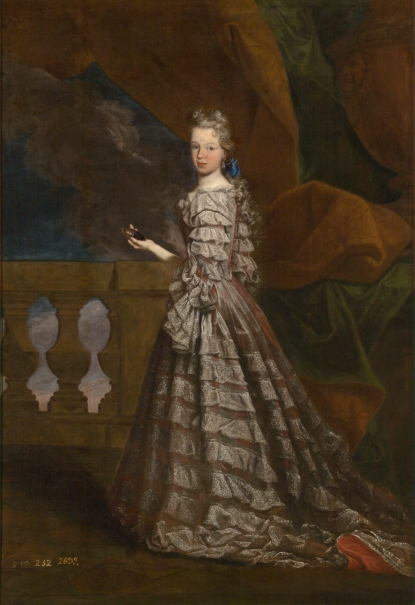
The first wife of Philip V and mother of the future Louis I and Ferdinand VI, Maria Luisa Gabriella of Savoy (1688–1714) played a prominent and recognised political role, not only as queen consort but also as governor in the king’s absence (1702, 1704, and 1710). Her marriage, celebrated in 1701, was sponsored by Louis XIV and interpreted as an opportunity to strengthen the alliance between the Bourbon and Savoy dynasties in the context of the War of the Spanish Succession. During the period of the pre-nuptial negotiations, Le Vey depicted her in this image holding a miniature of her future husband, a work inspired by Hyacinthe Rigaud’s portrait of 1700 (Versailles, château de Versailles).
Le Vey repeated this model in other portraits of the princess, in which the miniature image of the king is replaced by elements with similar symbolism, such as the crown. In the portraits executed after Maria Luisa’s arrival in Spain, the representation of her face was notably different, with an absence of the spontaneity conveyed in those earlier works; hence the fact that, ten years after her arrival, the queen still lamented the lack of a good court portraitist capable of depicting her as she wished. In 1712, Miguel Jacinto Meléndez was entrusted with configuring the official image of the queen, frequently depicting her alongside Philip V and later accompanied by her son, Prince Louis of Bourbon.
A version of the painting, which has been misattributed, is at the Musée de la Chartreuse in Douai (inv. 1271, oil on canvas, 76 x 60 cm), in which Marie Louise Gabrielle is depicted holding a sceptre instead of a miniature portrait of her betrothed.
García Pérez, Noelia, The female perspective III. Queen Isabella Farnese (1692-1766), Madrid, Museo Nacional del Prado, 2025, p.20-27; 28 n.1