Saint Anthony of Padua and the Miracle of the Mule
Ca. 1500. Oil on baltic oak planks.Not on display
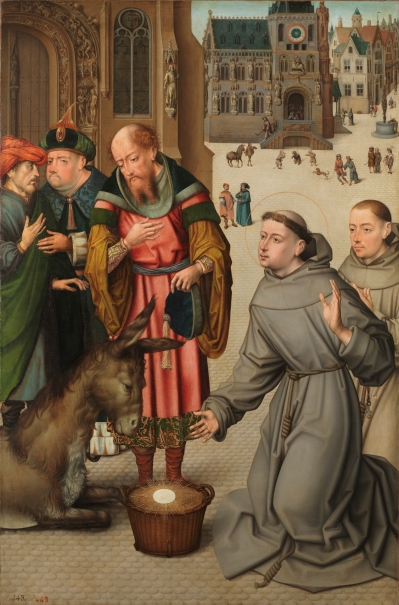
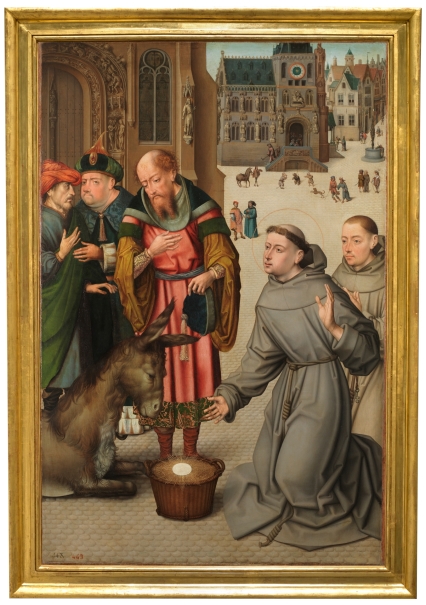
The work depicts a miracle from the life of saint Anthony that occurred in the city of Rimini in 1227 and is reported in nearly all the saint’s early biographies. Saint Anthony was preaching about the real presence of Christ in the Eucharist when an Albigensian heretic named Bonovillo challenged him, stating that he would believe in the dogma if a mule he had deprived of food for three days fell to its knees at the sight of a host. On the day of the challenge, which took place in the public square, the saint placed the Blessed Sacrament on top of the animal’s fodder and the mule knelt before it. Witnessing the miracle, the heretic was converted. The painting even shows the relief of the Crucifixion on the host lying on the basket of fodder. This hagiographic miracle is in a sense an adaptation of the biblical legend of Balaam’s donkey (Numbers 22:21–35) and of Isaiah’s statement about the ass knowing its master’s crib (Isaiah 1:3).
Up until 2024 the painting has been officially catalogued as an anonymous Flemish work of about 1500 linked to Bruges. The work has several affinities with the other two paintings attributed to the Master of the Bruges Passion Scenes apart from its extreme austerity and the presence of vacuous facial types with broad cheeks, large ears and very close-set eyes, which is how Friedländer defined the painter’s figures and works.
Comparison of the underdrawing of all Works reveals further reasons to support the idea of a common authorship. For example, the free, loose brushstrokes used to sketch the buildings in the background of the Prado work is also detected in the design of the buildings in the left background of the Bruges painting.
Despite these similarities, the Madrid painting, owing perhaps to its unusual iconography, lacks the histrionic people with grotesque faces that are found in the other two works attributed to the Master of the Bruges Passion Scenes, for example the tormentors who scourge Christ. In addition, the Prado painting does not display the same borrowings from the prints of Martin Schongauer (c. 1435/53–1491) and Albrecht Dürer (1471–1528) that are evident in certain figures in the London and Bruges works.
Bearing in mind the above iconographic and formal connections, this “Saint Anthony of Padua and the Miracle of the Mule” should be regarded securely as the work of the Master of the Bruges Passion Scenes, even though it is somewhat different from his other two known works in Bruges and London – where the lingering presence of Dürer and Schongauer is stronger – and is closer to other more contemporary models. This appears to signify an evolution in the master’s style, which in the Prado work displays a shift towards softer figures more reminiscent of Memling and David, and also coincided with the emergence of Juan de Flandes, whose connection with this master has yet to be sufficiently explored. All this makes it possible to date the work to around 1490.
Pérez Preciado, José Juan, Fifteenth-century netherlandish painting at the Museo Nacional del Prado. Catalogue raisonné, Madrid, Museo Nacional del Prado, 2024, p.165-172 nº.18