Saint Peter of Alcántara giving Communion to Saint Teresa of Jesus
1620 - 1630. Grey-brown wash, Pencil ground, White lead, Pencil, Squared-up on laid paper.Not on display
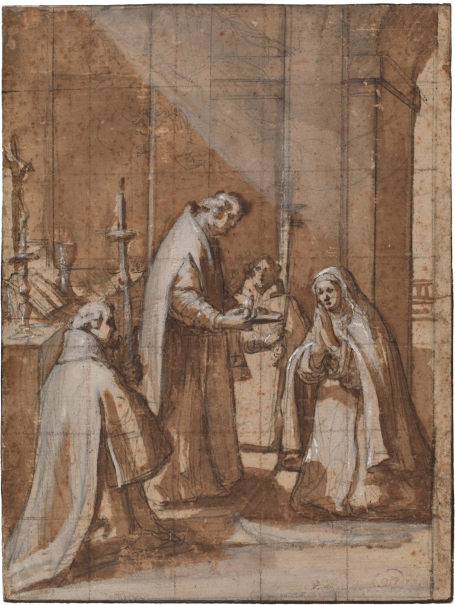
This drawing depicts a religious scene inside a temple, with a powerful arch that serves as a frame for the main group of figures. A kneeling nun is about to receive communion from the hands of a priest dressed in pontifical vestments. The priest is flanked by two acolytes, also kneeling, each one holding an altar candle. This scene has been traditionally interpreted as the communion of a saintly nun. However, according to the historians Manuel Castro and Salvador Ordax, it is Saint Peter of Alcántara giving communion to Saint Teresa of Jesus. A comparison between this drawing and the painting of the same name by Juan Martín Cabezalero at the Lazaro Galdiano Foundation reveals a practically identical composition. If that were the case, the acolytes would have to be identified as Saint Francis of Assisi and Saint Anthony of Padua. The episode depicted in the drawing is the one in which, according to legend, Saint Francis and Saint Anthony appear one day to act as deacon and subdeacon, respectively, at a mass officiated by Saint Peter of Alcántara, in the presence of Saint Teresa. The female figure appears to be wearing a Carmelite habit, identical to what she wears in another sketch preserved in the Museo del Prado, titled Saint Teresa of Jesus giving the Habits of the Barefoot Carmelite (D5988), to which it is probably related.
The large amount of preliminary work that can be observed in the drawing is very striking. As is typical in Carducho’s oeuvre, the sketch was drawn in black pencil but with fairly smooth and rapid strokes. Notable changes to all the figures in this first approach are perceptible. However, the most significant change was made to the acolyte in the foreground, as a pair of wings can be observed emerging from his back. This is an element that appears on many occasions on Saint Francis of Assis, and it has allowed this figure to be identified with the saint. This first phase of work is barely visible under the dense layer of brown wash with which Carducho covered the sheet to create the volumes and shadows. Likewise, he also retouched the final contours of the figures with a blunter black pencil. He then illuminated the scene with white lead; first with a very diluted layer, especially on the vestments of the figures, and then with thicker brushstrokes in specific areas. Among these, the cross, the chalice, the sacred Host and Saint Teresa’s headdress and cloak were highlighted, in order to give them even more prominence in the work. Finally, the artist gridded the drawing in black pencil. Then, he retouched some of the strokes with a sanguine pencil, as it is exemplified in the The Adoration of the Magi in the British Museum.
It is also remarkable that, once completed, a figure of Christ with the cross on the cloud supported by angels was added to the upper part of the sketch, with the possible intention of clarifying or enriching the scene. An interesting detail is that Christ’s body is cut off at shoulder height, which leads to the belief that the paper was originally of greater height. On the lower part of the sheet, on the floor, a new layer of white wash was applied with the paintbrush. Both the addition and the wash were apparently executed by another artist, less skilled than Carducho. Therefore, it may have been one of the master’s highly skilled pupils or even one of the possible owners of the drawing. It should also be taken into account that at Carducho’s auction, his drawings were bought by his most faithful disciples: Félix Castelo, Alonso Cano, Antonio de Puga and Francisco Herrera the Younger, among others. Be that as it may, what is evident is the continuous use that drawings served at the time, adding some elements to and retouching them when necessary to tailor an iconographic subject to the needs of the painter and, above all, the commissioner of the work.
It was probably a study for an altar painting or an altarpiece for a Carmelite convent, although it cannot be ruled out that it may have been drawn for a private individual.
Pascual Chenel, Á.; Rodríguez Rebollo, A., Vicente Carducho. Dibujos Catálogo razonado, Madrid, Biblioteca Nacional de España - Centro de Estudios Europa Hispánica, 2015, p.150-152 n.26, 179