formularioRDF
The itinerary <em>TITULORECORRIDO</em> has been successfully created. Now you can add in works from the Collection browser
<em>TITULOOBRA</em> added to <em>TITULORECORRIDO</em> itinerary

Close Continuar a ficha de la obra Continuar a ficha de la obra
02-06-2026
Sandro Botticelli

Florence (Italy), 1445 - Florence (Italy), 1510

Sandro Botticelli See author's file

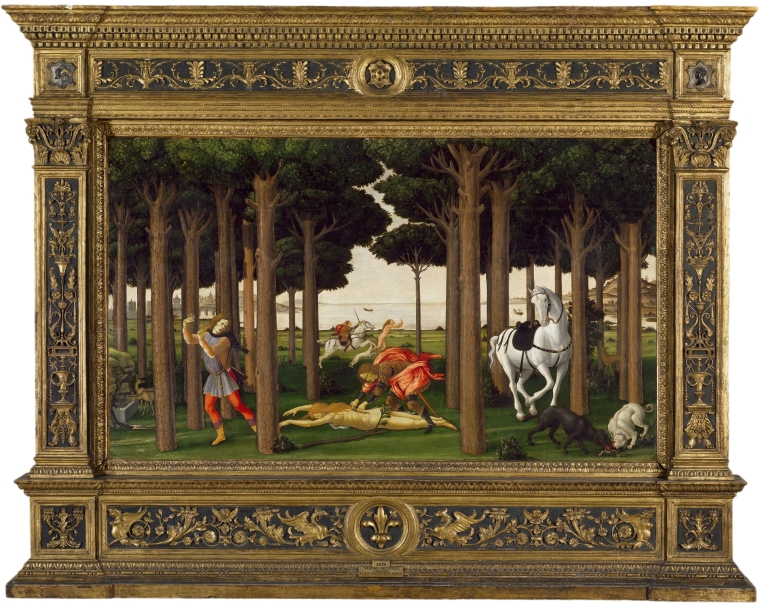
Scenes from the Story of Nastagio degli Onesti

1483. Mixed method on panel.
Room 056B

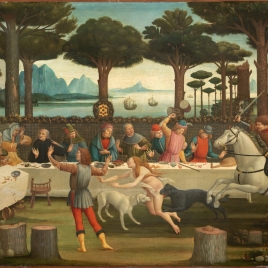
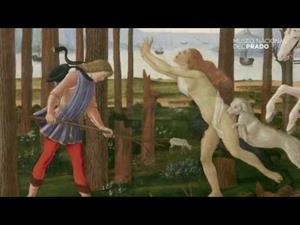
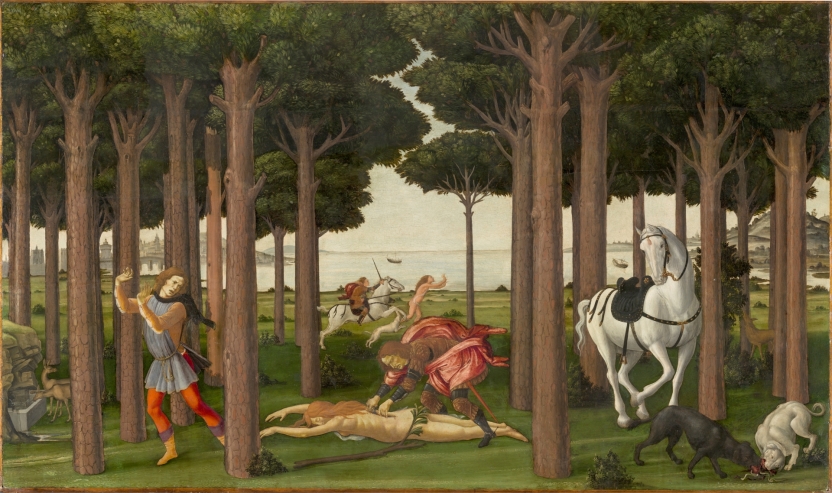
This work belongs to a set of four panels illustrating the Story of Nastagio degli Onesti (P002838, P002839, P002840 and one in a private collection), the eighth tale of the fifth day of Giovanni Boccaccio´s Decameron, written between 1348 and 1353. This is the story of Nastagio, a rich young nobleman from Ravenna enamoured with a noblewoman, daughter Paolo Traversari, who does not return his love. As Nastagio wanders in melancholy through the woods in Classe, near Ravenna, he witnesses the sudden appearance of an alarmed naked woman being pursued by two hounds and a knight (P002838). Nastagio later sees the knight tearing out the woman’s heart and throwing it to the hounds (P002839). The knight explains to Nastagio that, while they were still alive, the woman had spurned his love and thus led him to commit suicide with his own sword. She died shortly afterwards and was condemned to hell. Both would suffer an eternal punishment there: to perpetually relive the scene that Nastagio had witnessed. In fact, in the background of P002839, the horrifying persecution seems to be replayed over and over. Nastagio begins to ponder what he can take from the strange encounter. In P002840, it is clear that Nastagio has succeeded in inviting Paolo Traversari and his daughter to a banquet in the woods of Classe. Just when they were about to have dessert, the appearance occurs and, as the young man had foreseen, causes horror among the diners. When the knight tells the story, the women are moved and Nastagio’s beloved decides to join him to avoid a similar fate. In the background on the right, a servant girl tells him that her mistress is willing to satisfy him, but Nastagio says that he wants nothing more than to marry her honourably. The last painting (in a private collection) shows the wedding feast.

The panels were painted throughout the first half of 1483. They were commissioned to celebrate the wedding of Giannozzo di Antonio Pucci (1460–1497) and Lucrezia di Piero di Giovanni Bini (who was born in 1467 and died probably before 1494). The wedding took place between the end of 1482 and the beginning of 1483. The mezzano (negotiator) of the liaison between the two families was Lorenzo de Medici, Piero’s son and the most influential figure in the government of the Florentine Republic. The commissioner of the series was Antonio Pucci (1418–1484), the husband’s father and a close ally of the Medici.

The X-rays of the three panels show considerable differences between them in terms of pictorial execution. For example, the trees, an important unifying element of the series, are painted in three different ways, even in different shapes, as is clearly visible in the infrared reflectographies. The landscapes also vary from one another in terms of radiographic density and definition of the elements. The differences are such that they raise the possibility that the landscapes were executed by three different painters. The X-rays show that the figures in P002838 and P002840 are very carefully painted, with precise outlines, whereas in P002839 the execution is denser and the brushstrokes looser. On the surface, the figures in painting P002839, as well as the horse on the right and the two hounds, have a solid and compact appearance, less decorative than in the other panels in the series. In addition, the anatomy of the horse and the two hounds, and the way they fit into the space, are much more convincing than in the other paintings. With regard to the underlying drawing, a few general observations can be made about the three paintings located in the Museo del Prado. There is very little underdrawing in the first two paintings, unlike in P002840; objectively, there are few lines drawn and the pictorial execution follows them quite faithfully. In painting P002838, the drawing of the figures was carried out with harder strokes, whereas in painting P002839 the brushstrokes are looser. In none of the panels are the figures superimposed on an already painted landscape (Finaldi, G., Garrido, C. in: El trazo oculto. Dibujos subyacentes en pinturas de los siglos XV y XVI. [The concealed trace. Underdrawings in 15th and 16th-century paintings], Museo del Prado, 2006, pp. 138–147).

The panels with The Story of Nastagio influenced the Florentine artistic milieu and share similarities with several later works on the same theme, particularly two paintings now on display in the Brooklyn Museum (Forest Scene from the Story of Nastagio degli Onesti, inv. 25.95) and in Philadelphia Museum (Banquet Scene from the Story of Nastagio degli Onesti, inv. 64). These two paintings are of virtually identical size, executed around 1485. They could be attributed to the artist known as Pseudo Bartolomeo di Giovanni. Both are a clear indication that the initial set of four panels painted by Botticelli did not go unnoticed. According to the agreed interpretation of the coats of arms on the panel located in Philadelphia, and particularly to the location of both paintings in various inventories of properties, they would have been commissioned a few years later by the Del Nero family. The set consisted only of these two panels, unlike the one in the Palazzo Pucci. Originally from Genoa, this family moved to Florence in the course of the 14th century and settled in the Santo Spirito quarter in Oltrarno. Between 1400 and 1430, they thrived and ended up owning several houses in that area and a palace in the Piazza dei Mozzi, known since the end of the 19th century as Palazzo Torrigiani. Not only did the Del Nero family share favour towards the Medici with the Pucci family, as well as the friendship between Giannozzo Pucci and Bernardo Del Nero, but their paintings also seem to come from those that Botticelli painted for the former’s palatial alcove. In addition to the two fourteenth-century sets illustrating the Story of Nastagio, there is a painting that may have decorated the front of a cassone or wedding chest (Christie´s New York, 2007, lot 13). It dates from the late 15th to the beginning of the 16th century. It was thought to belong to the Ferrarese school; it was later attributed to Antonio Solario, known as ‘Zingaro’ (the Gypsy), and afterwards, to Ercole de´ Roberti. Although there are many elements that distinguish this work from the original set of four painted by Botticelli, it should not be entirely ruled out that the artist may have been familiar with the Palazzo Pucci paintings through sketches or some other artistic source. Another interesting way in which the tale was captured in art is the sketch for the first episode of the Story of Nastagio located in the British Museum, London. It dates to the 15th century (inv. SL,5237.116) and is attributed to Girolamo Romanino about 1535–45. Beyond the variants described in these examples, it is noteworthy that most of the later depictions of the Story of Nastagio degli Onesti are indebted to Botticelli’s paintings in one way or another (Vico Martori, A. in: Los ecos de las spalliere con la Historia de Nastagio degli Onesti de Sandro Botticelli, [The echoes of the spalliere, in Sandro Boticelli’s Story of Nastagio degli Onesti] in Boletín del Museo del Prado, XXXVII, 55–7, 2019–21, 2021, pp. 23–35).
Multimedia

Technical data

Imagen del carrusel
Imagen del carrusel
Inventory number
P002839
Author
Sandro Botticelli
Title
Scenes from the Story of Nastagio degli Onesti
Date
1483
Technique
Mixed method
Support
Panel
Dimension
Height: 82.5 cm; Width: 138.5 cm
Provenance
Pucci collection, Florence, 1868; Alexander Barker collection, London, 1868-1874; Frederick. R. Leyland collection, London, 1879-1892; Édouard Aynard collection, Lyon, 1892-1913; Joseph Spiridon collection, Paris, 1913-1929; Francisco de Asís Cambó collection, 1929-1941. Bequest of Francisco de Asís Cambó Batlle, 1941.
Entry date
1941

Bibliography +

Vasari, Giorgio (1511-1574), Le Vite de Piu Eccellenti Pittori,Scultori Ed Architettori.V..., G.C.Sansoni, 1873, pp. 312.

Plunkett, Count, Sandro Botticelli, George Bell and Sons, 1900, pp. 102.

Berenson, Bernard, Alumno di Domenico, The Burlington Magazine, 1, 1903, pp. 11.

Cartwright, Julia, The life and art of Sandro Botticelli, Londres, 1904, pp. 125.

Reinach, Salomon, Repertoire de Peintures du Moyen Age et de la Renaissance. 1, Ernest Leroux, 1905, pp. 734.

Diehl, Charles, Botticelli, Librairie Plon, 1907, pp. 100.

Rusconi, A.J., Sandro Botticelli, Instituto d'arti grafiche, 1907, pp. 73.

Crowe, J. A. (Joseph Archer), A new history of painting in Italy: from the II to the XVI, J. M. Dent and CoE. P. Dutton, 1908, pp. 422.

Isacker, K.Van, Anvers. Douze Siecles D'Art et D'Histoire, Fonds Mercator, Paris, 1926, pp. 101.

Arsene, Alexandre, Botticelli, París, 1929, pp. 52.

Yashiro, Jukio, Sandro Botticelli, Londres, 1929, pp. 292.

Brion, Marcel, Botticelli, Les Editions G.Cres & Cie, 1931.

Marle, Raymond Van, The development of the Italian schools of painting, Martinus Nijhoff, La Haya, 1931, pp. 216.

Mesnil, Jacques, Botticelli, Albin Michel, Paris, 1938, pp. 222.

Tormo y Monzó, Elías, Estudio de los Botticellis en España, Boletín de la Sociedad Española de Excursiones, 46, 1942, pp. 1-53 [1].

Sánchez Cantón, Francisco Javier (1891-1971)), La colección Cambó /, Alpha, Barcelona, 1955, pp. 44.

Salvani, Roberto, Tutta la pittura del Botticelli, Rizzoli, Milán, 1958, pp. 70.

Berenson, Bernard, Italian pictures of the Renaissance: list of the principal a, Phaidon, Londres, 1963, pp. 36.

Christie's forthcoming sales, 1967, pp. 7.

Montesa, Marqués de, Heráldica en el Museo del Prado, Arte Español / Revista Española de Arte, 25, 1967, pp. 84.

Bo, Carlo, La obra pictórica completa de Botticelli, Noguer, Barcelona.Madrid, 1970, pp. 36.

Sánchez Cantón, Francisco Javier, Museo del Prado. Catálogo de las pinturas, Museo del Prado, Madrid, 1972.

Lightbown, Ronald, Sandro Boticelli, Paul Elek, Berkeley-Los Angeles, 1978, pp. 47.

Rizzatti, Maria Luisa, Botticelli, Editorial Marin, Barcelona, 1978, pp. 24,42.

Museo Nacional del Prado, Museo del Prado: pintura italiana anterior a 1600, Gredos, Madrid, 1979, pp. 44-45.

Wyzewa, T., Le mouvement des arts en Allemagne e Anglaterre et en Italie, La Chronique des Arts. Supplément à la Gazette des Beaux-Arts, 99/00, 1982, pp. 263.

Museo Nacional del Prado, Catálogo de las pinturas, Museo del Prado, Madrid, 1985, pp. 76.

Colección Cambó, Ministerio de Cultura, Madrid, 1990, pp. 211.

Doce artistas de vanguardia en el Museo del Prado:Saura, Bar, Mondadori, Madrid, 1990, pp. 183.

Scott, Barbara, Letter from Paris. The Musée des Tissus in Lyons, Apollo, 134, 1991, pp. 280-282.

González LLacer, Jordi, El vasto legado de Cambó. El coleccionismo planificado, Galería Antiquaria, 9, 1991, pp. 45.

Garrido, Maria del Carmen, 'Différentes techniques observées dans la réalisation du dessin sous-jacent des peintures sur bois', Le dessin sous-jacent dans la peinture. Le dessin sous-jacent et pratique d'atelier. Colloque IX (12-14 Louvain La Neuve 1991), 1993, pp. 36-42 [36].

Museo Nacional del Prado, Museo del Prado. Inventario general de pinturas (III). Nuevas Adquisiciones. Museo Iconográfico. Tapices., Museo del Prado, Espasa Calpe, Madrid, 1996, pp. nº1721.

Castillo-Ojugas, Antonio, Una visita médica al Museo del Prado, You & Us, Madrid, 1998, pp. 120.

Museo Nacional del Prado, Pintura italiana del Renacimiento: guía, Museo del PradoAldeasa, 1999, pp. 41.

Didi-Huberman, Georges, Ouvrir Venus : nudité, rêve, cruauté, Gallimard, Paris, 1999, pp. 64-85 IV-VII.

Rubin, Patricia Lee, Renaissance Florence : the art of the 1470s, National Gallery, 1999, pp. 138-139.

Cast, D., Boccaccio, Botticelli y la Hª de Nastagio degli Onesti. En Historias inmortales, Barcelona, 2003, pp. 71-85.

Bartolomeo di Giovanni : collaboratore di Ghirlandaio e Bott..., Polistampa :, Firenze, 2004, pp. 30-31.

Botticelli e Filippino : L'Inquietudine e la Grazia Nella Pi..., Skira, Milano, 2004, pp. 102-105.

Yarza, Joaquín, 'El Decamerón y la historia de Nastaglio degli Onesti de Botticelli' en: Historias mortales: La vida cotidiana en el arte, Galaxia Gutenberg, Barcelona, 2004, pp. 139.

Cecchi, Alessandro, Botticelli, Motta, 2005, pp. 202, 218-219/206-213.

Zöllner, Frank, Sandro Botticelli, Prestel, Munich, 2005, pp. 223.

Finaldi, Gabriele; Garrido, Carmen, 'Sandro Botticelli y Bartolomeo di Giovanni. La Historia de Nastagio degli Onesti', G.Finaldi y C.Garrido. El trazo oculto. Dibujos subyacentes en pinturas de los siglos XV y XVI, Museo Nacional del Prado, Madrid, 2006, pp. 138-147 (o.r. nº7).

Enciclopedia del Museo del Prado, IV, Fundación Amigos del Museo del Prado, Madrid, 2006, pp. 1289.

Körner, H., Botticelli, Dumont, 2006, pp. 277-282 / 172-175.

Rubin, Patricia Lee, Images and Identity in fifteenth-century Florence, Yale University Press, 2007, pp. 229-271, 360-362 / 213-216.

Art and love in Renaissance Italy, Metropolitan Museum of Art: Yale, 2008, pp. 300-303.

Musacchio, Jacqueline Marie, Art, marriage, and family in the Florentine renaissance pala..., Yale University Press, 2008, pp. 13.

Botticelli to Titian: two centuries of italian masterpieces, Szépmuvészeti Múzeum, Budapest, 2009, pp. 99-111.

Botticelli : likeness, myth, devotion :, Hatje/Cantz, 2009, pp. 36 / 23.

Bayer,A, El amor y el arte en la Italia del Renacimiento, Numen, nº 7, 2009, pp. 28-33.

Garrard, Mary D., Brunelleschi' s egg : nature, art, and gender in Renaissance..., University of California Press, 2010, pp. 98.

Ghirlandaio y el Renacimiento en Florencia, Ghirlandaio y el Renacimiento, Museo Thyssen-Bornemisza, 2010, pp. 136-139.

Luque Lacaze, Alejandra, La belleza física de la Dama en el decamerón de Boccaccio, Boletín de arte, 32-33, 2011-2012, pp. 390-392.

Blanco, Miguel Angel, Historias naturales: un proyecto de Miguel Ángel Blanco, Museo Nacional del Prado, Madrid, 2013, pp. 52-55.

G. Navarro, C.; Perdices, A., La mirada del otro: escenarios para la diferencia, Museo Nacional del Prado, Madrid, 2017, pp. 51 n.7-9.

Nethersole, Scott, 'Botticelli, Lucretia and the visualization of violence' En: Botticelli: Heroines and Heroes, Paul Holberton Publishing,, Londres, 2019, pp. 56-77 [66-71 n.37].

Vico Martori, Alexandre, Los ecos de las spalliere con la Historia de Nastagio degli Onesti de Sandro Botticelli, Boletín del Museo del Prado., XXXVII, 2019-2021, pp. 23-35.

D'Arista, Carla Adella., 'The Botticelli panels' En: The Pucci of Florence: patronage and politics in Renaissance Italy, Harvey Miller Publishers,, 2020, pp. 68-73.

Vico Martori, Alexandre, Quattro quadri di pittura molto vaga e bella. 'Las spalliere con la Historia de Nastagio degli Onesti ed Sandro Botticelli', Tesis doctoral. Universitat de Girona, 2020.

García Cueto, David, 'Una aproximación a la obra de Botticelli en España', Editorial Planeta, 2022, pp. 343-365 [358-365].

Vico Martori, Alexandre; Serra, Maria de Lluc, Los azares de los panneaux de Cambó. El periplo de las pinturas de Botticelli en los años 1936-1941, Goya. Revista de arte, 383 Mayo - Agosto, 2023, pp. 148-156.

Other inventories +

Inv. Nuevas Adquisiciones (iniciado en 1856). Núm. 1721.
Autor, Botticelli. 1721. Asunto, la historia de Nastagio degli Honesti (cuadro II) / Tabla, 138 x 82 cm. / Nº catalogo, 2839 / Regalo de D. Francisco de Asis Cambó, en diciembre de 1941...

Catálogo Museo del Prado, 1942-1996. Núm. 2839.

Exhibitions +

La mirada del otro: Escenarios para la diferencia
Madrid
05.06.2017 - 10.09.2017

El legado Cambó
Madrid
31.01.1991 - 21.04.1991

El legado Cambó
Barcelona
31.01.1991 - 21.04.1991

Location +

Room 056B (On Display)

Expuesto
Update date: 02-06-2026 | Registry created on 28-04-2015

Visor 360

Drag with the cursor to rotate the piece

Other works by Sandro Botticelli

Print on demand

Print artworks available in our catalogue in high quality and your preferred size and finish.

Image archive

Request artworks available in our catalogue in digital format.

Up